

August 11, 2026
The Hallucination Tax: Why Real-Time AI Verification Is Becoming an Enterprise Requirement
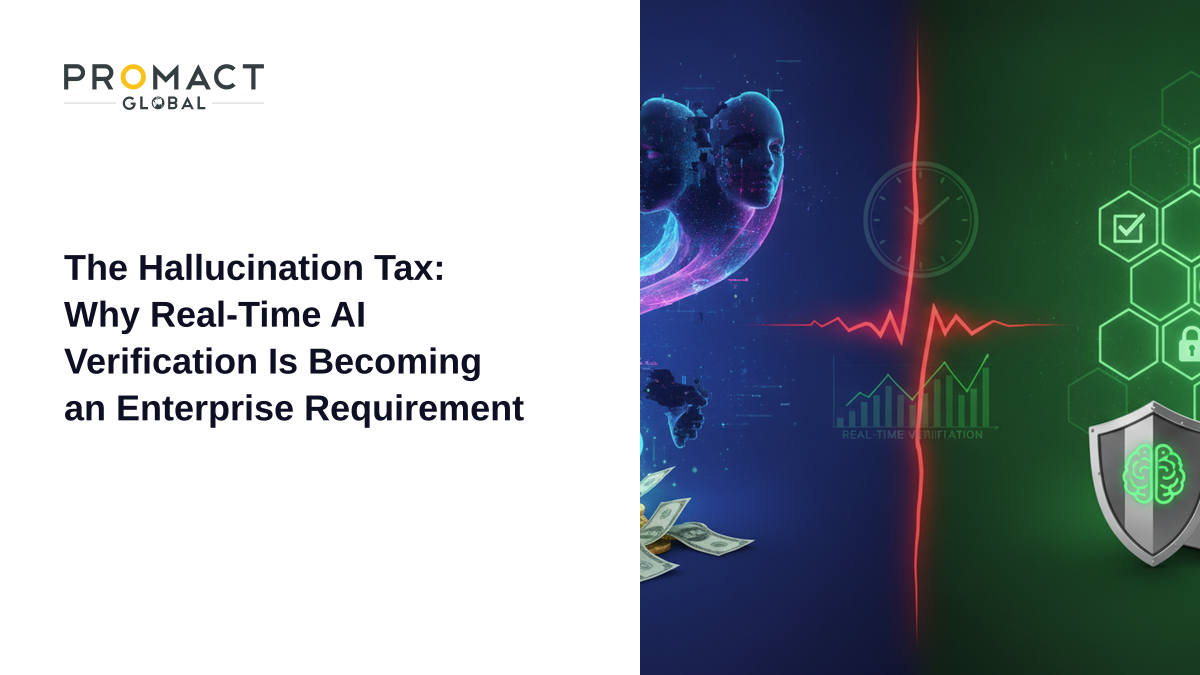
Enterprises spent 2025 racing to put generative AI into every workflow they could find. In 2026, the bill for that race is arriving — and it’s showing up as a line item nobody budgeted for: the cost of AI being confidently, fluently wrong. A 2025 EY Responsible AI Pulse survey of 975 C-suite leaders found that 99% of organizations have already reported AI-related financial losses, with 64% of those losses exceeding $1 million. Globally, hallucination-related losses are estimated to have reached $67.4 billion and counting.
That number is forcing a shift in how businesses think about AI reliability. For the last few years, “hallucination” was treated as a quirky, mostly-harmless side effect of chatbots — the kind of thing you’d catch with a quick read-through before hitting send. That assumption doesn’t hold anymore. As AI moves from answering questions to taking actions — drafting contracts, triaging support tickets, executing trades, writing code that ships — an unverified error doesn’t just embarrass someone in a meeting. It becomes a decision, a transaction, or a line of production code before a human ever sees it. This post covers why the hallucination problem is getting more expensive rather than less, what the new category of real-time verification tooling actually does, how regulation is starting to force the issue, and what businesses should be doing about it right now.
The Real Cost of an AI That’s Wrong With Confidence
The headline financial numbers only tell part of the story. The EY survey also found that 47% of enterprise AI users made at least one major business decision based on hallucinated content — meaning close to half of the organizations using AI at scale have already acted on something the model made up. The average affected company reported $4.4 million in losses tied to AI errors.
There’s also a hidden labor cost that rarely shows up in a board deck. Employees using AI tools now spend an estimated 4.3 hours per week verifying AI-generated content — roughly $14,200 per employee per year in overhead, just to catch mistakes the AI itself should never have introduced. That’s the quiet tax: even when hallucinations don’t cause a visible incident, the manual fact-checking they necessitate is eating the productivity gains the AI was supposed to deliver in the first place.
Where the Risk Concentrates
Hallucination rates aren’t evenly distributed. The 2026 Stanford HAI AI Index found rates across 26 leading models ranging from 22% to 94% depending on the benchmark and task, and the variance by domain is stark: legal-specific queries see error rates between 69% and 88% on some benchmarks, while general enterprise use hovers closer to 15–25%. Financial services firms — where 78% now use AI for data analysis — are running that same 15–25% hallucination band on financial tasks without additional safeguards. In other words, the industries with the least tolerance for being wrong are, structurally, some of the most exposed.
The trust gap compounds the problem. Verification behavior varies widely by survey, but even the more optimistic figures — around one in three users routinely verifying AI output — mean a majority of AI-generated content in most organizations moves downstream unchecked. A KPMG and University of Melbourne global study found that 66% of employees trust LLM outputs without checking them at all.
From Chatbot Errors to Agent Actions
The hallucination problem used to live mostly in customer-facing chat and content generation. That’s changing fast as businesses shift from AI that answers to AI that acts. When a chatbot hallucinates a product spec, a human copy-edits it before it ships. When an autonomous agent hallucinates an API parameter, a customer record, or a compliance status, it can execute on that error directly — no human read-through in the loop at all. This is the same dynamic driving agent sprawl across enterprises: as agents multiply across vendors, teams, and embedded SaaS tools, so does the number of places a hallucinated fact can turn into a real-world action nobody signed off on.
This is exactly the failure mode security teams have started flagging as a top concern in agentic AI deployments — an agent doesn’t need to be maliciously compromised to cause damage; it just needs to act confidently on something that was never true. The legal exposure is already materializing: Nippon Life Insurance Company of America sued OpenAI in March 2026, alleging ChatGPT effectively practiced law by helping a former claimant draft dozens of post-settlement filings — including, according to the complaint, a fabricated case citation — after the chatbot validated her decision to reopen an already-settled case. The suit seeks $300,000 in compensatory damages and $10 million in punitive damages, and it’s a preview of the liability enterprises should expect as AI-generated errors move from embarrassing to actionable.
The New Category: Real-Time Verification Tooling
Enterprise buyers have responded by pulling hallucination detection out of “nice-to-have eval tooling” and into “production infrastructure.” A wave of vendors launched or expanded real-time verification products through 2026. TrustScale’s Argus, launched August 5, 2026, is a representative example: rather than using a second AI model to “check” the first — an approach that inherits the same failure modes it’s trying to catch — Argus uses empirical, deterministic verification against evidence sources to flag unsupported claims and suggest corrections before content is published or acted on, claiming up to 98.5% accuracy and roughly 135x the speed of manual research.
Argus isn’t alone. Patronus AI’s open-source Lynx model focuses on hallucination detection in regulated domains; Galileo’s Luna-2 evaluators run sub-200ms inline checks designed to block high-risk responses before they reach a user; and observability platforms like Braintrust and Noveum now ship hallucination and faithfulness scorers directly into CI pipelines, so a model change that increases error rates gets caught before deployment rather than after a customer complaint.
Why “AI Checking AI” Isn’t Enough on Its Own
The core design shift across this category is a move away from purely model-based grading. Using one LLM to judge another’s output can catch obvious errors, but both models share the same blind spots and the same tendency to sound certain regardless of accuracy. The tools gaining enterprise traction pair model-based scoring with retrieval against verified sources, deterministic rule checks, and human-in-the-loop review for the highest-stakes outputs — treating verification as its own engineering discipline rather than a second opinion from a similar system.
Regulation Is Compounding the Pressure
Compliance is now pulling in the same direction as risk management. On August 2, 2026, the EU AI Act’s transparency obligations under Article 50 became enforceable — AI systems must disclose when users are interacting with AI, and synthetic content must carry machine-readable labels, with fines of up to €15 million or 3% of global turnover for violations. It’s worth being precise here: the Act’s separate, more demanding high-risk-system requirements — the ones covering risk management and human oversight for systems used in employment, education, and critical infrastructure — were pushed back to December 2, 2027 under a recently adopted “AI Omnibus.” Transparency is live now; the heavier obligations are still a runway away. For businesses working through what’s already in force, our EU AI Act compliance guide breaks down the practical steps.
Even with the high-risk timeline extended, the direction of travel is unambiguous: regulators in the EU and elsewhere are converging on the expectation that businesses can explain what their AI systems said, why, and how it was verified. Waiting for the December 2027 deadline to build that capability is a bet that verification infrastructure can be stood up quickly under pressure — a bet the $67.4 billion in existing losses suggests is a bad one.
What Businesses Should Do Now
Build Verification Into the Workflow, Not After It
Retrofitting fact-checking after an AI system is already in production is the expensive way to do this. The organizations avoiding six- and seven-figure losses are the ones that treat verification as a gate the output has to pass through before it reaches a customer, a decision, or another automated system — not a spot-check performed after something has already gone wrong.
Prioritize the Highest-Stakes Decision Points First
No enterprise can verify every AI output with equal rigor, and trying to is how verification programs stall out. The more effective approach, consistent with how leading organizations are governing growing fleets of AI agents, is to identify the small number of decision points — financial commitments, legal representations, customer-facing claims, anything touching regulated data — where a hallucination causes real damage, and put the strongest verification and human review there first.
Measure Verification Coverage, Not Just Adoption
Most enterprises can report how many employees or workflows now use AI. Far fewer can report what percentage of that AI output passes through any verification step before it’s relied upon. That second number is the one that actually predicts financial exposure, and it belongs on the same dashboard as usage metrics.
Frequently Asked Questions
Is “AI hallucination” still the right term for this problem now that AI takes actions, not just answers questions?
The term originated with chatbot errors, but the underlying issue — an AI system generating confident, unsupported claims — is the same whether it ends up in a paragraph of text or an autonomous agent’s next action. Many practitioners now use “AI reliability” or “AI assurance” to describe the broader discipline, but “hallucination” remains the common shorthand for the root failure.
Do smaller companies need real-time verification tooling, or is this only an enterprise-scale problem?
Hallucination rates don’t scale down with company size — a small business using AI for legal drafting or financial analysis faces the same task-specific error rates (as high as 69–88% on some legal benchmarks) as a large enterprise doing the same task. Smaller companies typically have less budget for dedicated verification tooling, which makes prioritizing the highest-stakes use cases even more important.
Does using a more advanced or expensive AI model solve the hallucination problem?
Better models generally hallucinate less, but the 2026 Stanford HAI AI Index still found error rates as high as 94% on certain benchmarks even among top-tier models — model quality reduces the problem, it doesn’t eliminate it. Verification remains necessary regardless of which model is deployed.
What’s the difference between hallucination detection and general AI evaluation (evals)?
Evals typically test a model’s overall performance against benchmarks before deployment. Hallucination detection tools operate continuously in production, checking each live output against evidence or rules in real time — closer to a runtime guardrail than a pre-launch test.
Is the EU AI Act the only regulation businesses need to track here?
No. While the EU AI Act’s transparency rules are the most concrete deadline live right now, similar disclosure and human-oversight expectations are emerging in US state-level AI legislation and sector-specific regulation (particularly in finance and healthcare), so businesses operating across jurisdictions should expect this to broaden rather than narrow.
What’s the fastest first step a business can take without buying new tooling?
Identify which existing AI-touched workflows currently have zero verification step — no read-through, no fact-check, no secondary review — and add even a lightweight human or rules-based check to the highest-stakes of those before investing in dedicated verification software.
Sources
- AI Hallucinations in Enterprise Apps: Real Costs, Root Causes, and How to Fix Them - Coverage of the EY 2025 Responsible AI Pulse survey findings on AI-related financial losses.
- The True Cost of AI Hallucinations in Business Data - Data on global hallucination losses, verification labor costs, and industry-specific error rates.
- AI Model Hallucination Rates 2026: The Definitive Honesty Rankings - Summary of the 2026 Stanford HAI AI Index hallucination benchmarks across leading models.
- 6 Proven Ways To Fact Check AI Accuracy And Verify Answers - Forbes reporting on user verification behavior, including the KPMG/University of Melbourne trust study.
- TrustScale Launches Argus to Detect and Correct AI Hallucinations and Power Safe Enterprise AI Adoption - Product launch announcement detailing Argus’s verification approach and claimed accuracy.
- Commission starts enforcing AI Act rules and new transparency requirements on 2 August - European Commission’s official notice on enforceable EU AI Act transparency obligations.
- EU AI Act: What’s Enforceable Now vs. Delayed - Goodwin Law analysis distinguishing enforced transparency rules from the delayed high-risk provisions.
- AI on Trial: Nippon Life Takes OpenAI to Court Over Alleged Unauthorized Practice of Law - Law firm analysis of the Nippon Life v. OpenAI lawsuit over a hallucinated legal citation.
Have a project like this in mind?
Tell us what you're building — we'll help you scope it and ship it.
Talk to usKeep reading
October 6, 2026
Patch in Minutes, Not Months: How AI Agents Are Breaking Open-Source Security Embargoes
October 5, 2026
Agents Now Create 70% of New Databases: What Supabase's Turso Deal Means for Enterprise Data Governance
October 4, 2026