October 6, 2026
Patch in Minutes, Not Months: How AI Agents Are Breaking Open-Source Security Embargoes
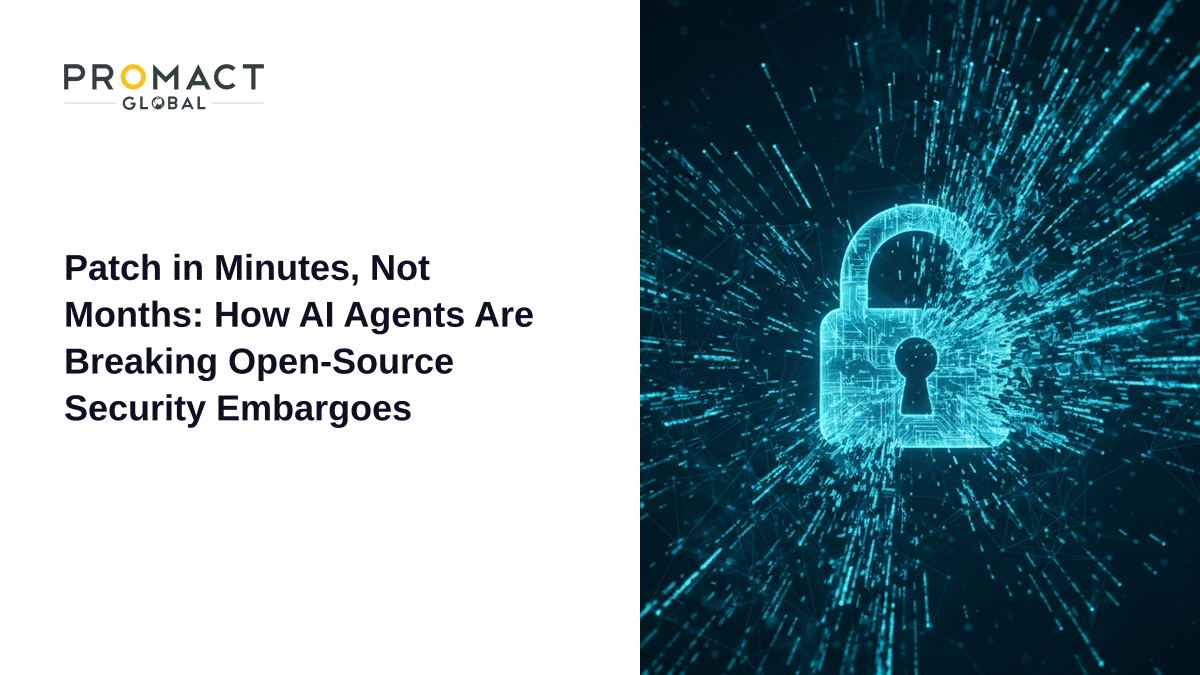
Open source has run on a quiet social contract for decades: a researcher finds a bug, tells the maintainers privately, and everyone agrees to keep details secret until a patch ships. That “embargo” assumes something that is no longer true: that only a handful of people are looking. In October 2026, maintainers are saying out loud that AI coding agents have broken that assumption.
This post explains what changed, what the evidence actually shows, and why it matters even if you never contribute to an open-source project. If your product depends on open-source libraries (and it does), the time between “a bug is hinted at” and “an exploit exists” is now your problem. We close with a practical checklist.
The Embargo Model Meets Autonomous Agents
What happened in the cohttp case
On August 22, OCaml maintainer Anil Madhavapeddy described a path-traversal bug in the cohttp library. He opened a public pull request to get the fix reviewed. Within roughly ten minutes, his own webserver logs showed probes matching the exact bug pattern. He then built a working exploit himself in under a minute using an AI agent, and concluded that ten minutes “seems quite long.”
His point is not that one library was unlucky. It is that a pull request, a mailing-list question or an odd commit is now a public clue that an automated agent can turn into an exploit. As he put it, just one person searching for the issue class is enough to alert someone else’s agent.
The research behind the worry
None of this is entirely new. In 2024, researchers at the University of Illinois showed that a GPT-4 agent could exploit 87% of a 15-vulnerability benchmark when given the CVE description, versus 7% without it. Those were older models. Agents have since improved considerably, and InfoQ’s October 2026 coverage reports the dynamic now showing up in real maintainers’ logs, not just lab benchmarks.
What Maintainers Are Seeing
A flood of reports
Nick Craig-Wood, who created the rclone project, reported that it received about 20 security disclosures through GitHub in its first ten years, and over 40 in the last month. Simon Willison’s post also relays that CVE assignment delays have stretched from two to three days to three to four weeks. More discoverers means more reports, more duplicates and more triage for volunteers.
Embargoes shrink
The QEMU project has formalized the shift. Its security process states that disclosures from automated tools are “highly likely to be independently re-discovered, potentially many times over in a very short timeframe,” and that maintainers will generally reject requests for arbitrary embargoes unless high-severity, extenuating circumstances are shown. If everyone can find the bug, secrecy buys little.
Proposed fixes
Madhavapeddy suggests three directions: private infrastructure for developing patches, continuous shipping through rapid releases without embargoes, and protocol-level protections such as virtual patching, similar to the way Cloudflare responded to Log4Shell. All three share one idea: assume the details leak, and shorten the window instead.
Why This Hits Enterprises, Not Just Maintainers
Defenders are already slow
Attackers are speeding up while defenders are not. Verizon’s 2026 Data Breach Investigations Report found that the median time to fully patch known-exploited vulnerabilities rose to 43 days from 32, and only 26% were fully remediated, down from 38%. It also reported that vulnerability exploitation overtook credential theft as the top initial access vector for the first time in the report’s 19-year history.
Put those together: exploits that can appear within minutes of a public clue, against patch cycles measured in weeks.
Your AI tooling is part of the surface
The same agents that help attackers also sit inside your own engineering workflow. We have covered how an autonomous Claude breach changed enterprise cybersecurity assumptions, how skill marketplaces leak credentials from coding agents, and how a symlink flaw let approval prompts misreport what file an AI coding assistant would write. The lesson repeats: agent speed benefits whoever is better organized to use it.
Defensive agents are the obvious counter
If attackers use agents to turn rumours into exploits, defenders need agents that turn advisories into tested patches just as fast. The sensible path is automating the boring parts: dependency inventory, triage, test runs and pull-request drafting, with humans approving the merge. Keep those agents in tightly scoped environments, as the first autonomous AI cyberattack showed what happens when an agent escapes its sandbox.
A Practical Playbook
1. Know what you run
Maintain a current software bill of materials for every service. You cannot patch what you cannot list, and “which of our apps uses this library” should be a query, not a Slack thread.
2. Shrink your patch window
Set explicit targets by severity, such as hours for internet-facing, actively exploited flaws and days for the rest. Track the median against the 43-day industry figure above.
3. Pre-approve the fast lane
Decide in advance which classes of fix (patch-level dependency bumps with passing tests) can ship without a committee. Slow approvals now cost more than they used to.
4. Watch upstream, not just advisories
Subscribe to the repositories of your critical dependencies. Public pull requests and security-labelled commits can signal a problem before any CVE exists.
5. Support the maintainers you depend on
Funding, sponsoring or contributing triage time to key projects directly reduces your own risk, because overwhelmed maintainers are a slower patch pipeline.
6. Assume details leak
Design for rapid rotation of credentials, short-lived tokens and the ability to disable a vulnerable feature quickly. These controls help whether or not a patch exists yet.
Conclusion: Plan for Minutes, Not Months
The embargo was a good solution to a world where finding a bug was hard. Agents have made finding, and weaponizing, bugs cheap, and the first projects are adapting their rules accordingly. Enterprises should do the same: inventory your dependencies, compress your patch window, automate the routine steps with human sign-off, and treat any public hint of a flaw as the starting gun, not a heads-up.
If you want help assessing your dependency exposure or building a safe AI-assisted patching workflow, the Promact team can help.
Frequently Asked Questions
What is a security embargo in open source?
It is an agreement to keep a vulnerability’s details private while maintainers prepare a fix, so users can patch before attackers learn how the flaw works.
Are AI agents really exploiting bugs within minutes?
One well-documented case, the cohttp bug, saw matching probes in the maintainer’s logs about ten minutes after a public pull request. It is a single account, but it is consistent with maintainer reports elsewhere and with earlier research.
What did the 87% figure measure?
It comes from a 2024 study in which a GPT-4 agent exploited 87% of 15 real one-day vulnerabilities when given the CVE description, and 7% without it. It was a small benchmark, so treat it as a signal rather than a rate for all software.
Does this mean open-source software is less safe than proprietary software?
Not necessarily. Agents can probe any software they can reach. Open source is simply where the effect is visible first because the fixes are public.
What should a small team do first?
Get an inventory of your dependencies and turn on automated alerts for them. Then set a patch-time target and pre-approve routine dependency updates.
Sources
- Just a rumour of a bug is enough to find a security exploit these days (Anil Madhavapeddy) - First-hand account of the cohttp bug and proposed mitigations
- AI Agents Are Disrupting Open Source Security Disclosure (InfoQ) - News coverage of the disclosure shift
- Simon Willison on the rumour-of-a-bug problem - Includes rclone maintainer’s disclosure numbers
- QEMU Security Process - Project policy on automated-tool disclosures and embargoes
- LLM Agents can Autonomously Exploit One-day Vulnerabilities (arXiv) - Study behind the 87% vs 7% result
- Verizon DBIR 2026 key findings (Help Net Security) - Patch time and remediation statistics
- Verizon DBIR 2026: Vulnerability Exploitation Is Now the #1 Way Breaches Start (watchTowr) - Analysis of exploitation overtaking credential abuse
Have a project like this in mind?
Tell us what you're building — we'll help you scope it and ship it.
Talk to usKeep reading
October 5, 2026
Agents Now Create 70% of New Databases: What Supabase's Turso Deal Means for Enterprise Data Governance
September 28, 2026
You Approved $20, It Ran $2,000: What Loopjacking Means for Every 'Human-in-the-Loop' AI Guardrail
September 27, 2026