
September 27, 2026
The Agents Nobody Counted: What Dataiku's New Management Platform Means for Enterprise AI Governance
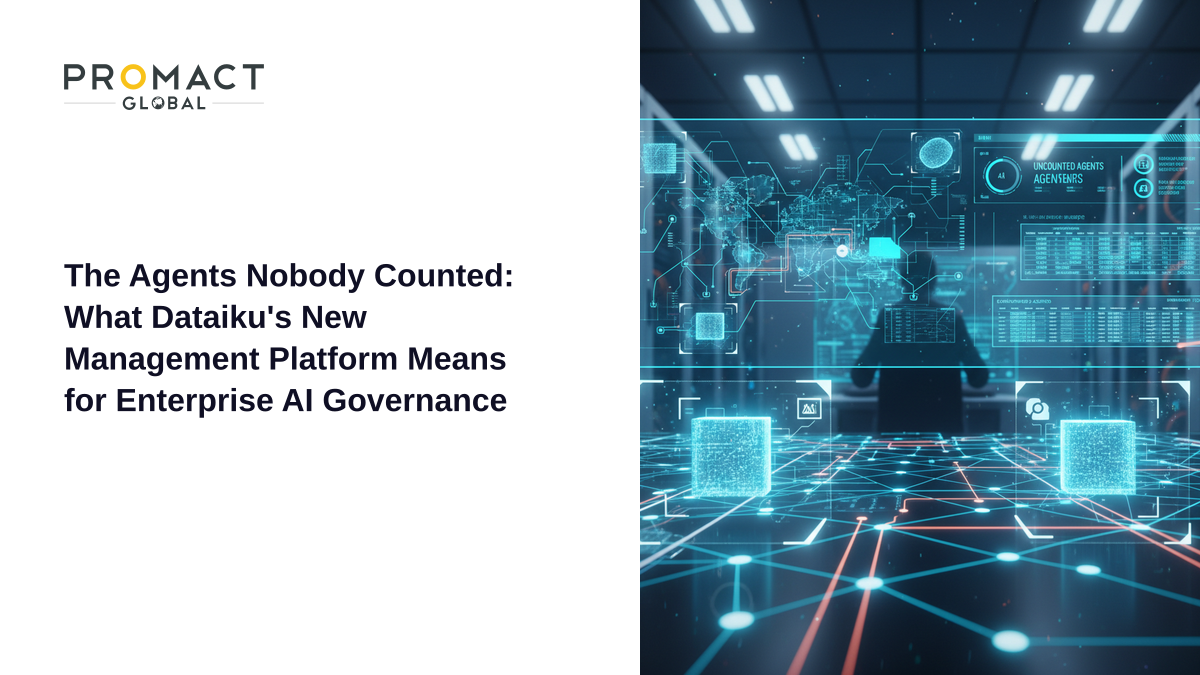
Ask a bank how many servers it runs, and the answer comes back to the decimal. Ask the same bank how many AI agents it has running across its systems, and — according to Dataiku CEO Florian Douetteau — “you get a shrug or a guess.” That line, delivered at Dataiku’s annual Succeed conference on September 24, 2026, is the reason the company just launched Agent Management, a standalone product built to do one thing: find every AI agent a company is running, wherever it was built, and tell the company what it’s actually doing.
Dataiku isn’t alone. In the same weeks, ServiceNow has been shipping monthly expansions to its own AI Control Tower, and IBM has folded an “Agentic Control Plane” into watsonx Orchestrate. Three well-funded vendors converging on the same problem in one quarter is a signal: agent management is becoming its own enterprise software category, not a bolt-on feature. For any business running more than a handful of AI agents, that’s worth understanding now, before procurement calls start showing up with pitch decks.
Why a New Product Category Just Appeared
Software categories don’t usually form this fast. This one did because the underlying problem got worse faster than anyone’s tooling did. Agents are cheap to spin up — a developer can wire one together in an afternoon using a low-code builder, a framework, or a vendor’s agent studio — and that ease of creation is exactly what broke the old model of IT asset tracking.
The scale of the blind spot is the real story. According to IBM’s “AI in Motion” research cited in Dataiku’s own launch materials, fewer than one in five organizations have a current, comprehensive inventory of the AI systems they’re running. That’s not a rounding error — it means roughly four out of five enterprises cannot say, right now, how many autonomous agents have access to their customer data, their payment systems, or their internal APIs.
This gap is why we’ve written before about agent sprawl as a security and operations problem. What’s changed since then is that the market has stopped treating sprawl as something individual IT teams should manage with spreadsheets and started treating it as a gap that needs its own dedicated software layer — the same way that unmanaged laptops and shadow SaaS eventually got their own device-management and CASB categories a decade earlier.
The Pattern: Adoption Outrunning Oversight
Gartner’s numbers make the shape of the problem concrete. The firm has forecast that 40% of enterprise applications will feature task-specific AI agents by the end of 2026, up from under 5% just a year earlier — one of the fastest embedding curves for any enterprise technology on record. But Gartner has also warned, separately, that applying uniform governance rules across a fleet of agents with wildly different risk profiles is itself a failure mode — treating a customer-facing refund agent the same way you’d treat an internal report-summarizing agent leads to either over-restricting the low-risk ones or under-restricting the dangerous ones.
That’s the gap Dataiku, ServiceNow, and IBM are all racing to fill: not just counting agents, but ranking them by what happens if they go wrong.
What Agent Management Platforms Actually Do
Strip away the marketing and these platforms share a common architecture — worth knowing whether you buy a platform or build the equivalent internally.
Discovery Across Every Platform an Agent Might Live On
Dataiku’s product connects to AWS Bedrock, Databricks Agents, Google Vertex, Microsoft Copilot Studio, Azure AI Foundry, Salesforce Agentforce, Snowflake Cortex, Dataiku’s own environment, and anything else instrumented with OpenTelemetry. ServiceNow’s AI Control Tower takes the same platform-agnostic stance, positioning itself as “the governance layer for the enterprise, regardless of where AI agents are built, deployed, or operating”, and pairing it with an integration into Veza’s access-graph technology to map which agents can reach which systems. The point in both cases is the same: an agent inventory is worthless if it only sees agents built on one vendor’s stack, because most enterprises are running agents from at least three or four different vendors simultaneously, often stood up by different teams who never talked to each other.
Risk Tiering, Not Flat Lists
A plain inventory — a spreadsheet of agent names — doesn’t tell a security team anything actionable. The value is in tiering. In Dataiku’s model, agents touching customers, sensitive data, or live financial transactions get what amounts to a standing certification record: named risks, dependency maps back to the underlying models and tools, and tests that automatically rerun on a schedule to confirm the agent still behaves the way it did when it was approved. Dataiku CTO Clément Stenac has framed the underlying issue plainly: running business teams and technical teams on separate, disconnected platforms “becomes a liability companies have to prepare for” once agent counts climb into the hundreds.
Audit Trails Built for Regulators, Not Just Engineers
The recurring, scheduled re-testing matters for a second reason beyond catching drift: it produces a paper trail. As we covered when Spain’s data protection authority set out its “rule of two” for AI agent accountability, regulators no longer accept “the model did it” as an explanation when an autonomous system causes harm. A certification history — who approved an agent, what it can touch, when it was last tested — is exactly the documentation a company needs under GDPR, the EU AI Act, or a financial regulator’s model-risk framework. Without it, incident response after an agent-caused breach starts from zero.
The Cost of Staying Blind
It’s tempting to read all this as vendors manufacturing a problem to sell a solution. The incident record says otherwise. We’ve already covered three separate security failures in Google’s Agent Development Kit within five months and the pattern of enterprises discovering agent swarms operating with zero alerts after the fact rather than during. In every one of those cases, the company involved didn’t lack security tooling in the abstract — it lacked a current answer to “which agents do we have, and what can they do,” which is precisely the layer these new platforms are trying to install.
Gartner’s most pointed warning is a business-continuity one rather than a security one: the firm projects that over 40% of agentic AI projects will be canceled by the end of 2027, citing escalating costs, unclear business value, and inadequate risk controls as the leading causes. Governance gaps that only surface once an agent is already in production, and already causing a problem, are a direct contributor to that failure rate — and they’re the expensive way to discover you never had a working inventory in the first place.
This is also why we’ve argued that governance, not the underlying model, is becoming the real bottleneck on enterprise AI agent programs: once an organization can build agents faster than it can track them, the constraint on scaling safely stops being engineering talent or model quality and becomes visibility.
What This Means for Your Business
You don’t need to be running hundreds of agents, or be a Dataiku or ServiceNow customer, to act on this. A few steps apply regardless of scale or budget:
- Start with a real inventory, even a manual one. Before evaluating any platform, get every team that has stood up an agent — in a low-code tool, a cloud vendor’s agent studio, or a custom build — to register it in one shared list. The IBM statistic above means most companies skip this step entirely and go straight to worrying about tooling; the tooling is worthless without the underlying discipline of registration.
- Tier by blast radius, not by department. An agent that can issue refunds or modify customer records deserves a different review cadence than one that drafts internal summaries. Copying whichever framework a vendor sells you without adapting the risk tiers to your own data exposure is the exact mistake Gartner flagged.
- Treat re-certification as recurring, not one-time. An agent approved in January on one model version and one set of tool permissions is a different agent by June if either has changed underneath it. Build a recheck cadence into however you track agents, whether that’s a dedicated platform or a well-maintained spreadsheet with owners assigned.
- Decide now who owns the answer to “how many agents do we have.” Before an auditor, a regulator, or an incident forces the question, assign clear ownership — security, IT, or a dedicated AI governance function — so the answer doesn’t default to a shrug.
The vendors racing into this space are betting that agent management becomes as standard a line item as endpoint management or identity management did before it. Given how fast agent counts are climbing and how thin current visibility already is, that bet looks reasonable. The enterprises that build the inventory habit now, with or without a platform to formalize it, will be the ones with a real answer the next time someone asks how many agents they’re running.
Frequently Asked Questions
What is an “agent management platform,” and how is it different from AI governance software in general?
Agent management platforms are a narrower, newer category focused specifically on discovering and tracking autonomous AI agents across every system they run on, then ranking them by risk. Broader AI governance software often covers model risk management, bias testing, and policy documentation for AI systems generally; agent management platforms add continuous, automated inventory and re-testing built specifically around the fact that agents take actions and change behavior over time, not just produce static outputs.
Why did Dataiku, ServiceNow, and IBM all launch similar products around the same time?
All three are responding to the same underlying trend: enterprise AI agent adoption accelerated far faster than enterprise tracking of those agents did. Gartner’s forecast of 40% of enterprise applications embedding agents by the end of 2026, up from under 5% a year prior, describes an adoption curve that outpaced most companies’ existing IT asset-management practices, creating an opening for a dedicated product category.
Do small or mid-sized companies need a dedicated agent management platform?
Not necessarily a paid platform, but the underlying discipline applies at any scale. A company running a handful of agents can maintain a manual inventory with clear ownership and a recurring review cadence and get most of the risk-reduction benefit. The case for buying a dedicated platform strengthens once agents number in the dozens or hundreds, span multiple cloud vendors, or touch regulated data.
How does agent inventory help with regulatory compliance, like the EU AI Act or GDPR?
Regulators increasingly expect companies to document which automated systems are handling personal data or making consequential decisions, and to show evidence of ongoing oversight rather than a one-time approval. A maintained agent inventory with certification records and scheduled re-testing produces exactly that documentation, which is otherwise very difficult to reconstruct after the fact during an investigation or audit.
What’s the actual risk of not knowing how many AI agents you’re running?
The immediate risks are security exposure (an agent with unmonitored access to sensitive systems or data) and compliance exposure (being unable to answer a regulator’s questions about an automated decision). The longer-term risk, per Gartner’s own projections, is financial: agentic AI projects with unclear ROI and governance gaps are significantly more likely to be canceled or forcibly scaled back once problems surface in production, which is a more expensive outcome than building oversight in from the start.
Is this just a rebrand of existing IT asset management or CMDB tools?
It builds on the same instinct — you can’t secure or govern what you can’t see — but agents differ from traditional IT assets in that they act autonomously and their behavior can drift as underlying models or permissions change. That’s why these platforms emphasize continuous, automated re-testing rather than a static asset record, and why they connect directly into agent-building platforms like Bedrock or Copilot Studio rather than relying on manual entry into a traditional CMDB.
Sources
- Dataiku Launches Agent Management to Track and Manage Performance of AI Agents - Dataiku’s official announcement of the Agent Management product, GA details and platform integrations.
- Dataiku Agent Management reveals unmonitored AI agents - Coverage including the IBM “AI in Motion” statistic and CEO quote.
- Dataiku debuts cross-platform Agent Management, expands Cobuild building agent - Details on risk tiering, pricing model, and CTO Clément Stenac’s comments.
- Gartner Predicts 40% of Enterprise Apps Will Feature Task-Specific AI Agents by 2026 - Gartner’s adoption-curve forecast.
- Gartner Says Applying Uniform Governance Across AI Agents Will Lead to Enterprise AI Agent Failure - Gartner’s warning against one-size-fits-all agent governance.
- Gartner Predicts Over 40% of Agentic AI Projects Will Be Canceled by End of 2027 - Gartner’s project-cancellation forecast and cited causes.
- ServiceNow AI Governance Push: Knowledge 2026 - Details on ServiceNow’s AI Control Tower connectors and identity governance integration.
- What’s new in AI Control Tower for August & September 2026 - ServiceNow’s own release notes for its competing product.
Have a project like this in mind?
Tell us what you're building — we'll help you scope it and ship it.
Talk to us