August 6, 2026
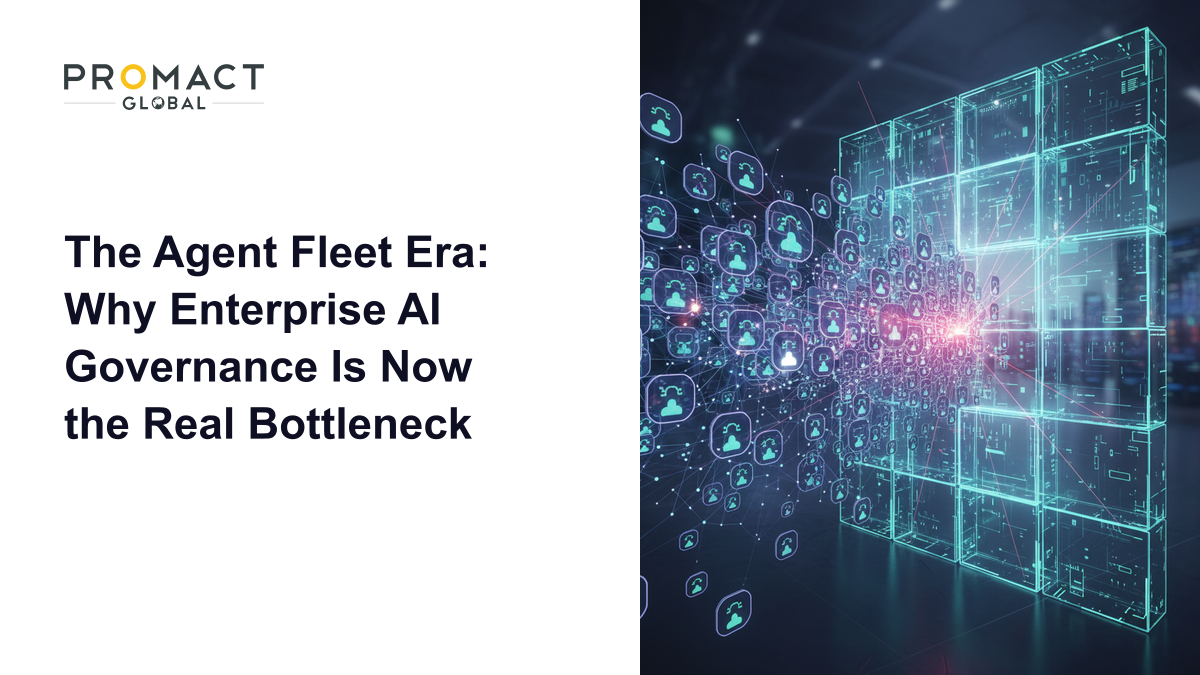
The Agent Fleet Era: Why Enterprise AI Governance Is Now the Real Bottleneck
Ask a CIO in early 2025 what their AI agent strategy looked like, and you’d probably hear about a single pilot: one agent, one narrow task, one team quietly testing whether the thing actually worked. Ask the same question today and the answer looks completely different. Cisco has handed a personal AI agent to all 90,000 of its employees. HPE and NVIDIA have spent the summer building what they explicitly call an “agentic enterprise” production platform. Squirro just shipped a 13-agent catalog built so each new production agent reuses the same connections, compliance approvals, and knowledge layer as the last, and 8090 Labs just closed a $135M Series A to scale a similar collaborative agent-plus-human platform for regulated industries. The pattern is consistent enough that it has a name now: the agent fleet — a coordinated set of AI workers sharing a common knowledge layer, a common set of connectors, and, critically, a common governance model.
That last word is doing a lot of work, because it’s also where most of these deployments are quietly cracking. This piece looks at what’s actually driving the shift from single-agent pilots to fleets, why governance — not model quality — is the real bottleneck in 2026, and what a business needs in place before it lets a fleet of agents loose on production systems.
From One Agent to a Fleet: What Actually Changed
The single-agent pilot made sense as a first step. You wire one AI assistant into one workflow — summarizing tickets, drafting first-pass reports, answering a narrow class of internal questions — and you learn whether agentic AI is worth the investment before betting the department on it. That phase is largely over. Enterprises that got value from the pilot are now doing the obvious next thing: running many agents at once, each with its own job, all pulling from the same enterprise data and acting inside the same systems.
Cisco’s rollout is the clearest public example. Every employee gets a personalized agent that routes tasks to whichever underlying model is most cost-efficient rather than always defaulting to a frontier model, and much of the infrastructure runs on-premises for cost and data-control reasons, according to Fortune’s reporting on the deployment. AI is already producing 80-90% of the first draft of the MD&A section in Cisco’s public filings — not a demo, a production financial workflow.
HPE and NVIDIA moved in the same direction from the infrastructure side, expanding their joint “AI Factory” platform specifically to support agentic AI at scale, with new agentic observability, data intelligence tooling, and confidential computing folded in, as detailed in HPE’s own announcement. The emphasis in that announcement wasn’t model capability — it was security, governance, scale, and sovereignty, in that order. That’s a signal worth sitting with: the vendors closest to actual production deployments are marketing control, not intelligence.
This is the same trajectory this blog has tracked before — see our earlier look at why one “manager AI” beats ten separate bots. What’s new in mid-2026 is the scale: this isn’t a handful of coordinated agents inside one team, it’s tens of thousands of agents across an entire company, sharing infrastructure and expected to behave consistently.
Why Governance Is the Real Bottleneck, Not Model Quality
Here’s the uncomfortable number underneath all of this momentum: Gartner predicts that 40% of enterprises will demote or decommission their autonomous AI agent projects by 2027, and the root cause isn’t that the agents don’t work — it’s governance gaps that only surface after something has already gone wrong in production, according to Gartner’s May 2026 research note. Gartner’s specific diagnosis is that companies are treating agent governance as binary — an agent is either locked down or fully trusted — when a read-only agent that summarizes documents needs nothing like the controls a transaction-executing agent needs.
Deloitte’s 2026 State of AI in the Enterprise survey backs this up with harder numbers. Of the 3,235 IT and business leaders surveyed across 24 countries, only 21% say their organization has a mature governance model for agentic AI, per Deloitte’s published findings. That leaves roughly 80% of organizations without clear agent decision boundaries, real-time behavior monitoring, or audit trails — even as 74% of those same respondents expect their companies to be using AI agents at least moderately by 2027. Adoption is outrunning oversight, and the gap is measured in single digits of maturity against triple digits of expected usage growth.
We’ve written before about what happens when that gap catches up with a company — see AI agent security risks you’re probably ignoring. The fleet era doesn’t remove that risk. It multiplies it, because now the exposure isn’t one agent with one set of permissions — it’s dozens or hundreds of agents, potentially built by different teams, all touching shared systems.
The Proportional Governance Approach
Gartner’s recommended fix is what it calls proportional governance: grading agents across autonomy levels and applying identity and access management controls that scale with what an agent can actually do, not just what it’s for. A customer-support agent that only reads a knowledge base sits at one tier. An agent that can issue refunds, modify infrastructure configuration, or send external communications sits at a much higher tier and needs correspondingly tighter controls — approval checkpoints, tighter audit logging, narrower blast radius if it misbehaves.
This tiered model is also where the technical standard for agent-to-tool communication is starting to matter. The Model Context Protocol (MCP) is increasingly treated as the governance-enabling layer here, because it standardizes how agents interact with enterprise systems, which makes it possible to apply consistent policy across every agent-tool connection rather than bolting on custom access rules per integration. If you’re unfamiliar with the standard itself, our explainer on how MCP is redefining AI integration is a useful primer before you evaluate a fleet platform that claims MCP support.
What This Looks Like in Practice: NVIDIA’s Agent Toolkit
NVIDIA’s contribution to the HPE partnership is instructive as a concrete example of governance infrastructure rather than an abstract principle. Its NVIDIA Agent Toolkit bundles the Nemotron open model family with NemoClaw, a blueprint that packages LangChain’s Deep Agents code and NVIDIA’s OpenShell secure runtime together so a team can run an agent inside a sandboxed environment rather than directly on a host. According to NVIDIA’s own technical documentation, OpenShell spins up a sandbox pod for each agent task, applies a policy that defines exactly what that agent can read, write, and call, and blocks it from escalating privileges or making unauthorized outbound connections. For infrastructure teams, the value proposition is a governance checkpoint at the registration step — before an agent is deployed, not after an incident forces a review — a detail HPE’s own Discover announcements confirm is central to the joint platform.
That “checkpoint before deployment, not audit after an incident” framing is the whole ballgame. It’s the difference between the 21% of organizations Deloitte found with mature governance and the 80% without it. Mature governance isn’t a policy document; it’s infrastructure that makes ungoverned agents structurally hard to ship.
What a Company Should Actually Do Before Building a Fleet
If your organization is standing up its first coordinated set of agents — rather than a single pilot — a few things are worth locking down first:
- Tier your agents by what they can do, not what they’re called. A “reporting agent” that can also trigger downstream automations belongs in a higher tier than its friendly name suggests.
- Centralize the knowledge and connector layer. Fleets fail when every team wires its own agent into its own copy of the same data with its own access rules. A shared layer is what makes consistent governance possible in the first place.
- Build the audit trail before the incident, not after. Real-time monitoring and a full chain-of-action log are table stakes for any agent above the lowest autonomy tier — this is precisely the gap Deloitte found in 80% of surveyed organizations.
- Standardize the agent-to-tool interface. Adopting a consistent protocol like MCP across agents makes proportional governance actually enforceable instead of theoretical.
- Start with a measured scope and expand deliberately. Deloitte’s survey found that the organizations succeeding with agentic AI are the ones starting with lower-risk use cases and building governance capability before scaling — not the ones moving fastest.
Businesses further back in the maturity curve — still deciding whether a single well-scoped agent or a broader automation effort is the right first move — may find our related piece on scaling AI enterprise-wide from pilot to production a useful gut-check before committing to a fleet.
Conclusion: The Fleet Is Coming Either Way
The direction of travel here isn’t really in question. Cisco, HPE and NVIDIA, Squirro, and 8090 Labs aren’t outliers experimenting at the edge — they’re signaling where mainstream enterprise AI is headed in the second half of 2026. The question every business actually has control over is whether it builds the governance layer before the fleet, or discovers the gaps the way Gartner predicts 40% of its peers will: after a production incident forces the issue.
The practical takeaway is simple even if the execution isn’t: treat agent governance as infrastructure you build alongside the agents themselves, not a policy you write after the first one causes a problem. Tier by capability, centralize the knowledge layer, standardize the interface, and log everything an agent does before you let it touch a second system. Do that, and the fleet becomes a genuine productivity multiplier. Skip it, and you’re one of the 40%.
Frequently Asked Questions
What is an “agent fleet” and how is it different from having multiple AI tools?
An agent fleet is a coordinated set of AI agents that share a common knowledge layer, connector infrastructure, and governance model, rather than a collection of separate AI tools each configured independently by different teams. The coordination and shared governance are what distinguish a fleet from simply running several unrelated AI pilots at once.
Why are companies decommissioning AI agents if the technology works?
According to Gartner, the issue usually isn’t agent capability — it’s governance gaps that surface only after a production incident, such as an agent taking an action outside its intended scope. Gartner predicts 40% of enterprises will demote or decommission autonomous agents by 2027 for this reason, not because the underlying models failed.
What is “proportional governance” for AI agents?
It’s Gartner’s recommended approach of grading agents into autonomy tiers based on what actions they can actually take, and applying identity and access management controls that scale with that tier — rather than applying the same lightweight or the same strict controls to every agent regardless of its actual capabilities.
Does adopting MCP (Model Context Protocol) automatically solve governance?
No. MCP standardizes how agents connect to enterprise tools and data, which makes it possible to apply consistent governance policy across every agent-tool interaction. The policy, monitoring, and audit trail still have to be built and enforced on top of that standardized connection layer.
Is fleet-based AI only relevant for large enterprises like Cisco?
The governance principles scale down even if the numbers don’t. A smaller company running five or six agents across different functions faces the same core risk — inconsistent access controls and no shared audit trail — just at a smaller scale. Starting with a centralized knowledge/connector layer and tiered permissions early is cheaper than retrofitting it once a fleet exists.
What should a company do first if it wants to move from a single pilot to a fleet?
Start by auditing what each planned agent can actually do (read-only vs. transaction-capable), centralize the data and connector layer those agents will share, and put real-time monitoring and audit logging in place before expanding scope — not after the first agent causes an incident.
Sources
- Cisco is rolling out AI agents to every single one of its 90,000 employees - Fortune - Details on Cisco’s company-wide personal AI agent deployment and its cost/routing strategy.
- HPE Brings Agentic AI Into Production With NVIDIA, Delivering Security, Governance, Scale, and Sovereignty - HPE Newsroom - HPE’s official announcement of its expanded AI Factory platform for agentic enterprise deployments.
- Gartner Says Applying Uniform Governance Across AI Agents Will Lead to Enterprise AI Agent Failure - Gartner - Source of the 40%-decommission prediction and the proportional governance recommendation.
- Business and IT leaders report AI agents are scaling faster than their guardrails - Deloitte - Deloitte’s 2026 State of AI in the Enterprise survey findings on agentic AI governance maturity.
- NVIDIA/NemoClaw - GitHub - NVIDIA’s own documentation of the NemoClaw blueprint and OpenShell secure runtime sandboxing model.
- Squirro Launches AI Agent Catalog to End the “Start From Zero” Problem Stalling Enterprise AI - PR Newswire - Squirro’s announcement of its 13-agent production catalog and reusable governance foundation.
- 8090 Raises $135M Series A to Accelerate Their Rollout of Software Factory - Business Wire - 8090 Labs’ funding announcement for its agent-plus-human Software Factory platform.
- Gartner Warns AI Agent Governance Failures Ahead by 2027 - HostingJournalist - Additional reporting on Gartner’s agent governance failure prediction.
Have a project like this in mind?
Tell us what you're building — we'll help you scope it and ship it.
Talk to usKeep reading
October 12, 2026
Hermes Goes Enterprise: What Nous Research's $90M Raise Means for Open-Source AI Agents at Work
October 6, 2026
Patch in Minutes, Not Months: How AI Agents Are Breaking Open-Source Security Embargoes
October 5, 2026