

May 13, 2026
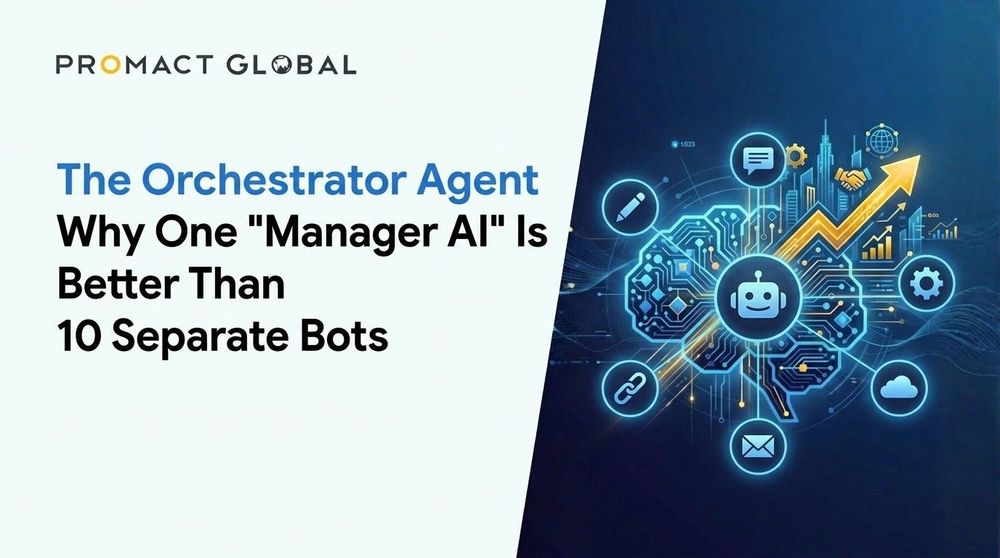
The Orchestrator Agent: Why One "Manager AI" Is Better Than 10 Separate Bots
Introduction: More AI Is Not Always Better AI
Picture a busy restaurant kitchen during a Saturday dinner rush. There are chefs for cold starters, hot mains, desserts, and garnishing. Each one is brilliant at their job. But without a head chef calling the shots and coordinating the flow of every dish, the result is chaos. Tables wait too long. Orders get mixed up. Perfectly cooked food sits cold.
Now swap the kitchen for a business running a dozen AI tools at once. One bot handles customer queries. Another processes invoices. A third monitors inventory. A fourth flags compliance risks. Each is doing its job. But they are not talking to each other. They are not aligned to a shared goal. And every time a process spans more than one system, something falls through the cracks.
This is the gap that the AI orchestrator agent is designed to close.
Over the last few years, AI adoption in business has moved fast. Companies have invested in automation tools, large language models, and purpose-built bots across nearly every function. But as these tools multiply, a new problem has emerged: coordination. Individual AI systems are powerful in isolation, but most real-world business tasks do not live in isolation. They cross departments, depend on sequential steps, and require context that no single bot carries on its own.
The orchestrator agent solves exactly this problem, and understanding how it works is quickly becoming important knowledge for any business leader thinking seriously about where AI goes next.
What Is an AI Orchestrator Agent?
An AI orchestrator agent is essentially a “manager AI.” It sits above a collection of specialized AI agents and coordinates their actions toward a shared objective. It does not do all the work itself. Instead, it understands the goal, breaks it down into tasks, assigns each task to the most suitable agent, monitors progress, and synthesises the results into a coherent output.
Think of it like a project manager who does not write code, design screens, or run user tests, but knows exactly who should handle each of those things and in what order. Without that project manager, every specialist works in their own world. With one, the whole team moves toward the same destination.
In technical terms, multi-agent AI management describes a system where multiple AI models, tools, or bots operate within a defined hierarchy. The orchestrator is at the top. Beneath it are “worker agents” or “specialist agents,” each optimised for a narrow task: searching the web, reading a database, writing a report, sending a notification, or running a calculation. The orchestrator agent passes instructions down, receives results back, and decides what happens next.
This architecture is sometimes called “agentic AI,” because the agents are not just responding to single prompts. They are taking sequences of actions, adapting as they go, and working toward longer-horizon goals. It is a meaningful step up from the chatbot-style AI most people encountered first.
Why One Manager AI Outperforms Ten Separate Bots
There is an instinct in technology adoption to solve every problem with a dedicated tool. Need to summarise documents? Add a summarisation bot. Need to monitor social media? Add a listening tool. Need to schedule meetings? Add a scheduling assistant. This approach is understandable, but it creates a sprawl of disconnected systems that each need to be managed, maintained, and integrated.
The AI orchestrator agent flips this model. Instead of many isolated tools that each do one thing, you have one intelligent layer that understands context and delegates appropriately.
Here is why that matters in practice.
Context does not get lost. When a business task moves from one tool to another in a disconnected system, context disappears at every handoff. The scheduling bot does not know what was discussed in the customer query. The invoice processor does not know the order was flagged for review. An orchestrator agent carries context across every step, because it is overseeing the whole chain.
Decisions improve. A standalone bot can only act on what it directly sees. An orchestrator agent can weigh information from multiple sources before deciding what to do next. If one agent reports a compliance risk while another agent spots a delay in fulfilment, the orchestrator can factor both into its next instruction, rather than each system acting independently on incomplete information.
Errors get caught earlier. In a multi-agent system without orchestration, an error in step two might not surface until step eight. The orchestrator monitors each step and can intervene, re-route, or flag for human review before a small problem becomes a large one.
The system adapts. Orchestrators can be designed to learn from outcomes and adjust how they delegate tasks. This is what separates a well-built AI orchestrator agent from a rigid workflow automation tool. Automation follows a fixed path. An orchestrator thinks about the path.
How Orchestrator-Agent Architecture Works
At a high level, the architecture involves three layers working together.
The first layer is the orchestrator itself. This is typically a large language model or a purpose-built reasoning engine that understands natural language goals, can plan sequences of actions, and communicates with other systems via APIs or tool-calling protocols. When given an objective like “prepare a financial risk summary for the board meeting,” the orchestrator figures out what that requires: pulling recent financial data, checking against current market benchmarks, identifying anomalies, and formatting the output in a readable way.
The second layer is the collection of specialist agents. These are narrower systems optimised for specific tasks. One might be a retrieval-augmented generation (RAG) system that pulls from internal documents. Another might be a calculation engine. Another might be a communication tool that drafts and sends an email. Each specialist is very good at its job and does not need to understand the full picture.
The third layer is the human oversight interface. In most responsible deployments, the orchestrator surfaces decisions, exceptions, or completed outputs to a human at defined checkpoints. This is not a limitation of the technology; it is a design choice that keeps humans in the loop for decisions that carry significant business or legal weight. The best orchestrator systems are built to work with human judgment, not to replace it.
The data flowing between these layers is managed through memory systems, context windows, and structured handoffs. When built well, this architecture feels seamless from the outside. To an end user, it looks like one intelligent assistant that can handle complex, multi-step requests. Behind the scenes, it is an orchestra of specialised agents playing different instruments under one conductor.
Real-World Applications: Where Orchestration Is Already Working
The value of AI orchestrator agent architecture becomes clearest in industries where processes are complex, time-sensitive, and span multiple systems.
Logistics and supply chain management is one of the most active areas. A logistics company might have separate systems for demand forecasting, warehouse inventory, carrier routing, and customer communications. Without orchestration, updating all four systems after a supply disruption takes manual effort and introduces delays. With an orchestrator agent, a single trigger, say, a port delay alert, can automatically prompt the inventory agent to check stock levels, the routing agent to identify alternative carriers, and the communications agent to draft proactive updates for affected customers. The orchestrator coordinates the response in minutes, not hours.
Financial services is another domain seeing early adoption. Risk monitoring, transaction review, and regulatory reporting each have dedicated tools in most institutions. An AI orchestrator agent can sit across all three, correlating signals in real time and escalating only the situations that genuinely warrant human review. This reduces alert fatigue for compliance teams and speeds up detection of anomalies that would otherwise require manual correlation.
Human resources and talent operations is a less obvious but increasingly important application. Recruiting, onboarding, benefits administration, and performance management each have their own platforms in many organisations. An orchestrator agent can manage multi-step workflows that span all of them: reading a new hire’s offer letter, initiating the background check process, scheduling equipment provisioning, and sending onboarding documentation, all triggered by one event and coordinated without manual handoffs between four different HR systems.
In each of these cases, the benefit is not just speed. It is coherence. The entire process maintains shared context, adapts to exceptions, and produces an output that reflects the whole picture rather than one narrow slice of it.
When Should Your Business Start Thinking About This?
Not every business needs an AI orchestrator agent today. But there are clear signals that suggest it is worth serious consideration.
If your team regularly moves data manually between systems because your tools do not talk to each other, orchestration is likely to deliver measurable value. If you have deployed multiple AI or automation tools that each work well in isolation but require human coordination at every handoff, an orchestrator can eliminate much of that overhead. If your most valuable workflows involve five or more sequential steps, span multiple departments, and currently depend on a single person who “knows how everything connects,” that is a process that an orchestrator was built for.
The question of when to invest also depends on how mature your underlying data infrastructure is. An AI orchestrator agent is only as good as the systems it coordinates. If your data lives in disconnected silos without reliable APIs, the first investment should be in data infrastructure. Orchestration works best on top of a reasonably clean, accessible data environment.
For businesses that are earlier in their AI journey, starting with a single well-defined use case is a practical approach. Pick one complex, multi-step process that currently causes friction, design a small multi-agent system around it, and measure the outcome. The learnings from that first deployment are almost always more valuable than any theoretical planning.
Building With Orchestrator Architecture: What Good Looks Like
From the work done building AI-powered software products across different industries, a few principles consistently separate successful orchestrator deployments from frustrating ones.
Clarity of objective matters more than technical sophistication. An orchestrator agent is only as effective as the goal it is given. Vague instructions produce vague results. Before any technical design begins, the business objective needs to be precise: not “improve customer service” but “reduce average resolution time for billing queries from 48 hours to 4 hours by automating the first three steps of the resolution process.”
Human oversight checkpoints should be designed deliberately, not added as an afterthought. Every orchestrated workflow should have defined moments where a human can review, approve, or redirect the process. This builds trust in the system and catches the edge cases that always exist in real-world deployments.
Testing should include adversarial scenarios. Real data is messy. Real users send unexpected inputs. A multi-agent system that performs perfectly on clean test data and breaks on the first unusual real-world input is not production-ready. Stress-testing the orchestrator’s handling of ambiguous goals, conflicting signals from agents, and missing data is essential.
Finally, the right team to build this includes people who understand both the business process and the technical architecture. An AI orchestrator agent is not a product you buy and plug in. It is a system you design around a specific business context, and that design work requires close collaboration between domain experts and engineers.
Conclusion: The Shift from Tools to Intelligence
The history of software in business is a history of adding tools. A tool for accounting, a tool for CRM, a tool for HR, a tool for project management. For decades, “digital transformation” largely meant digitising existing processes by adding the right tools in the right places.
The AI orchestrator agent represents something different. It is a shift from tools that assist with tasks to intelligence that coordinates across tasks. It does not replace the specialist systems already in place. It adds a layer of understanding that connects them, gives them shared context, and lets them work as a system rather than a collection of parts.
For businesses willing to invest the time to design it thoughtfully, multi-agent AI management is one of the more significant productivity shifts available right now. The technology is mature enough to deploy at scale. The use cases are proven. And the gap between companies that adopt it well and those that do not is likely to widen considerably over the next few years.
The question is not really whether to explore orchestrator agent architecture. It is how soon, and where to start.
Have a project like this in mind?
Tell us what you're building — we'll help you scope it and ship it.
Talk to usKeep reading
October 9, 2026
SAP Buys TechWolf: Why the Grounding Layer, Not the Model, Is Enterprise AI's Next Battleground
October 8, 2026
Oracle Fusion Claw: What a Governed Agent Runtime Inside Your ERP Means for Finance and Operations Teams
October 7, 2026