
October 5, 2026
Agents Now Create 70% of New Databases: What Supabase's Turso Deal Means for Enterprise Data Governance
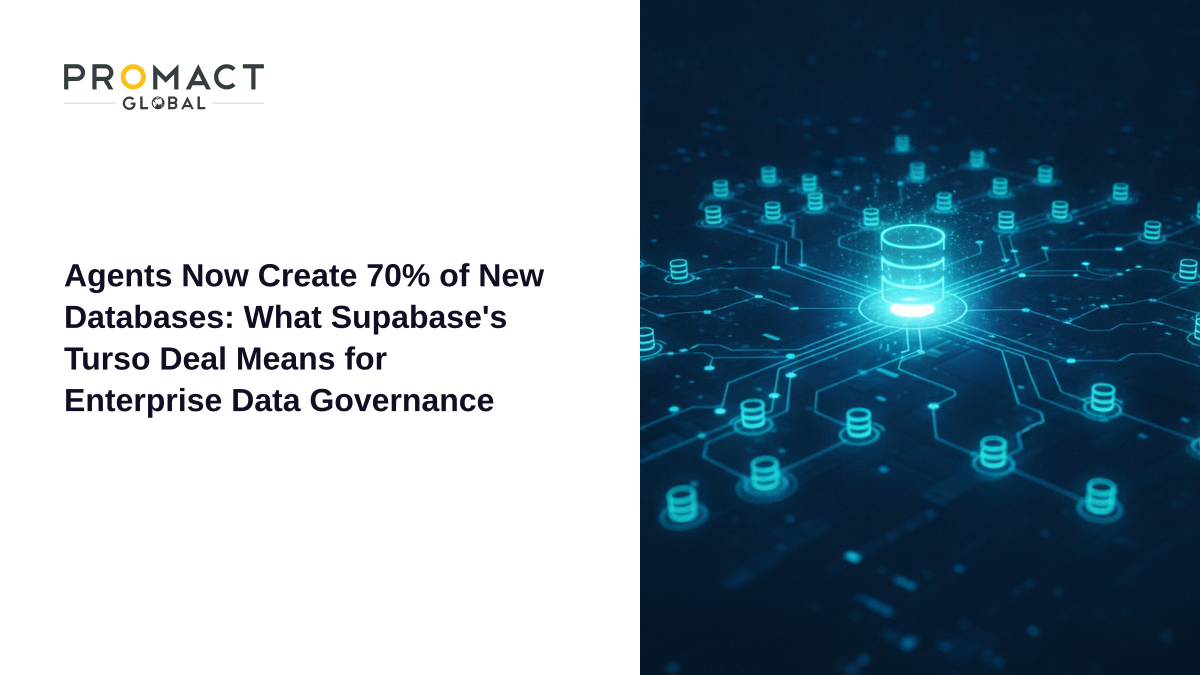
Somewhere in your company right now, an AI coding assistant is probably spinning up a database. Nobody filed a ticket, nobody picked a region, and nobody will remember to delete it. That is no longer a thought experiment: when Supabase announced a $150 million raise and its acquisition of Turso on October 2, 2026, it disclosed that roughly 70% of new databases on its platform are now created by agents or AI-driven tools, not by people.
This post unpacks what the deal says about where infrastructure is heading, why a decades-old database design is suddenly under strain, and what engineering and IT leaders should do before agent-created data stores become the next sprawl problem.
What Supabase Actually Announced
Supabase, the open-source Postgres platform popular with startups and AI app builders, raised $150 million led by GIC, with participation from CapitalG, IronArc and SquarePeg, and agreed to acquire Turso. Terms were not disclosed, and closing timing and conditions were not stated.
Turso builds an open-source, SQLite-compatible database. Its founder, Glauber Costa, joins Supabase as Head of Agentic Services alongside co-founder Pekka Enberg and the Turso team. Turso’s own announcement frames the goal plainly: give every agent its own database.
The Numbers Behind the Bet
Coverage of the announcement says Supabase is adding more than 1 million users and 4 million databases per month, with the 70% agent-created share cited above. The same coverage reports a 600% surge in agent-driven database creation over the past year. These are company-reported figures, so treat them as directional rather than audited, but the direction is hard to ignore.
What Does Not Change
For existing customers, nothing changes immediately: Supabase continues to build around Postgres, and Turso continues its SQLite work and stays open source.
Why Agents Strain the Traditional Database Model
A conventional Postgres deployment assumes a long-lived server process, careful provisioning and a human who owns it. Agents behave differently.
Ephemeral, Numerous and Isolated
An agent working on a task may want a scratch database for an hour, a separate one per customer, and a throwaway copy to test a migration. Multiply that by hundreds of agents and you get many small, short-lived data stores that need instant, lightweight and tightly isolated environments.
The Economics of Idle
Turso’s approach is reported to store databases as segments in object storage, load them on demand and suspend them when idle, which makes near-zero idle cost possible. Paying for an always-on server for a database used for ten minutes is the mismatch this design attacks.
A Graduation Path
Supabase has signalled a path where agents that start on lightweight databases can later use Supabase’s auth, storage and other services, per press reports. The pattern is prototype cheaply, promote what proves valuable.
What This Means for Enterprise Teams
The infrastructure story is interesting. The governance story is more urgent. If agents create most new databases, then data lives in places your inventory may never see.
Data Sprawl Joins Agent Sprawl
We have previously written about AI agent sprawl and about counting the agents you did not know you had. Agent-created databases are the data-layer version of the same problem: each one may hold customer records, prompts or credentials, and each needs an owner, a retention rule and a deletion date.
Environments Need Homes and Boundaries
Our piece on why agents need persistent execution environments argued that compute is only half the picture; state has to live somewhere too. Per-agent databases are that state layer. Likewise, the case for putting agents in a box applies to data: isolation per agent limits blast radius if one is compromised or confused.
Vendor Consolidation Is a Strategic Signal
A leading Postgres platform buying a SQLite specialist suggests the market believes agent workloads need both a durable relational core and a cheap disposable edge. Expect competitors to respond with similar offerings, and expect your vendors to pitch “agent-ready” databases within months.
A Practical Playbook
- Inventory agent-created data stores. Query your cloud and database platforms for resources created by service accounts and API keys tied to coding assistants.
- Tag at creation. Require every agent-provisioned database to carry an owner, a purpose and an expiry.
- Set quotas and budgets. Cap how many databases and how much storage a single agent or project can create.
- Separate scratch from system of record. Disposable per-agent databases should never hold production data without an explicit promotion step and review.
- Review credentials. Agents that create databases also receive connection strings; rotate and scope them like any other secret.
- Plan for portability. Both Postgres and SQLite are open, which helps. Keep schemas and exports portable so a vendor shift does not strand data.
Conclusion
The headline number is not the $150 million; it is the 70%. When most new databases on a major platform are created by software rather than people, databases stop being deliberate infrastructure decisions and become a by-product of agent activity. That is powerful for developer speed and risky for governance.
Actionable takeaways: assume agents are already creating data stores in your environment, give them cheap isolated places to work, and make ownership, expiry and promotion rules non-negotiable. Teams that treat agent-created data as a first-class governance topic now will avoid a painful cleanup later.
Frequently Asked Questions
What did Supabase announce on October 2, 2026?
Supabase announced a $150 million funding round led by GIC and an agreement to acquire Turso, an open-source SQLite-compatible database company. Financial terms of the acquisition were not disclosed.
Why would AI agents need their own databases?
Agents often need scratch space, per-customer isolation or disposable test copies. Small, instantly provisioned and cheaply idled databases suit that pattern better than a single long-running server.
Is Postgres being replaced?
No. Supabase says it will keep building around Postgres while Turso continues its SQLite work. The two are positioned as complementary, with a path to move from lightweight to full-featured use.
Is the 70% figure independently verified?
It comes from Supabase’s announcement as relayed in press coverage. It is a company-reported statistic, so treat it as a strong indicator rather than an audited measurement.
What should enterprises do about agent-created databases?
Inventory them, require owner and expiry tags, set quotas, keep scratch data separate from production systems and rotate the credentials agents receive.
Sources
- Supabase: Supabase is acquiring Turso - official announcement of the deal and Glauber Costa’s new role
- Turso: Turso is joining Supabase - Turso’s announcement and per-agent database vision
- Pulse 2: Supabase Raises $150 Million And Acquires Turso - funding round and investor details
- Ventureburn: Supabase Raises $150 Million, Acquires Turso for Agentic AI - growth statistics and agent isolation context
- ByteIota: Supabase Acquires Turso, the $150M Agentic Database Bet - Turso architecture and what stays the same
- Runtime Wire: Supabase raises $150M and agrees to acquire Turso - additional deal coverage
Have a project like this in mind?
Tell us what you're building — we'll help you scope it and ship it.
Talk to usKeep reading
October 6, 2026
Patch in Minutes, Not Months: How AI Agents Are Breaking Open-Source Security Embargoes
October 1, 2026
Governing the Apps AI Builds: What Microsoft's Copilot Managed Runtime Means for Enterprise Shadow IT
September 28, 2026