November 16, 2026
Agentic Workflows: Patterns, Examples and How to Start
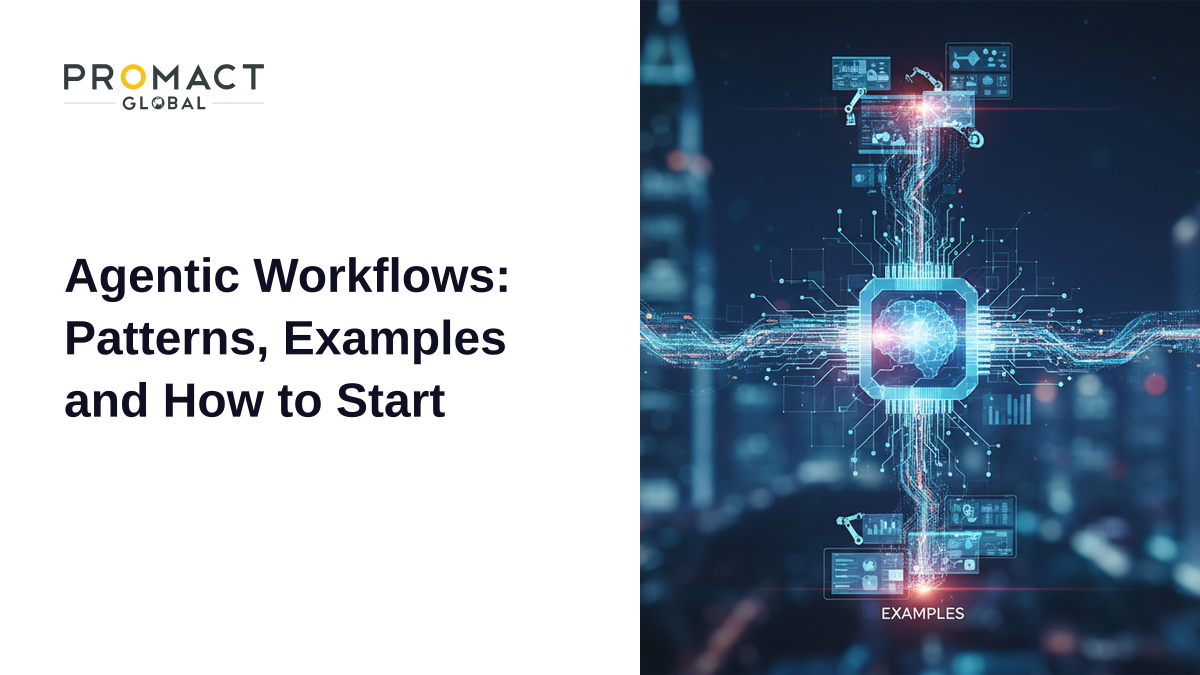
Agentic workflows are processes in which an AI model plans, uses tools, checks its own work and adjusts its next step, instead of answering once and stopping. In practice, that covers everything from a fixed three-step pipeline with a model in each step to a fully autonomous agent that decides its own route. The difference matters, because it determines how much your system costs, how predictable it is and how much risk you carry.
This guide explains what agentic workflows are, the patterns that make them work, how to choose between a scripted workflow and a free-roaming agent, and a checklist for getting your first one into production.
What Are Agentic Workflows?
An agentic workflow is a multi-step process where a large language model (LLM) does more than generate text: it reasons about a goal, calls tools such as search, databases or APIs, and loops until the job is done. The “agentic” part is the loop. A normal prompt gives you one answer; an agentic workflow gives the model several chances to plan, act, check and improve.
The idea was popularised by Andrew Ng, who argued in The Batch that iterative workflows could drive more AI progress than the next generation of models. His example: on the HumanEval coding benchmark, GPT-3.5 answering in one pass scored 48.1% and GPT-4 scored 67.0%, but GPT-3.5 wrapped in an agent loop reached up to 95.1%. The loop mattered more than the model upgrade.
If you are still sorting out the vocabulary, our explainer on AI agents vs agentic AI covers how the terms relate.
What Is the Difference Between a Workflow and an Agent?
In a workflow, your code decides the sequence of steps; in an agent, the model decides. Anthropic’s Building Effective Agents guide draws the line precisely: workflows are “systems where LLMs and tools are orchestrated through predefined code paths,” while agents are systems where “LLMs dynamically direct their own processes and tool usage.”
Both are “agentic systems”, and most useful business deployments sit somewhere between the two ends.
| Scripted workflow | Autonomous agent | |
|---|---|---|
| Who picks the next step | Your code | The model |
| Predictability | High | Lower |
| Cost per run | Lower, fixed | Higher, variable |
| Best for | Well-defined, repeatable tasks | Open-ended problems with unknown step counts |
| Main risk | Rigid when inputs vary | Errors compound across steps |
| Testing effort | Moderate | High, needs sandboxing |
What Are the Main Agentic Workflow Patterns?
There are five widely used workflow patterns, plus the autonomous agent loop. Anthropic’s guide and the LangGraph documentation describe the same set.
Prompt chaining
The task is split into fixed steps, each model call building on the last, with optional checks in between. Example: extract the fields from an invoice, validate them against purchase-order rules, then draft the approval note.
Routing
An input is classified and sent to a specialised prompt, tool or model. Example: a support inbox where billing questions, technical faults and cancellations each go to a different handler.
Parallelization
Subtasks run at the same time, or the same task runs several times and the results are compared (voting). Example: scanning a contract for risk, compliance and pricing issues in three parallel passes.
Orchestrator-workers
A central model breaks the task into subtasks it chooses at runtime, delegates them to worker models and combines the results. Example: researching a market, where the number of sub-questions is unknown in advance. See our post on the orchestrator agent for the business case.
Evaluator-optimizer
One model produces a draft and another critiques it, looping until the output meets the criteria. This is the “reflection” idea from Ng’s list of four patterns: reflection, tool use, planning and multi-agent collaboration.
The autonomous agent loop
The model plans, acts with tools, reads the result and decides what to do next. Use it only where you cannot predict the steps. For a deeper look at the building blocks, read our guide to AI agent architecture.
When Should You Use a Workflow Instead of an Agent?
Start with the simplest option that works and add autonomy only when it clearly improves results. Anthropic’s guidance is to use “the simplest solution possible”, noting that a single model call with retrieval and examples is often enough, and that agents trade higher cost and compounding errors for flexibility.
A practical decision rule:
- Can you write down the steps? Use a scripted workflow (chaining, routing or parallelization).
- Do the steps depend on what the model finds along the way? Use orchestrator-workers or an agent.
- Is quality the problem rather than flexibility? Add an evaluator-optimizer loop to an existing workflow.
- Is a mistake expensive or irreversible? Keep a human approval step before the final action, whichever pattern you choose.
What Are Examples of Agentic Workflows in Business?
The best examples are repetitive, document-heavy processes with clear success criteria. These are typical shapes, not Promact case results:
| Process | Pattern | What the workflow does | Human checkpoint |
|---|---|---|---|
| Invoice processing | Prompt chaining | Reads the invoice, matches it to the purchase order, drafts the posting | Approve exceptions |
| Support triage | Routing | Classifies the ticket and sends it to the right handler | Review low-confidence cases |
| Contract review | Parallelization | Checks risk, compliance and pricing clauses in parallel | Lawyer signs off |
| Market research | Orchestrator-workers | Splits the question, gathers sources, synthesises a brief | Analyst reviews |
| Report writing | Evaluator-optimizer | Drafts, critiques against a rubric, revises | Editor approves |
For more industry-specific scenarios, see our post on real AI agent examples by business function.
Why Do Agentic Workflows Fail?
Most failures come from unclear business value, rising costs and weak controls rather than from the technology itself. Gartner predicts that over 40% of agentic AI projects will be scrapped by the end of 2027, citing escalating costs and unclear business value. The same report warns about “agent washing”, where vendors relabel chatbots as agentic products, and estimates only about 130 of the thousands of agentic AI vendors are genuine.
Common causes you can avoid:
- Starting too big. An open-ended agent where a three-step chain would do.
- No measurement. Nobody agreed what “better” means before the build.
- No visibility. When a multi-step run goes wrong, you cannot see which step failed. Our guide to AI agent observability shows how to trace each step.
- No guardrails. Agents that can act need scoped access and approvals.
How Do You Build Your First Agentic Workflow?
Pick one repetitive process, script the happy path, add tools and checks, and release it to one team before scaling. This sequence works for most teams:
- Choose a narrow process with a measurable cost, such as hours per week or error rate.
- Map the steps and the exceptions. Note where a person currently makes a judgment call.
- Start with a scripted workflow. Use the simplest pattern from the list above.
- Add tools with least-privilege access. Give the workflow only the systems and records it needs.
- Insert human approval before any irreversible action, such as sending money, deleting data or contacting customers.
- Log every step so you can debug, audit and improve.
- Pilot with one team, measure against the baseline, then expand.
Promact follows the same shape on its AI agent solutions engagements: a short workflow audit to map where time is lost, a build trained on the client’s own templates and systems with human-in-the-loop approvals, and a go-live in one team before scaling. Governance matters as soon as more than one workflow is live; our AI agent governance framework is a good starting point.
Checklist before go-live
- A named owner and a baseline metric
- The pattern is the simplest one that works
- Tool access is scoped and logged
- Human approval on high-stakes actions
- Tracing and alerts on every step
- A rollback or kill switch
- A review date to decide whether to expand
Conclusion: Actionable Takeaways
Agentic workflows are about giving AI a loop (plan, act, check, adjust), and the winning move is usually restraint.
- Use a scripted workflow when you can write the steps down, and an agent only when you cannot.
- Learn the five patterns; most business problems need one or two of them.
- Add an evaluator loop when quality is the issue, not complexity.
- Keep humans on irreversible actions and log everything.
- Measure against a baseline, because unclear value is a leading reason projects get cancelled.
Frequently Asked Questions
What are agentic workflows in simple terms?
They are multi-step AI processes where the model plans, uses tools and checks its own work in a loop, rather than giving one answer to one prompt.
What is the difference between an agentic workflow and an AI agent?
In a workflow, predefined code decides the order of steps; in an agent, the model decides its own steps and tool use. Anthropic treats both as types of agentic system.
What are the main agentic workflow patterns?
Prompt chaining, routing, parallelization, orchestrator-workers and evaluator-optimizer, plus the fully autonomous agent loop. Andrew Ng’s four patterns are reflection, tool use, planning and multi-agent collaboration.
Are agentic workflows safe for enterprise use?
They can be, with scoped tool access, human approval on high-stakes actions, step-level logging and clear ownership. Without those controls, errors can compound across steps.
Do I need a framework to build one?
Not necessarily. Anthropic suggests starting with LLM APIs directly, because frameworks can hide prompts and responses and make debugging harder. Use one only if you understand what it does underneath.
Sources
- Building Effective Agents - Anthropic - definitions of workflows vs agents and the core patterns
- How Agents Can Improve LLM Performance - The Batch, DeepLearning.AI - Andrew Ng on agentic workflows and the HumanEval results
- Workflows and agents - LangGraph documentation - workflow patterns and the agent loop
- Over 40% of agentic AI projects will be scrapped by 2027, Gartner says - Reuters via The Star - cancellation forecast and agent washing
- Build agentic design patterns - DeepLearning.AI - course covering reflection, tool use, planning and multi-agent workflows
Have a project like this in mind?
Tell us what you're building — we'll help you scope it and ship it.
Talk to usKeep reading
October 30, 2026
Akamai Agent Sandbox: Why AI-Written Code Needs a Boundary
October 29, 2026
Only 0.229: What Cisco's New Agentic Security Benchmark Reveals About AI Agents and Vulnerability Detection
October 27, 2026