
November 2, 2026
AI Agents vs Agentic AI: What's the Difference?
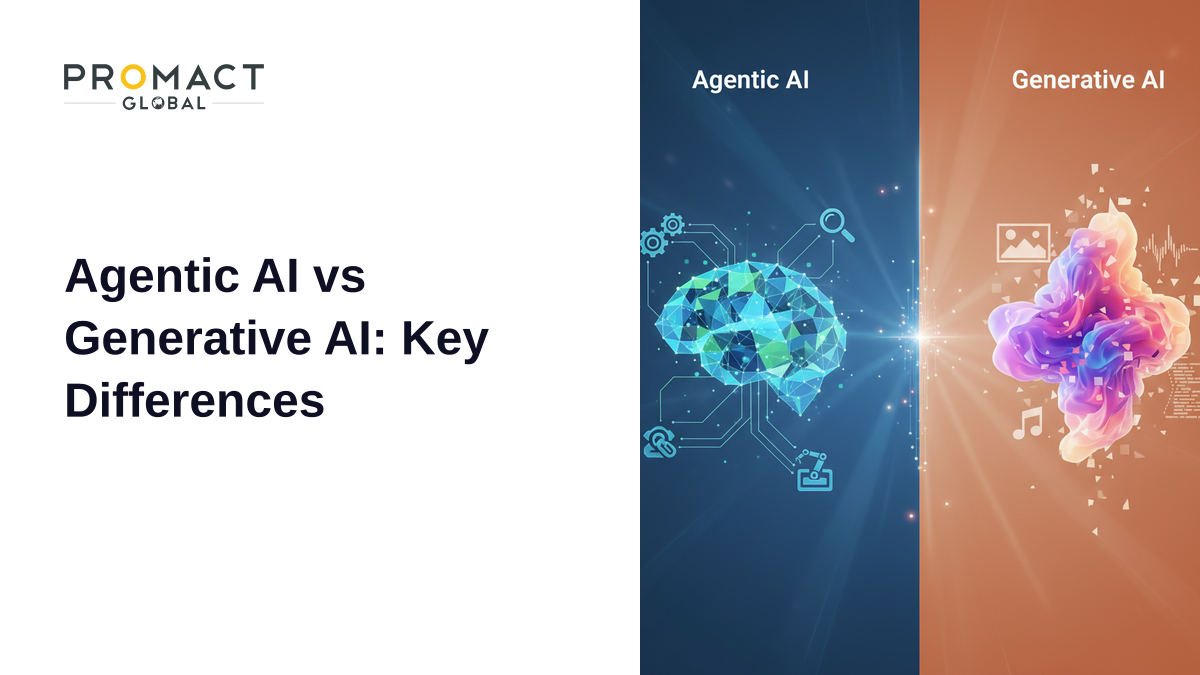
An AI agent is a single piece of software that uses an AI model and tools to complete a specific task. Agentic AI is the broader approach, or system design, in which one or more agents plan, decide and act toward a goal with limited supervision. In short: the agent is the worker, and agentic AI is how the work gets planned and coordinated. The two terms are used interchangeably in a lot of marketing, which makes buying decisions harder than they need to be.
This guide explains the difference in plain words, compares the two side by side, shows where each one fits in a real business, and gives you a simple way to decide what you actually need.
What Is the Difference Between AI Agents and Agentic AI?
The cleanest way to think about it is scope. An AI agent has a defined job: triage a support ticket, pull data from a document, book a meeting. Agentic AI describes a system with a goal, such as “get this insurance claim processed,” where the system works out the steps, picks the tools, and may hand work between several agents along the way.
A 2025 academic taxonomy frames it the same way. It describes AI agents as modular, LLM-driven systems for narrow, task-specific automation, and agentic AI as a shift toward multi-agent collaboration, dynamic task decomposition, persistent memory and coordinated autonomy.
Anthropic offers a useful engineering lens. In its guide to building effective agents, it separates two designs. Workflows are “systems where LLMs and tools are orchestrated through predefined code paths,” while agents are systems where LLMs “dynamically direct their own processes and tool usage.” Both fall under the umbrella of agentic systems.
You will also see the word “agentic” used as an adjective, meaning “behaves with some autonomy.” That is why the vocabulary feels slippery: a single agent can be quite agentic, and a system of several agents can still be rigid. For a deeper definition, see our guide to what agentic AI is for business leaders.
AI Agents vs Agentic AI: Side-by-Side Comparison
| Dimension | AI agent | Agentic AI |
|---|---|---|
| Scope | One bounded task or role | An end-to-end goal or process |
| Planning | Follows a fixed or short sequence | Breaks goals into steps and adapts the plan |
| Number of components | Usually one agent plus tools | Often several agents plus an orchestrator |
| Memory | Often limited to the current task | Persistent context across steps and sessions |
| Human oversight | Review of outputs | Approval gates at decision points, audit trail |
| Typical example | Invoice-data extractor | Accounts-payable process from receipt to payment |
| Cost and effort | Lower, faster to ship | Higher, needs governance and monitoring |
| Main risk | Wrong output on one task | Errors compounding across linked steps |
Treat this as a spectrum rather than two boxes. Most real deployments sit somewhere in the middle, and that is fine.
Is Agentic AI Just Multiple AI Agents Working Together?
Partly. Multi-agent coordination is one common way to build an agentic system, but it is not the definition. A single agent that plans its own steps, uses several tools, and checks its own work can already be agentic. And five agents wired into a fixed script are really just a workflow.
What makes a system agentic is the degree of goal-directed autonomy, not the head count. If you want to see when splitting work across several agents pays off, read our piece on multi-agent systems and when one AI bot isn’t enough.
Real Examples: Where Each One Fits
Examples of AI agents
- Support triage agent: reads an incoming ticket, tags it, drafts a reply for a human to approve.
- Document extraction agent: pulls names, dates and amounts from PDFs and emails into a CRM or ERP.
- Scheduling agent: finds a time across calendars and sends the invite.
These are valuable because they are narrow. They are easy to test, easy to measure, and easy to turn off.
Examples of agentic AI
- Claims or prior-authorization handling: a coordinated set of agents gather records, check policy criteria, draft the submission, flag exceptions to a person, and follow up on status.
- Procure-to-pay: matching invoices to purchase orders, chasing missing paperwork, and routing exceptions, with the system deciding the next step.
- Software delivery: agents that plan a change, write code, run tests and prepare it for human review.
Here the value comes from connecting steps that people currently stitch together by hand. So does the risk.
Which One Does Your Business Need?
Start with the simplest thing that solves the problem. Anthropic’s own advice is to find “the simplest solution possible, and only increasing complexity when needed,” noting that agentic systems “often trade latency and cost for better task performance.”
| If your situation looks like this | Start with |
|---|---|
| One repetitive task, clear inputs and outputs | A single AI agent |
| A fixed multi-step process that rarely changes | A workflow with AI steps |
| A messy process with exceptions, many systems and judgment calls | An agentic system with human approval gates |
| No clean data or process documentation yet | Fix that first, then revisit |
A practical rule of thumb: if you can write the steps down in a flowchart that will still be accurate next quarter, you probably do not need full agentic AI. If the steps depend on what the system finds along the way, you might.
Promact’s AI agent solutions follow this staged approach. The agent works inside your existing tools, high-stakes decisions route to a person for approval, and every action is logged. You decide what the agent may do alone and what always needs sign-off.
Why Does the Distinction Matter for Buyers?
Because the label affects what you pay for. Gartner has warned about “agent washing,” where vendors relabel existing products such as chatbots, assistants and RPA as agentic. In its June 2025 forecast, Gartner predicted that over 40% of agentic AI projects will be canceled by the end of 2027, citing escalating costs, unclear business value or inadequate risk controls. It also estimated that only about 130 of the thousands of vendors claiming agentic capabilities offer the real thing.
Adoption is moving regardless. Gartner has also predicted that up to 40% of enterprise applications will include task-specific AI agents by 2026, up from less than 5% in 2025. And in McKinsey’s 2025 State of AI survey, 23% of respondents said their organizations were scaling an agentic AI system somewhere in the business, with another 39% experimenting with agents. These are industry figures, not Promact’s, and they come from forecasts and surveys made in 2025, so treat them as direction rather than precision.
The takeaway for buyers: expect plenty of single-task agents inside the software you already own, and be skeptical when a vendor says “agentic” without showing how the system plans, uses tools and hands off to a human.
What Are the Risks of Moving From Agents to Agentic AI?
The jump in autonomy brings new failure modes.
Errors compound
A wrong answer from one agent is a wrong answer. A wrong answer passed to the next step in an automated chain becomes a bad decision. Keep chains short at first and test each hand-off.
Access and security
More autonomy usually means more system access. Give each agent only the permissions its job needs, and log every action. Our article on AI agent security risks covers what to lock down first.
Governance and accountability
Someone must own what the system does. Decide up front which actions are automatic, which need approval, and who is responsible when something goes wrong.
How to Get Started: A Five-Step Checklist
- Pick one painful, repetitive process. Choose something with clear inputs, outputs and a measurable cost in hours.
- Map the exceptions. List where a person currently makes a judgment call. These are your approval gates.
- Start with a single agent. Prove accuracy and time saved on one task before chaining anything.
- Add autonomy gradually. Let the system plan more only after the earlier step is reliable and monitored.
- Measure and review. Track hours recovered, error rates and escalations every month.
For a practical onboarding approach, see how to onboard your first AI agent.
Conclusion: Key Takeaways
- An AI agent does a task. Agentic AI pursues a goal, often by coordinating agents.
- Autonomy is a spectrum. Most businesses should start at the narrow end.
- Choose the simplest design that works, and add complexity only when it demonstrably improves results.
- Be wary of “agent washing”: ask any vendor how the system plans, which tools it uses and where a human approves.
- Keep a person in the loop for high-stakes decisions, and log everything.
Frequently Asked Questions
Are AI agents and agentic AI the same thing?
No. An AI agent is a specific piece of software that performs a task using an AI model and tools. Agentic AI is the broader approach where systems plan and act toward goals with limited supervision, often by coordinating several agents.
Is ChatGPT an AI agent or agentic AI?
A basic chat conversation is neither: it responds to prompts. It becomes agent-like when it is given tools and permission to take actions, and more agentic the more it plans and carries out multi-step work on its own.
Is agentic AI better than AI agents?
Not automatically. Agentic systems can handle more complex work but cost more, take longer to build and carry more risk. For a simple, well-defined task, a single agent or a plain workflow is often the better choice.
What is an example of agentic AI in business?
Handling an insurance claim end to end is a common one: gathering records, checking policy rules, preparing the submission, flagging exceptions to a person and following up on status, with the system deciding the next step as it goes.
Do I need agentic AI to start automating work?
No. Most businesses get early wins from a single agent on one repetitive task, such as data extraction or ticket triage. Move toward agentic designs only when the process genuinely needs planning and adaptation.
Sources
- AI Agents vs. Agentic AI: A Conceptual Taxonomy, Applications and Challenges (arXiv) - academic paper distinguishing task-specific agents from multi-agent agentic systems
- Building effective agents (Anthropic) - definitions of workflows versus agents and guidance on keeping designs simple
- Gartner: Over 40% of Agentic AI Projects Will Be Canceled by End of 2027 - forecast and the “agent washing” warning
- Gartner: 40% of Enterprise Apps Will Feature Task-Specific AI Agents by 2026 - adoption forecast for embedded agents
- The State of AI in 2025 (McKinsey) - survey data on agent experimentation and scaling
- Agentic AI vs. Generative AI (IBM) - IBM’s overview of agentic AI concepts
Have a project like this in mind?
Tell us what you're building — we'll help you scope it and ship it.
Talk to us