

April 16, 2026
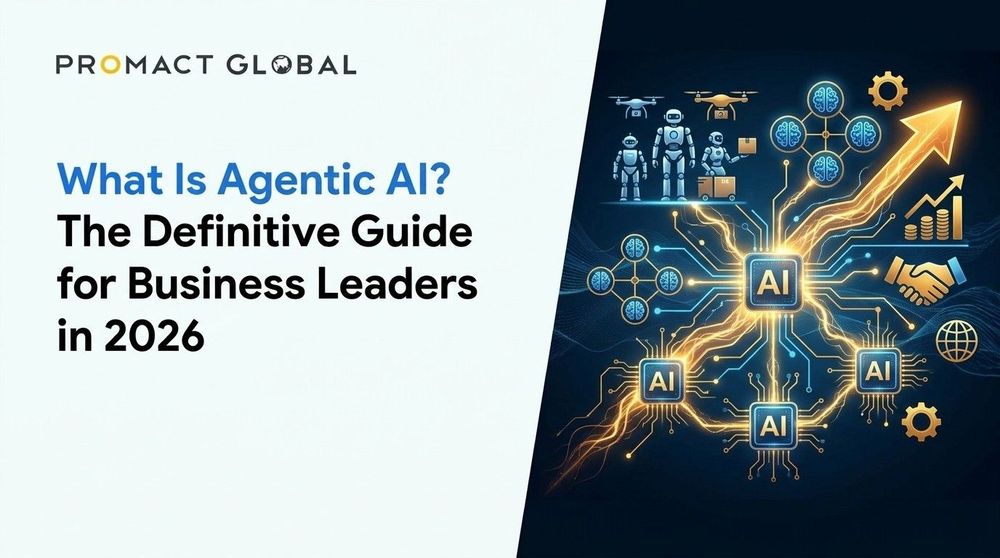
What Is Agentic AI? The Definitive Guide for Business Leaders in 2026
Introduction: Something Has Shifted in the Way AI Works
Most business leaders have already used a chatbot. You type a question, it replies, you ask a follow-up, it replies again. The interaction feels like a conversation, but underneath it, the AI is doing something fairly simple: it reads your input and produces an output. That is where the process ends.
Agentic AI is different. It does not wait for a question. It sets goals, makes decisions, runs tasks, uses tools, and keeps going until the job is done. Think less “answering machine” and more “digital colleague who works through the night without needing coffee.”
That might sound like hype, but the numbers back it up. Gartner predicts that 40% of enterprise applications will leverage task-specific AI agents by 2026, compared to less than 5% in 2025, according to the United States Artificial Intelligence Institute. That is an enormous jump in a very short window, and it is happening because the technology has crossed a threshold where it is genuinely useful, not just impressive in a demo.
This guide is written for business leaders who want to understand agentic AI for enterprise without getting buried in technical jargon. We will cover what it is, how it actually works, why it matters to your business, and how you can think about readiness before making any decisions.
What Is Agentic AI, Exactly?
At its core, agentic AI refers to artificial intelligence systems that can pursue goals over multiple steps, make independent decisions along the way, and take real actions in the world, such as browsing the internet, writing code, sending emails, updating databases, or calling external software tools.
The word “agentic” comes from “agency,” which means the capacity to act independently. When you give a traditional AI model a task, it produces a result. When you give an agentic AI system a goal, it figures out how to achieve it.
Here is a simple comparison. If you ask a standard AI, “Draft a report on our Q3 sales,” it will write that report based on whatever context you have given it. If you ask an agentic AI the same thing, it might pull data directly from your CRM, cross-reference it with your marketing platform, search for relevant industry benchmarks online, and then draft the report with live numbers and citations. It would do all of that on its own, without you guiding each step.
This shift from reactive to proactive is the heart of what agentic AI for enterprise is about.
How Agentic AI Actually Works
Understanding the mechanics helps you make smarter decisions. You do not need a computer science degree for this. Think of agentic AI as a system built around a few key behaviors.
Planning and Goal Decomposition
An agentic AI system receives a high-level goal and breaks it down into smaller tasks, similar to how a project manager reads a brief and turns it into a to-do list. This planning layer is what separates agents from standard AI models. It allows the system to handle complexity rather than just responding to a single prompt.
Tool Use
Agentic systems are connected to tools. These can include web browsers, code executors, file systems, APIs, calendars, email clients, and more. The ability to use external tools is what gives agents real-world reach. Without tools, an AI can only generate text. With tools, it can take action.
Memory
Unlike a standard chatbot that forgets everything once the conversation ends, many agentic AI systems have memory. They can remember previous interactions, store information about your business context, and build on past decisions. This is what allows them to handle long-running tasks that span hours or even days.
Feedback Loops and Self-Correction
A good agentic system does not just run forward blindly. It checks its own work. If a step fails or produces an unexpected result, the system can try a different approach. This self-correcting behavior is what makes agents reliable enough to operate without constant human supervision.
How Agentic AI Differs from Chatbots and Copilots
There is a lot of confusion in the market about where chatbots end and agentic AI begins. It helps to think of it as a spectrum.
A basic chatbot answers questions. It is reactive and single-turn. A copilot, like the kind embedded in many productivity tools today, assists a human in completing a task but still waits for the human to make each decision. An agentic AI system, by contrast, can take initiative, run multi-step processes, and operate with minimal human intervention.
The analogy that works well here is the difference between a GPS that gives you directions and a self-driving car that actually takes you there. Both use maps and route-planning logic, but only one removes you from the driving seat.
For enterprise purposes, this distinction matters because it changes the economics. A copilot saves a knowledge worker a few hours each week. An agent can potentially automate entire workflows, freeing up teams to focus on higher-value work.
Real-World Use Cases of Agentic AI for Enterprise
Theory only goes so far. Here is where agentic AI for enterprise is already showing up in practice.
Customer Support Operations
Instead of routing tickets to human agents for every issue, an agentic system can investigate the problem, look up account history, cross-check documentation, and resolve common issues autonomously. Only the complex or sensitive cases escalate to a human. Companies using this approach report significant reductions in average handling time and support costs.
Software Development
AI agents are being used to write code, run tests, identify bugs, and suggest fixes across large codebases. A developer can describe what they want to build in plain language, and the agent can handle much of the scaffolding and testing. This is particularly valuable for product engineering teams managing multiple projects at once, since it reduces the cognitive load on senior engineers.
Financial Operations and Reporting
Agents can pull financial data from multiple sources, reconcile discrepancies, flag anomalies, and generate reports automatically. What used to take a finance team several days at month-end can now happen in hours, with the agent running in the background.
HR and Talent Operations
From screening resumes to scheduling interviews to onboarding new employees, agentic AI can handle much of the administrative workflow that currently consumes HR teams. This does not replace human judgment in hiring decisions; it removes the repetitive coordination work that surrounds those decisions.
IT and Infrastructure Management
Agents can monitor systems, detect performance issues, and trigger automated responses without waiting for an on-call engineer. In some cases, they can diagnose and resolve incidents entirely on their own, reserving human intervention for situations that genuinely require it.
Why 2026 Is the Inflection Point
You might wonder why this is all happening now. The honest answer is that several things came together at roughly the same time.
Large language models became significantly more capable over the past two years. Models can now follow complex, multi-step instructions with a level of reliability that was not possible before. Alongside that, the tooling ecosystem for building agents matured. Frameworks like LangChain, AutoGen, and CrewAI made it practical for engineering teams to build agentic workflows without starting from scratch.
Cloud infrastructure also caught up. Running an agent that takes hundreds of actions in sequence requires significant compute, and the cost of that compute has dropped to the point where it is commercially viable for most businesses.
Put those three things together, and you get the conditions for a rapid adoption curve. The Gartner projection of 40% enterprise adoption by 2026 reflects exactly that. This is not a distant future. For many organisations, the decisions are happening right now.
What Enterprise Readiness Actually Looks Like
Knowing what agentic AI for enterprise can do is one thing. Knowing whether your organisation is ready to use it is another question entirely.
Data Quality and Accessibility
Agents are only as useful as the data they can access. If your systems are fragmented, your data is inconsistent, or your APIs are poorly documented, an agent will struggle. Before investing in agentic AI, audit your data infrastructure. Clean, well-structured, accessible data is the foundation.
Clear Process Definition
Agents work best when the task they are performing has a clear structure. If your team struggles to describe a workflow in plain language, an agent will struggle to execute it. The discipline of process documentation that helps agentic AI also benefits your team regardless of whether you adopt AI.
Human Oversight Design
The most successful agentic deployments we have seen treat human oversight as a feature, not an afterthought. Design your workflows so that humans are notified at key decision points, especially those involving sensitive data, customer interactions, or irreversible actions. The goal is not to remove humans from the loop entirely, but to put humans in the right parts of the loop.
Security and Compliance Frameworks
An agent that can take actions in the real world is also an agent that can make mistakes or be exploited if not properly secured. Organisations need to think about access controls, audit trails, and compliance requirements before granting agents broad permissions. This is especially important in regulated industries like finance and healthcare.
Team Readiness
Technology adoption fails more often because of people than because of technology. Your engineering teams need to understand how to build and maintain agentic systems. Your business teams need to understand how to work alongside them. Change management is as important as the technical build.
Common Misconceptions Worth Clearing Up
A few beliefs about agentic AI circulate widely and are worth addressing directly.
The first is that agents are autonomous and therefore uncontrollable. In reality, well-designed agentic systems have hard limits on what they can and cannot do. They operate within defined boundaries, and those boundaries are set by the teams that build them.
The second is that agentic AI will replace entire job functions overnight. The more accurate picture is gradual augmentation. Agents take on specific, well-defined tasks, which changes how humans spend their time but rarely eliminates roles entirely in the near term.
The third misconception is that agentic AI requires a massive investment to get started. Proof-of-concept projects can often be scoped tightly to test value in a specific workflow before any large-scale commitment. Starting small and building evidence is a more sustainable approach than a big-bang rollout.
How Software Product Engineering Companies Help Bridge the Gap
Most enterprises are not in the business of building AI systems from scratch. That is where specialist software and product engineering partners come in. A good engineering partner helps you move from “we want to explore agentic AI” to “we have a working system delivering measurable results.”
This involves more than writing code. It involves understanding your business workflows well enough to design agents that actually fit them, building with security and scalability in mind from day one, and setting up the monitoring and oversight mechanisms that keep agents operating reliably over time.
The difference between a successful agentic AI deployment and a failed one often comes down to the quality of that foundational engineering work. Cutting corners on architecture to ship fast tends to produce systems that break in production, erode trust, and get shelved.
At Promact Global, our approach to agentic AI for enterprise starts with understanding the specific problem before writing a single line of code. The best agentic systems are not the most technically sophisticated ones. They are the ones that solve the right problem in a way the team can trust and maintain.
A Practical First Step for Business Leaders
If you are a business leader reading this and trying to decide where to start, here is a useful frame. Identify one workflow in your organisation that is repetitive, rule-based, data-driven, and currently consuming significant human time. That is your starting point.
Document that workflow in enough detail that you could hand it to a new team member and they could follow it. Then ask whether an agent could follow the same steps. If the answer is yes, you have a candidate for a proof-of-concept project.
From there, the conversation about tools, infrastructure, and partners becomes much more grounded and practical. The goal of that first project is not to transform your organisation. It is to build confidence, surface the real constraints, and generate enough evidence to make smarter decisions about what comes next.
Conclusion: The Shift Is Underway
Agentic AI for enterprise is not a future trend. It is a present reality that is scaling rapidly. Business leaders who understand what it is, how it works, and what readiness actually requires are in a far better position to make decisions that generate real value rather than spending on AI projects that underdeliver.
The technology has matured enough to be genuinely useful. The question now is not whether agentic AI will change how businesses operate. It is whether your organisation will shape that change intentionally or react to it after the fact.
The leaders who treat this as a strategic question, not just a technology question, will be the ones who get the most from it.
Have a project like this in mind?
Tell us what you're building — we'll help you scope it and ship it.
Talk to usKeep reading

October 12, 2026
Hermes Goes Enterprise: What Nous Research's $90M Raise Means for Open-Source AI Agents at Work
October 11, 2026
One Agent to Rule Them All? What Google's Gemini Agent Means for Enterprise AI Strategy

October 10, 2026