
November 9, 2026
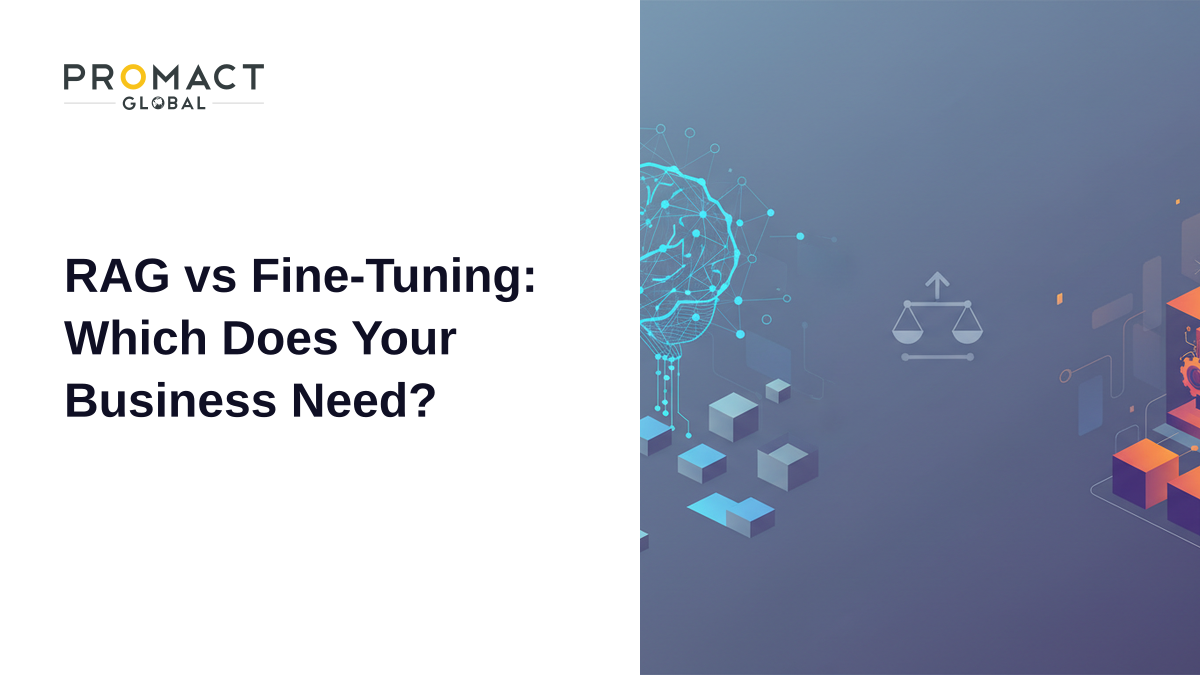
RAG vs Fine-Tuning: Which Does Your Business Need?
Use RAG (retrieval-augmented generation) when your AI needs to know things: current, private or frequently changing facts. Use fine-tuning when your AI knows enough but behaves badly: wrong tone, inconsistent format, or shaky reasoning on a narrow task. Most business projects should start with neither, then add RAG, and only reach for fine-tuning once a specific behavior problem survives.
That is the short answer to the RAG vs fine-tuning question. The rest of this guide explains why, shows how the two compare on cost, speed and risk, gives you a simple decision table, and ends with a checklist you can use before you commit budget.
What Is the Difference Between RAG and Fine-Tuning?
RAG leaves the model unchanged. At question time, a retrieval system finds relevant passages in your documents and places them in the prompt, so the model answers from that material. The idea was formalized in the 2020 paper by Lewis and colleagues, which combined a pre-trained model (its “parametric memory”) with a searchable index of documents (its “non-parametric memory”).
Fine-tuning changes the model itself. You train it further on your own examples so its weights shift toward the behavior you want. Modern techniques such as LoRA train small add-on matrices instead of the whole model. The authors report roughly 10,000 times fewer trainable parameters and about 3 times lower GPU memory than full fine-tuning of GPT-3 175B, which is a large part of why fine-tuning is far more accessible than it used to be.
A useful mental model: RAG is an open-book exam, and fine-tuning is extra schooling. One gives the model the right pages at the right moment. The other changes how it thinks and writes.
Which Problem Are You Actually Solving?
OpenAI’s guidance on optimizing LLM accuracy frames the choice as a diagnosis. Each failure is either a context problem (the model lacks or has outdated knowledge) or a behavior problem (the model has the knowledge but applies it inconsistently). RAG fixes context. Fine-tuning fixes behavior.
Context problems: reach for RAG
- Answers must reflect policies, prices or documents that change weekly.
- The model must use proprietary data it was never trained on.
- Users need to see which document an answer came from.
Behavior problems: consider fine-tuning
- Output must follow a strict format every time (a JSON schema, a report template, a claims summary).
- Brand voice or tone keeps drifting despite good prompts.
- A narrow, repetitive task needs higher accuracy, or the same accuracy from a smaller, cheaper model.
If you cannot say which kind of failure you have, you are not ready to choose. Build a small evaluation set of 50 to 100 real questions first and label each wrong answer as “missing knowledge” or “wrong behavior.” The pattern will usually make the decision for you.
Does Fine-Tuning Teach a Model New Facts?
Not reliably, and this is the most common misunderstanding. In a study titled Fine-Tuning or Retrieval?, Ovadia and colleagues compared unsupervised fine-tuning with RAG for injecting knowledge. They found that fine-tuning gave some improvement, but RAG consistently outperformed it, both for facts the model saw in training and for entirely new ones. They also note that models struggle to learn new factual information through fine-tuning.
OpenAI’s guidance points the same way: it positions fine-tuning as a fix for behavior (format, tone, consistency) and RAG as the fix for missing or outdated knowledge. If your goal is “make the assistant know our product catalog,” RAG is almost always the right tool. If your goal is “make it answer in our house style, every time,” fine-tuning earns its place.
RAG vs Fine-Tuning: Side-by-Side Comparison
| Factor | RAG | Fine-tuning |
|---|---|---|
| Best for | Current, private, changing knowledge | Consistent behavior, format, tone |
| What changes | The prompt (retrieved context) | The model’s weights |
| Updating knowledge | Update the documents; no retraining | Retrain with new data |
| Source citations | Natural: you know which passages were used | Hard: knowledge is baked into weights |
| Upfront effort | Build ingestion, chunking, search | Curate training examples, run training, evaluate |
| Ongoing cost | Retrieval infrastructure plus longer prompts on every call | Hosting a custom model; shorter prompts can lower per-call cost |
| Main risk | Poor retrieval returns the wrong passages | Overfitting, stale knowledge, data-prep cost |
| Time to first result | Days to weeks | Weeks, mostly spent on data quality |
The cost row deserves a caveat: figures quoted online vary widely and are mostly vendor estimates, so use the shape rather than the numbers. Fine-tuning is front-loaded (data preparation and training), while RAG is recurring (every request carries retrieved text, and the search layer needs running and tuning). Your own query volume decides which curve is cheaper.
How Much Does Each Approach Cost?
Rather than quote unreliable price tags, here is where the money actually goes:
- Data work. For fine-tuning, assembling clean, representative examples is usually the largest hidden cost. OpenAI advises that training-data quality matters more than quantity and suggests starting with around 50 examples. For RAG, the equivalent work is cleaning, structuring and indexing your documents.
- Evaluation. Both need a test set. Skipping it is the most expensive shortcut in AI projects.
- Run costs. RAG adds retrieval infrastructure and longer prompts. Fine-tuning adds model hosting and retraining each time requirements change.
- Maintenance. RAG needs fresh documents and monitoring of retrieval quality. Fine-tuned models need re-evaluation whenever the base model or your process changes.
Can You Use RAG and Fine-Tuning Together?
Yes, and sometimes you should. In a Microsoft-led study of an agriculture use case, fine-tuning improved accuracy by more than 6 percentage points, and RAG added about 5 further points on top, so the gains were cumulative. OpenAI describes the methods as additive rather than exclusive: fine-tuning can replace long instructions and examples, while RAG supplies current information.
Combining them is not automatic, though. OpenAI’s own example shows that adding RAG to an already fine-tuned model lowered a translation score from 87 to 83, because the model had learned the task and the extra context added noise. Test the combination against your evaluation set instead of assuming it helps.
What About Prompt Engineering?
Both approaches come after prompt engineering. OpenAI calls it “typically the best place to start,” because it is the cheapest and fastest lever and sometimes the only one you need for tasks like summarization or translation. Its limit is scale: very long prompts get unwieldy and models can miss details buried in the middle.
A practical order of operations:
- Write a clear prompt and build your evaluation set.
- If failures are about missing knowledge, add RAG.
- If failures are about format, tone or consistency, add fine-tuning.
- If both appear, combine them and measure.
A Decision Table for Business Teams
| Your situation | Start with | Why |
|---|---|---|
| Internal assistant answering from HR, policy or product documents | RAG | Knowledge changes and answers need sources |
| Customer-support bot that must match your brand voice | Prompting, then fine-tuning if tone still drifts | It is a behavior problem |
| Extracting fields from invoices or contracts into a fixed schema | Fine-tuning (after prompting) | Repetitive, format-sensitive task |
| Regulated environment where every answer needs an audit trail | RAG | Retrieved passages give you provenance |
| High-volume, narrow task where cost per call matters | Fine-tune a smaller model | Shorter prompts and a smaller model can cut run costs |
| Agent that needs both live data and strict output formats | Hybrid | Knowledge in retrieval, behavior in weights |
Where Does Promact Fit In?
Choosing between these approaches is a data and architecture question before it is a model question. Promact’s AI, data and analytics services cover AI model development and data engineering, the two skills these projects depend on: getting your data into a shape a model can use, and evaluating whether the result is good enough to trust.
Two earlier Promact articles are worth reading alongside this one. Promact’s work with Cohere’s embeddings explains how scattered documents become searchable knowledge, the foundation of any RAG system. And why fine-tuned open-source models are beating the giants covers the cost and control case for fine-tuning smaller models.
The retrieval layer is also becoming a strategic asset in its own right. Our look at why the knowledge layer beats the model shows how much of enterprise AI quality depends on what the model is given, not just which model you choose. If hallucinations are your worry, the hallucination tax covers verification on top of either approach.
Frequently Asked Questions
Is RAG better than fine-tuning?
Neither is better in general. RAG is better for knowledge that changes or must be cited, and fine-tuning is better for consistent behavior, format or tone. Research on knowledge injection found RAG outperformed fine-tuning for adding facts.
Is RAG cheaper than fine-tuning?
It depends on volume. RAG usually has a lower upfront cost but adds retrieval infrastructure and longer prompts to every request. Fine-tuning costs more up front, mainly in data preparation, and can lower per-request cost for steady, high-volume tasks.
Can I use RAG and fine-tuning together?
Yes. Studies and vendor guidance show the gains can be additive, but not always, so test the combination on your own evaluation set before committing.
Does RAG stop hallucinations?
No. RAG gives the model better context and makes answers easier to verify, but poor retrieval can still produce wrong or unsupported answers. Keep human review and automated checks in place for high-stakes use.
Should I try prompt engineering first?
Yes. It is the fastest and cheapest option, and OpenAI recommends starting there and building an evaluation set before adding RAG or fine-tuning.
Conclusion: Your Next Steps
- Diagnose first. Label 50 to 100 real failures as missing knowledge or wrong behavior.
- Exhaust prompting. Improve prompts and examples before adding complexity.
- Add RAG for knowledge problems. Clean and structure your documents, then measure retrieval quality as carefully as answer quality.
- Fine-tune only for behavior problems. Use a small set of high-quality examples and a hold-out set to catch overfitting.
- Measure the combination. Never assume hybrid beats either approach alone.
Sources
- OpenAI: Optimizing LLM accuracy - official guidance on prompting, RAG and fine-tuning
- Ovadia et al.: Fine-Tuning or Retrieval? Comparing Knowledge Injection in LLMs - RAG vs unsupervised fine-tuning for new knowledge
- Balaguer et al.: RAG vs Fine-tuning: Pipelines, Tradeoffs, and a Case Study on Agriculture - cumulative gains from combining both
- Lewis et al.: Retrieval-Augmented Generation for Knowledge-Intensive NLP Tasks - the original RAG paper (NeurIPS 2020)
- Hu et al.: LoRA: Low-Rank Adaptation of Large Language Models - efficient fine-tuning technique
Have a project like this in mind?
Tell us what you're building — we'll help you scope it and ship it.
Talk to us