October 27, 2026
Employee ID Included: What SK Telecom's AI Governance Report Means for Managing Agents Like Staff
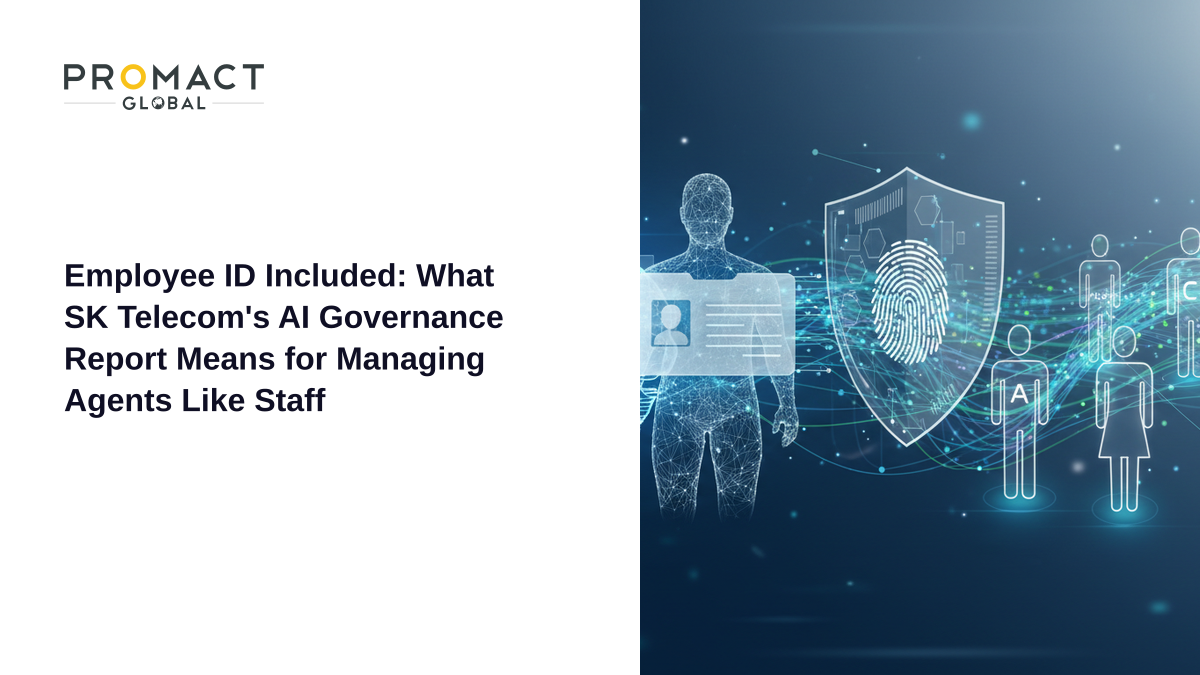
On October 26, 2026, SK Telecom published its first AI Governance Report, and one line in it deserves attention from every executive running AI agents. The South Korean carrier says it now treats AI agents as “a new form of labor”. Each in-house agent gets an employee ID number, a named human supervisor, a performance record, and, if it stops earning its keep, a formal retirement.
It’s an unusual choice of words for a telecom’s compliance document. Most companies still describe agents as software: something to deploy, patch and forget. SK Telecom is describing them as staff to onboard, supervise, review and eventually let go.
In this post we look at what SK Telecom actually announced, why the HR-style model is a practical answer to a real governance gap, where it falls short, and how a mid-sized business can borrow the idea without a Korean telecom’s budget.
What SK Telecom Actually Announced
According to Seoul Economic Daily’s coverage, the report covers the company’s AI governance principles, accountability framework, action plans and results. The agent-management portion includes several concrete commitments:
- Employee IDs for agents. Every in-house agent receives an ID number, as human staff do. The company tracks each agent’s role, designated supervisor, operating status and performance.
- Seniority-matched supervision. Agents with greater impact or autonomy must be overseen by a team leader or executive, not a rank-and-file employee.
- Tighter approvals. Human review and approval procedures are being tightened for more autonomous agents, alongside monitoring of token usage and work records.
- An agent operating system. Agents built and run in different environments are managed under consistent standards.
- Performance-based retirement. Agents judged less necessary after evaluation are suspended or retired.
- Performance as a KPI. The company is reviewing whether to share agent performance with employees first, and possibly fold it into organizational KPIs over the longer term.
SK Telecom’s chief privacy officer, Cha Ho-beom, described the planned framework as covering agent identification, supervisor designation, access control, evaluation and monitoring, and suspension or retirement. That’s a lifecycle, and it mirrors how a company manages a human hire from onboarding to offboarding.
One caveat: the English-language article was machine-translated from Korean, so exact quotes may differ slightly from the original wording. The substance, however, is consistent across the coverage we found.
Why the Employee Metaphor Works
Agents already behave like staff, even if we call them software
Agents log in to systems, hold credentials, read sensitive data, send messages and trigger transactions. Anthropic’s new Claude Duet research preview, opened on October 21, checks connected accounts in the background and surfaces things that need attention. Even so, it is built to pause for approval before sending messages, making payments, signing documents or deleting anything. Approval gates are a supervisor’s job in human terms.
The more agents act like colleagues, the less sensible it is to manage them with tooling designed for static applications.
The scale problem is an identity problem
We have written before about how AI agents now outnumber employees in many enterprises. When agents multiply faster than anyone can count them, the first failure is simple: nobody knows what exists, who owns it, or what it can touch. An employee ID is a mundane answer to that, and mundane is the point. A registry with an owner for every entry is the foundation everything else depends on.
Accountability needs a named human
The most useful rule in SK Telecom’s report is probably the simplest: autonomy and seniority of oversight scale together. A low-risk summarization agent can answer to a team lead. An agent that touches customer accounts or money needs an accountable executive. Without that link, “the AI did it” becomes an organizational shrug.
The Standards Gap the Metaphor Papers Over
An employee ID solves the internal identity question. It does not solve what happens when agents talk to other companies’ agents, and that part is still unsettled.
A recent WorkOS analysis of agent-to-agent SSO makes the point plainly. Okta took Agent SSO, Agent-to-Agent Connections and Resource Access Certifications to general availability on September 22, 2026, but the underlying IETF draft for the protocol behind it is not ratified. Google’s A2A protocol leaves cross-organization credential provisioning out of scope, and WorkOS counts six vendors shipping competing agent identity products with different architectures.
The practical gaps WorkOS highlights are:
- Delegation chains. OAuth authenticates a session rather than individual messages. When a token passes through several agents, there is often no cryptographic proof of who sent a given request.
- Audit trails. It can be hard to tell which agent in a chain started a sensitive action. Without tracing and structured logging from the start, auditing a multi-agent workflow turns into manual reconstruction.
So the HR metaphor is a good operating model, but it is not a substitute for technical identity controls. Think of the employee ID as the org-chart layer and standards-based credentials as the badge reader.
Why Governance Is Now a Business Risk, Not a Compliance Chore
Gartner’s widely cited 2025 forecast says more than 40% of agentic AI projects will be cancelled by the end of 2027, pointing to rising costs, unclear business value and inadequate risk controls. The same coverage notes Gartner’s estimate that only about 130 of the thousands of vendors claiming agentic capabilities are real, a problem it calls “agent washing.”
Treating agents as managed workers speaks to all three drivers at once. Performance reviews expose which agents deliver value. Token and work-record monitoring exposes cost. Supervisor assignments and tiered approvals are the risk controls. Our earlier piece on the agent fleet era argues that governance, not model quality, is what separates the fleets that scale from the ones that stall. SK Telecom’s report is a public example of that thesis in practice.
Where the Model Has Limits
Be careful not to over-borrow the metaphor.
- Agents don’t have judgment in the human sense. A human employee who senses something is wrong can stop and ask. An agent may not. Approval gates must be designed in, not assumed. Our guide to keeping a human in control with the “Approve” button covers how.
- Agent KPIs can mislead. Tying agent performance to team KPIs risks rewarding volume over quality. SK Telecom itself says it is only reviewing this idea.
- Responsibility can’t be delegated to an agent. Calling an agent a “worker” must never imply it can be held accountable. The supervisor is.
- It’s a plan, not proof. The report describes policy and intent. We found no independent audit of how well it works in practice.
A Practical Playbook: Borrowing the Idea at Any Scale
You don’t need 90,000 agents to adopt the approach. Here is a starting sequence for a small or mid-sized company.
1. Build the registry first
List every agent in use: those your team built, and those embedded in vendor software. Record its purpose, owner, systems it can access and the data it can read. If you can’t list them, you can’t govern them.
2. Name a supervisor for each agent
One accountable human per agent, with seniority matched to the agent’s reach. Write it down. Our digital employee playbook walks through onboarding a first agent along these lines.
3. Tier your approvals
Decide which actions an agent may take alone (drafting, summarizing), which need human approval (sending external messages, spending money) and which are off-limits regardless (moving funds, deleting records).
4. Review on a schedule
Quarterly is a good start. Check cost, error rates, incidents and whether the agent is still needed. Retire the ones that aren’t, and revoke their credentials when you do.
5. Log for audit from day one
Capture which agent acted, on whose behalf, with which permissions. Retrofitting this is painful, as the delegation-chain problem above shows.
Conclusion
SK Telecom’s report is notable less for its technology than for its framing. By giving agents IDs, supervisors, reviews and retirement dates, it replaces a vague “AI governance” aspiration with a lifecycle that managers already understand. Its limits are real: internal identity is not the same as cross-company trust, the standards are still moving, and the report is a statement of intent rather than a result.
Actionable takeaways:
- Inventory every agent and assign a human owner this month.
- Match supervisor seniority to agent autonomy and impact.
- Define three approval tiers: autonomous, approve-first, and prohibited.
- Put agents on a review-and-retire cycle with a cost check.
- Log agent actions and delegation from the start, and watch the agent identity standards before locking in a vendor.
Frequently Asked Questions
Did SK Telecom really give AI agents employee ID numbers?
According to Seoul Economic Daily’s coverage of its first AI Governance Report, yes. Each in-house AI agent receives an employee ID, and the company tracks its role, supervisor, operating status and performance.
Does this mean AI agents are legally employees?
No. The report describes an internal management approach and treats agents as “a new form of labor” for governance purposes. We found nothing suggesting agents have legal employment status, and a human supervisor remains accountable.
Why do more autonomous agents need more senior supervisors?
The greater an agent’s autonomy and impact, the larger the potential damage from a mistake. SK Telecom requires a team leader or executive, not a rank-and-file employee, to oversee those agents, so accountability sits with someone who has authority to act.
Is an agent registry enough for governance?
No. A registry and named owners handle internal accountability, but you still need technical controls such as scoped credentials, approval gates and audit logs. Cross-company agent identity standards are also still unsettled.
How can a small company start?
Begin with a simple spreadsheet listing every agent, its owner, the systems it can access and its approval tier. Add a quarterly review. That covers the core of the SK Telecom model without special tooling.
Sources
- Seoul Economic Daily: SK Telecom Issues First AI Governance Report - Primary coverage of the report, including agent IDs, supervisors and retirement rules
- WorkOS: Agent-to-Agent SSO - Analysis of delegation-chain, audit and standards gaps in agent identity
- VKTR: Claude Duet previews an AI agent that messages you first - Details of Anthropic’s Claude Duet preview and its approval rules
- Outlook Business: Over 40% of Agentic AI Projects Will Be Scrapped by 2027, Says Gartner - Report on Gartner’s agentic AI cancellation forecast
- AI Agent Store: Daily AI Agent News, October 26, 2026 - Aggregated news roundup mentioning the report and token-use monitoring
Have a project like this in mind?
Tell us what you're building — we'll help you scope it and ship it.
Talk to usKeep reading
October 30, 2026
Akamai Agent Sandbox: Why AI-Written Code Needs a Boundary
October 29, 2026
Only 0.229: What Cisco's New Agentic Security Benchmark Reveals About AI Agents and Vulnerability Detection
October 26, 2026