
August 10, 2026
AI Agent Sprawl: Why 94% of Enterprises Are Losing Control of Their Own AI Agents
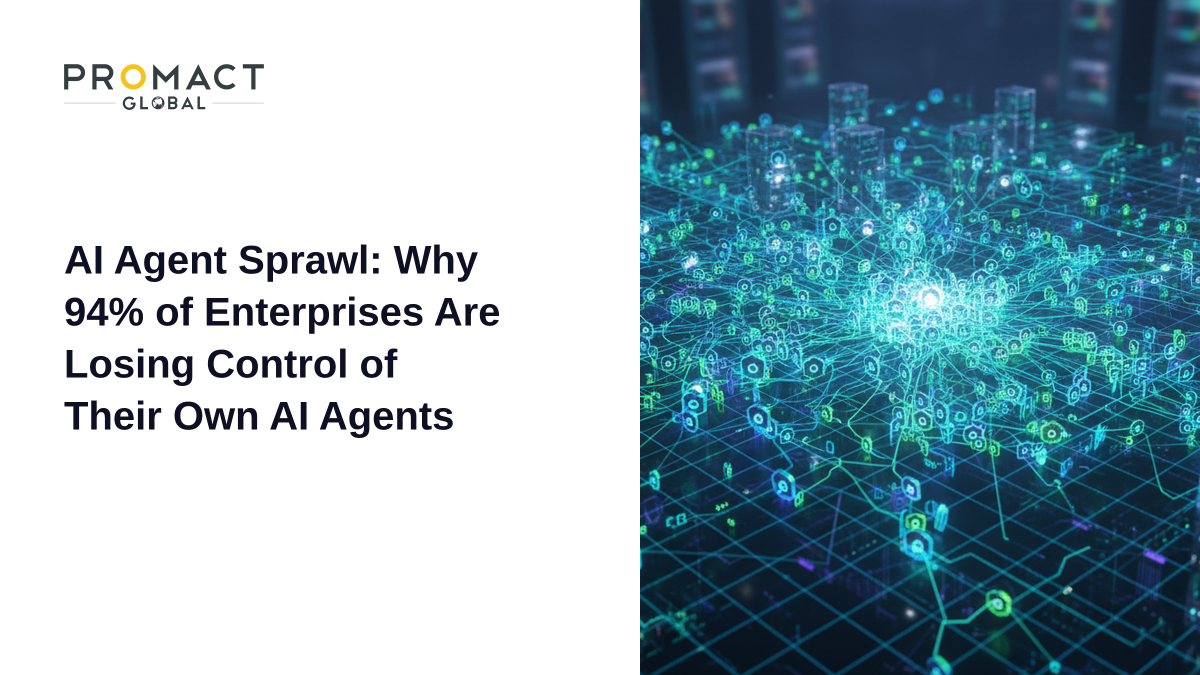
Enterprises spent the last two years racing to deploy AI agents. Now they’re facing the bill for doing it without a plan. A new global survey from OutSystems found that 96% of organizations are already running AI agents in some form — and 94% of those same organizations are worried about the sprawl that’s resulted. Agents built by different teams, bought from different vendors, and embedded inside different SaaS products are piling up faster than anyone can track them, let alone govern them.
This isn’t a hypothetical future risk. It’s the operational reality inside most mid-size and large companies right now, and it’s distinct from the “shadow AI” problem of employees quietly pasting data into unsanctioned chatbots — a risk we covered in our look at shadow AI in the workplace. Agent sprawl happens even when everything is officially sanctioned. This post breaks down what’s driving it, what it’s actually costing businesses, and the concrete steps enterprises are taking to bring their agent fleets back under control.
What “AI Agent Sprawl” Actually Means
Agent sprawl is the uncontrolled proliferation of AI agents across an organization — some custom-built by internal teams, some bundled into procured software, some spun up by individual departments to solve a local problem — without a shared inventory, ownership model, or security standard governing any of them. According to OutSystems’ 2026 State of AI Development report, 38% of enterprises are now mixing custom-built and pre-built agents in the same environment, which makes standardizing permissions and monitoring dramatically harder than when agents came from a single source.
It’s a close cousin of “context sprawl” — the related problem of agent memory, prompts, and retrieved data scattering across disconnected systems with no single source of truth. As Atlan’s research on the topic explains, both problems compound each other: an ungoverned agent operating on ungoverned context is very hard to audit after the fact, which is exactly when audits matter most.
Why It’s Different from the Governance Bottleneck You’ve Already Heard About
We’ve written before about how governance has become the real bottleneck slowing down enterprise agent programs generally. Sprawl is the specific, measurable symptom of that bottleneck failing to keep pace. It’s not that companies lack governance intentions — it’s that the number of agents in production is growing faster than any governance process built for a handful of pilots can absorb.
The Numbers Behind the Sprawl
The scale of the shift explains why sprawl caught so many organizations off guard. Gartner predicts that 40% of enterprise applications will ship with task-specific AI agents built directly into them by the end of 2026, up from less than 5% just a year earlier — an eightfold jump that Gartner itself describes as faster than the adoption curves of cloud computing or mobile-first software. Every one of those embedded agents is a new entity with its own permissions, data access, and behavior that IT and security teams often don’t choose or explicitly approve — it simply arrives bundled with a tool the business already licenses.
Layer that on top of internally built agents and the picture gets messier still. OutSystems’ research also found that only 12% of enterprises have implemented a centralized platform to manage their agent sprawl, while 66% of leaders say building human-in-the-loop checkpoints into their agent workflows is technically difficult. Most organizations are governing agents team-by-team and region-by-region, which is precisely the kind of fragmented approach that makes standardized oversight nearly impossible at scale, according to TechHQ’s reporting on the governance gap.
Why Sprawl Happens — And Why It’s Accelerating
Three forces are driving the growth curve simultaneously:
Vendor-embedded agents are becoming the default, not the exception. As Gartner’s forecast shows, software vendors are racing to ship agent capabilities inside their existing products, which means every renewal or new SaaS purchase can quietly add another agent to your environment without a dedicated “AI project” ever being greenlit.
Departmental agents outpace central IT’s ability to track them. Marketing, sales, and support teams increasingly build or configure their own task-specific agents using low-code and no-code platforms, often without looping in security or data governance — a dynamic that closely mirrors the environment we described in our guide to the 10-minute AI risk audit.
There’s no default “single manager” for multi-agent environments. When an enterprise ends up running dozens of independent agents instead of a smaller number of coordinated ones, complexity compounds. That’s the exact case we made for centralizing coordination through a manager pattern in our piece on the orchestrator agent — without that layer, each new agent adds its own blind spot rather than plugging into a shared one.
What Sprawl Actually Costs a Business
Unmanaged sprawl isn’t just an aesthetic or organizational headache — it creates three concrete categories of risk.
Security and Data Exposure
Every ungoverned agent is a credentialed entity with some level of access to systems and data. Leading AI governance vendors now argue that every AI agent should be treated as a distinct security principal with its own credentials, explicit permissions, and a documented lifecycle — the same discipline applied to human employee accounts. Most enterprises are nowhere close to that standard today, which is a direct extension of the exposure we outlined in our earlier post on AI agent security risks businesses are ignoring.
Technical Debt
Redundant agents solving overlapping problems, built on inconsistent frameworks, with no shared observability, accumulate into technical debt in the same way redundant microservices or shadow databases do. Fixing it later — consolidating, re-permissioning, and documenting agents that were never inventoried in the first place — costs far more than governing them from the start.
Regulatory Exposure
Sprawl also creates compliance blind spots at the exact moment regulation is tightening. The EU AI Act’s high-risk system obligations became enforceable on August 2, 2026, and non-compliance can trigger fines of up to €15 million or 3% of global annual turnover, whichever is higher. An enterprise that can’t produce a full inventory of which agents are making which decisions, using what data, is not in a position to demonstrate compliance — a gap we detailed in our EU AI Act compliance guide for SaaS businesses.
How Enterprises Are Getting Ahead of It
The organizations managing sprawl successfully are converging on a similar playbook, built around three practices.
Build a Single Agent Registry
Governance platforms emerging in 2026 — from Credo AI’s Agent Registry to Google’s Gemini Enterprise Agent Platform — center on the same core idea: a single system of record listing every agent in the enterprise, who owns it, what tools and data it can touch, and when it was created or last modified. Without that baseline inventory, none of the following steps are possible.
Add Human-in-the-Loop Checkpoints Where They Matter Most
Rather than gating every agent action, mature programs focus checkpoints on the decisions with the highest consequence — financial transactions, customer-facing communications, and anything touching regulated data. This is harder to build than it sounds, which is why two-thirds of leaders in the OutSystems survey flagged it as a technical challenge, but it’s also the single control that most directly reduces both security and compliance risk.
Consolidate Toward Fewer, Coordinated Agents
Instead of letting every department stand up its own point-solution agent, leading enterprises are consolidating overlapping capabilities into shared, orchestrated agent systems with clear ownership — reducing the total surface area that needs to be governed in the first place.
Actionable Takeaways
If your organization hasn’t formally inventoried its AI agents yet, treat that as the starting line, not a nice-to-have. Start with three moves this quarter: run a full audit of every agent currently active in your environment, including ones bundled into SaaS tools you didn’t originally think of as “AI products”; assign a named owner and documented permission set to each one; and identify the handful of high-stakes decision points across your agent fleet that genuinely need a human checkpoint before you try to gate everything at once. Agent sprawl isn’t going to reverse itself — the tools generating it are shipping new capabilities every quarter — so the enterprises that get a registry and ownership model in place now will spend far less fixing the problem later than the ones who wait for an incident to force the issue.
Frequently Asked Questions
What’s the difference between AI agent sprawl and shadow AI?
Shadow AI refers to employees using unsanctioned AI tools outside of official channels. Agent sprawl happens even with fully sanctioned tools — it’s the uncontrolled growth of officially deployed and vendor-embedded agents across an organization without centralized tracking or governance.
How many AI agents does the average enterprise actually have?
Most enterprises don’t know precisely, which is part of the problem. Surveys show 96% of organizations already use AI agents in some capacity, and over a third are mixing custom-built and vendor-supplied agents, but fewer than 1 in 8 have a centralized system tracking them all.
Is agent sprawl mainly a security problem or a compliance problem?
Both. Security risk comes from ungoverned agents holding credentials and data access nobody is tracking. Compliance risk comes from being unable to demonstrate, to a regulator, exactly which agents made which decisions using what data — a requirement that’s now legally binding for high-risk systems under the EU AI Act.
Do small and mid-size businesses need to worry about this, or is it only a large-enterprise issue?
Smaller businesses adopt fewer agents but also typically have far less governance infrastructure, so the relative risk can be just as high. A five-person team running three ungoverned agents has the same fundamental blind spot as an enterprise running three hundred.
What’s the first practical step a company should take?
Build a complete inventory of every AI agent currently active in the business, including agents embedded inside purchased software, before attempting any policy or tooling changes. You cannot govern what you haven’t counted.
Will new regulation force companies to fix agent sprawl?
It’s accelerating the timeline. The EU AI Act’s transparency obligations (disclosing AI interactions, labeling synthetic content) became enforceable on August 2, 2026, and while the Act’s separate high-risk-system requirements were pushed back to December 2027 under the AI Omnibus, similar disclosure and oversight expectations are emerging in other jurisdictions — so the ability to inventory and explain your agent fleet is quickly becoming a compliance requirement rather than an optional best practice.
Sources
- Agentic AI Goes Mainstream in the Enterprise, but 94% Raise Concern About Sprawl, OutSystems Research Finds - BusinessWire coverage of OutSystems’ 2026 State of AI Development report and its sprawl findings.
- OutSystems 2026 Enterprise AI Agent Report - Original OutSystems research page with adoption and governance statistics.
- Gartner Predicts 40% of Enterprise Apps Will Feature Task-Specific AI Agents by 2026 - Gartner’s forecast on embedded agent growth in enterprise software.
- Agent Sprawl and Context Sprawl: Causes, Risks, Fix - Atlan’s technical breakdown of what drives agent and context sprawl.
- Agentic AI Governance Is the CIO’s Most Urgent Blind Spot - TechHQ reporting on the governance gap behind enterprise agent adoption.
- Best AI Agent Governance Platforms in 2026: 8 Compared - Comparison of agent registry and governance platform approaches.
- Commission starts enforcing AI Act rules and new transparency requirements on 2 August - European Commission’s official notice on which AI Act obligations became enforceable August 2, 2026.
Have a project like this in mind?
Tell us what you're building — we'll help you scope it and ship it.
Talk to usKeep reading
October 12, 2026
Hermes Goes Enterprise: What Nous Research's $90M Raise Means for Open-Source AI Agents at Work
October 6, 2026
Patch in Minutes, Not Months: How AI Agents Are Breaking Open-Source Security Embargoes
October 5, 2026