August 13, 2026
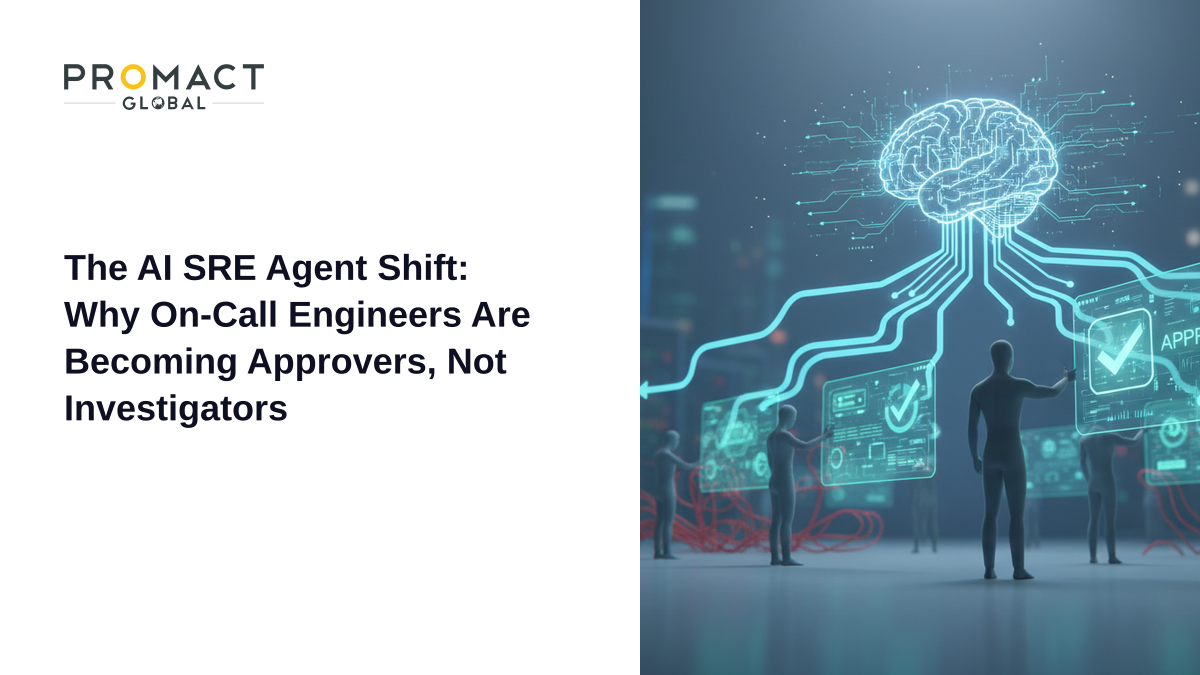
The AI SRE Agent Shift: Why On-Call Engineers Are Becoming Approvers, Not Investigators
It used to be simple: something breaks in production, a pager goes off, and a human being spends the next twenty minutes squinting at dashboards trying to figure out what changed. In the last twelve months, that job has quietly started disappearing. Not because outages stopped happening, but because the first responder to most of them is no longer a person.
Between March and July 2026, every major observability and cloud platform — Amazon, Microsoft, Datadog, New Relic, Dynatrace, and PagerDuty — shipped an autonomous “SRE agent” that investigates incidents, correlates telemetry, and in a growing number of cases, fixes the problem before anyone gets paged. This isn’t another incremental AIOps dashboard. It’s a structural change to who — or what — does the first hour of every incident, and it has implications well beyond the infrastructure team, echoing the same governance questions Promact has raised around enterprise AI governance becoming the real bottleneck.
This post covers what actually shipped, the numbers behind the shift, and what it means for how engineering teams should structure on-call, approvals, and accountability going forward.
The Convergence: Every Major Vendor Shipped an SRE Agent in 2026
The timing is the story here. Six vendors that normally compete on dashboards and alerting all converged on the same idea within a few months of each other.
Datadog moved first, taking Bits AI SRE to general availability on December 2, 2025 — an agent that investigates alerts using telemetry, architecture, and organizational context to surface root cause in minutes rather than having an engineer piece it together manually.
Microsoft followed with Azure SRE Agent reaching general availability on March 10, 2026. At GA, Microsoft disclosed the results of running the agent across its own internal services first: 1,300+ agents deployed, 35,000+ incidents mitigated, and over 20,000 engineering hours saved every month — the dogfooding data that shaped the product before it reached customers. Notably, Azure SRE Agent doesn’t stay in its own lane — it can call a customer’s Datadog MCP Server or New Relic MCP Server directly, pulling in logs and metrics from competing platforms to diagnose an issue.
New Relic announced its own SRE Agent at its Advance 2026 event in March, as part of a broader Intelligent Observability push. The company’s 2026 AI Impact Report, built from aggregated data across 6.6 million platform users, found that AI-enabled accounts achieved 2x higher correlation rates and 27% less alert noise than non-AI accounts, and resolved issues roughly 25% faster on average — a gap that widened to nearly double during peak-load periods.
Amazon’s entry, AWS DevOps Agent, reached general availability on March 31, 2026, built on Amazon Bedrock AgentCore. It’s already in production at Western Governors University, T-Mobile, and Zenchef, and it’s priced by the second the agent spends actually working an incident rather than as a flat subscription — a signal that vendors expect this to be judged on measurable time saved, not seat count.
PagerDuty, the incumbent in the on-call space, used its Spring 2026 platform release to reposition its SRE Agent as a “virtual responder” that can be added directly to on-call schedules and escalation policies, using the Model Context Protocol to reach into a customer’s full stack.
And on July 27, 2026, Dynatrace announced its own Autonomous SRE Agent and Cloud SRE Agent, the latter coordinating remediation across AWS, Azure, and Google Cloud simultaneously, alongside a no-code Agent Builder for teams that want to define their own automated responders.
Six vendors, one thesis: the first responder to a production incident is becoming software, not a person holding a laptop at 3 a.m.
What These Agents Actually Do — and Where the Line Still Sits
Strip away the branding and the pattern across all six products is the same three-step loop: detect, investigate, propose (or execute) a fix.
Detection and triage. The agent watches telemetry — metrics, logs, traces, deployment events — continuously, rather than waiting for a threshold alert. It correlates signals across services to figure out whether five different alerts are actually one incident.
Root-cause investigation. Instead of an engineer manually tracing a request across a dozen microservices, the agent traces the causal chain itself, cross-referencing recent deployments, known error patterns, and topology to generate a ranked list of likely causes.
Remediation. This is where the products diverge, and where the real governance question lives. Some actions — restarting a pod, scaling a service, rolling back a deployment — are common enough and low-risk enough that agents increasingly execute them directly. Higher-risk changes still route to a human for sign-off, which is exactly the “approve, don’t do” boundary Promact wrote about in The “Approve” Button: How to Keep Human Control Over AI in Modern Businesses. PagerDuty’s own rollout reflects this caution directly: its SRE Agent launched with early access as a “virtual responder” in Q2 2026, and only reaches early access as a “fully autonomous responder” — one that can act without a human in the loop — in the second half of 2026.
The Numbers Behind the Shift
The scale of this shift isn’t speculative — it shows up in the adoption data. Gartner forecasts that 40% of enterprise applications will feature task-specific AI agents by the end of 2026, up from less than 5% just a year earlier — an eightfold jump Gartner calls one of the fastest enterprise technology transitions since the arrival of the public cloud.
That forecast lines up with what the vendors themselves are reporting. Microsoft’s 20,000+ engineering hours saved per month running Azure SRE Agent internally, and New Relic’s 25% faster issue resolution across millions of accounts, both point in the same direction: the agent isn’t replacing the investigation step so much as compressing it from tens of minutes to single-digit minutes, freeing engineers to spend on-call time on judgment calls instead of log-grepping.
From Investigator to Approver: The New On-Call Job
The practical effect inside engineering teams is a role change, not a headcount change — at least so far. Engineers who used to spend the first 20 minutes of an incident gathering context now spend that time reviewing a summary an agent already assembled, and deciding whether to approve its proposed fix. That’s a meaningfully different skill: less “can I find the bug in the logs,” more “do I trust this diagnosis enough to click go.”
It’s the same shift Promact described in The Digital Employee Playbook: How to Onboard Your First AI Agent — the useful mental model isn’t “we bought a monitoring feature,” it’s “we hired a new team member who happens to run 24/7 and needs an onboarding plan, a scope of authority, and a manager who reviews its work.” Teams that treat an SRE agent as just another dashboard widget tend to either under-trust it (ignoring its diagnoses and doing the work manually anyway, wasting the investment) or over-trust it (letting it execute changes nobody fully understands until something goes wrong at 3 a.m. for a different reason).
The Governance Question Nobody’s Answering Yet
Here’s the part that should worry platform and security teams more than it currently does: several of these agents now reach across tool boundaries by design. Azure SRE Agent calling into a customer’s Datadog or New Relic MCP Server, or PagerDuty’s SRE Agent using MCP to touch observability tools, internal developer platforms, and CI/CD pipelines in the same investigation, means a single incident response can now involve four or five autonomous agents from different vendors acting inside the same production environment.
That’s precisely the failure mode Promact flagged in AI Agent Sprawl: Why 94% of Enterprises Are Losing Control of Their Own AI Agents — permissions and audit trails multiplying faster than any single team can track them. An SRE agent with write access to your infrastructure is a more consequential blast radius than a chatbot with read access to your wiki, and most organizations don’t yet have a clear answer for who owns the incident record, or the liability, when two autonomous agents from two different vendors both touch the same remediation — and it gets sharper, not softer, once the agent in question can restart production services on its own.
What This Means for Your Team
If your organization is evaluating one of these tools — or already has one running in a “read-only” mode without much oversight — a few practical steps matter more than picking the “best” vendor:
Start read-only, and time-box the escalation. Every vendor above ships a diagnosis-only mode before an execute mode for a reason. Run it there first, measure how often its root-cause calls match what your engineers independently find, and only extend write access to specific, bounded action types once you trust the pattern.
Define the blast radius explicitly, per action type. “Restart a stateless pod” and “roll back a database migration” are not the same risk category, and shouldn’t share the same approval threshold. Map out, in writing, which remediation types can run autonomously and which always require a human click.
Assign an owner for cross-vendor incidents. If your Azure agent is pulling data from a Datadog MCP server during an investigation, someone needs to own what happens when those two systems disagree about root cause — before it happens during a live outage, not after.
Audit the audit trail. Make sure every autonomous action — not just every alert — is logged with which agent took it, what data it used, and who (if anyone) approved it. That log is what will matter in a postmortem, or in front of a regulator, six months from now.
The vendors converging on autonomous SRE agents within the same few months is a strong signal this isn’t a fad — it’s where incident response is headed structurally. The organizations that get value out of it will be the ones that treat the transition as an operating-model change, not a tool swap.
Frequently Asked Questions
What is an AI SRE agent, exactly?
It’s a software agent that continuously monitors telemetry (metrics, logs, traces, deployments), automatically correlates related alerts into a single incident, investigates the likely root cause using context like recent deployments and system topology, and either recommends or directly executes a fix, depending on how much autonomy it’s been granted.
Are these agents actually fixing problems on their own, or just helping humans investigate faster?
Both, depending on the vendor and the customer’s configuration. Most 2026 launches shipped with a diagnosis-and-recommend mode first, with fully autonomous remediation for low-risk actions (like restarts or scaling) arriving as a separate, later-stage capability that customers opt into deliberately.
Do these tools only work with their own vendor’s monitoring data?
Increasingly, no. Several of the 2026 releases use the Model Context Protocol (MCP) to reach across vendor boundaries — for example, Microsoft’s Azure SRE Agent can pull data from a customer’s Datadog or New Relic MCP Server during an investigation, rather than being limited to Azure’s own telemetry.
What’s the actual risk if we let an SRE agent execute changes automatically?
The main risks are scope creep (an agent touching more of the production environment than intended), unclear accountability when multiple agents from different vendors are involved in one incident, and audit gaps if actions aren’t logged as clearly as human-initiated changes. Most vendors mitigate this by keeping high-risk actions behind a human approval step.
Is this only relevant to large enterprises with big infrastructure teams?
No — the underlying observability platforms (Datadog, New Relic, PagerDuty) serve companies of all sizes, and the SRE agent features are rolling into existing subscriptions rather than being enterprise-only add-ons in most cases. Smaller teams arguably benefit more, since they have fewer engineers to cover on-call rotations in the first place.
How is this different from the AIOps tools that already existed?
Earlier AIOps tools mostly did anomaly detection and alert correlation — flagging that something was wrong. The 2026 generation of SRE agents goes a step further: they perform the root-cause investigation an engineer would normally do manually, and in bounded cases, execute the remediation themselves.
Sources
- Dynatrace Brings Autonomous Operations to Enterprise AI, Moving from Insight to Action - Official Dynatrace press release announcing Autonomous SRE Agent, Cloud SRE Agent, and Agent Builder, July 27, 2026.
- PagerDuty Unveils Next Generation of the Operations Cloud Platform with the Spring 2026 Release - PagerDuty’s official announcement of SRE Agent as a virtual responder and its autonomous-responder roadmap.
- Datadog Launches Bits AI SRE Agent to Resolve Incidents Faster - Datadog’s press release on Bits AI SRE reaching general availability.
- Announcing General Availability for the Azure SRE Agent - Official Microsoft Tech Community post with Azure SRE Agent’s GA date and internal-deployment metrics.
- Azure SRE Agent: Expanding Observability and Multi-Cloud Resilience - Official Microsoft Tech Community post on Azure SRE Agent’s Datadog and New Relic MCP Server integrations.
- Announcing General Availability of AWS DevOps Agent - Official AWS Cloud Operations blog post on DevOps Agent’s GA launch and customer adoption.
- New Relic AI Impact Report 2026: How AIOps is Solving the “Firefighting” Crisis for Engineers - New Relic’s official report with correlation rate, alert noise, and resolution speed data.
- New Relic Data Report Reveals Clear Link Between AIOps Usage and Increased Engineer Productivity - New Relic’s press release confirming the report’s 6.6 million-user sample size.
- Gartner Predicts 40% of Enterprise Apps Will Feature Task-Specific AI Agents by 2026, Up from Less Than 5% in 2025 - Gartner’s official press release with the enterprise agent adoption forecast.
Have a project like this in mind?
Tell us what you're building — we'll help you scope it and ship it.
Talk to usKeep reading
October 6, 2026
Patch in Minutes, Not Months: How AI Agents Are Breaking Open-Source Security Embargoes
October 5, 2026
Agents Now Create 70% of New Databases: What Supabase's Turso Deal Means for Enterprise Data Governance
October 4, 2026