

October 16, 2026
One Front Door for AI Agents: What Google's Gemini Coworker Agents Mean for Enterprise Governance
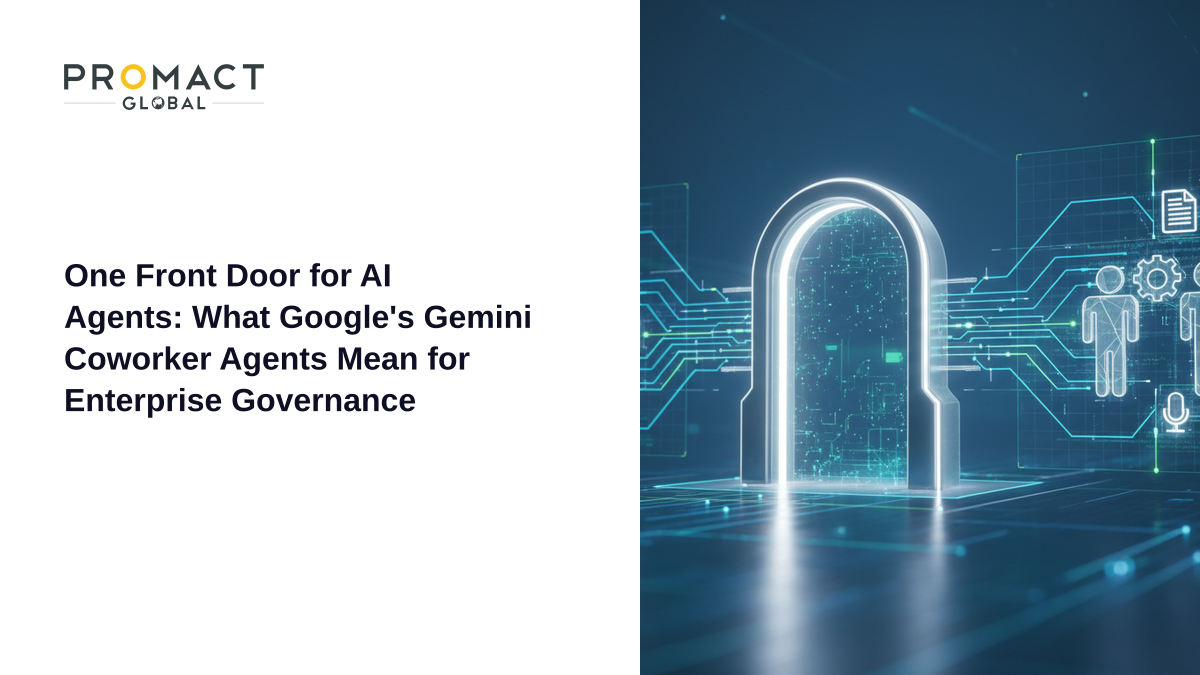
On October 8, 2026, Google Cloud CEO Thomas Kurian stood on stage at Gemini at Work and called the new Gemini agent “a single, universal agent for work”. It chats, executes tasks, writes code, and creates media. It runs in Google Workspace, but also inside Microsoft 365 and Slack. And, most strikingly, it can be given its own email address and directory listing, like a new hire.
For enterprise leaders, this is more than another product launch. It is a bet that companies want one “front door” for agents instead of a patchwork of copilots, and it makes a hard question urgent: if an AI coworker has an identity, a budget and access to your systems, who is accountable for it? This post covers what Google announced, what is still unproven, and what you should do before your own agents start behaving like employees.
What Google Actually Announced
One agent, many surfaces
According to Futurum’s analysis, the Gemini agent runs on web, iOS, Android, Windows, Mac and the command line, and can be embedded headlessly in third-party apps. Long-running jobs continue in the cloud after a user closes their laptop, and the agent can spawn temporary sub-agents for pieces of a larger task. Reworked’s coverage notes the model choice is limited for now, and Decrypt reports that the system routes work across Gemini and Anthropic’s Claude models.
It also connects to the systems where work actually lives: Salesforce, ServiceNow, Jira, Snowflake, Databricks and any server that speaks the Model Context Protocol. If MCP is new to you, our explainer on what MCP is and why founders keep searching for it is a good primer.
Coworker agents with their own identity
The headline feature is the “coworker agent.” A manager describes a role, and Gemini creates an agent with its own Workspace account, including an email address, storage and a directory seat. Decrypt describes teammates tagging it in chats like a colleague, with the agent appearing under its own name in document edit history.
Futurum’s analyst view is that this is the most consequential announcement for application buyers, because giving agents identities in the same processes used for employees makes audit trails clearer.
Governance and cost controls
Google paired the launch with a governance stack. Per Futurum, it includes cryptographically attested agent identity, OAuth-propagated permissions, per-agent audit trails, an Agent Sandbox, and an Agent Gateway that Google calls an “AI network firewall.” There is also Smart Routing across models and real-time, per-project spend caps that pause an agent when triggered. Spend caps are not new to the platform; PPC Land reported project-level caps with alerts as a budget is approached, and the new launch extends the idea to agents.
Why “One Front Door” Is a Real Strategic Shift
The case for consolidation
Most enterprises today run a collection of assistants: one in the office suite, one in the CRM, one in the IT service desk, plus whatever teams built themselves. Each has its own permissions, logging and bill. We described the resulting mess in AI Agent Sprawl, and the governance bottleneck in The Agent Fleet Era.
A single agent surface reduces the number of places IT has to secure, audit and budget. Futurum points out that supporting multiple model families also removes one reason buyers build their own orchestration layer.
The case for caution
Consolidation concentrates risk as well as convenience. Several things deserve skepticism:
- Availability and pricing are unclear. Futurum notes Google did not disclose pricing or general availability dates for most announcements. Reports say small and midsize businesses are in early access, with everyone else promised access “soon.”
- Metering is unresolved. Google told Futurum it does not intend to charge a per-seat license for coworker agents in Workspace, but how agent activity will be metered, and so billed, is still open.
- The Microsoft question. Running inside Microsoft 365 puts Gemini in direct competition with Microsoft’s native Copilot on its home turf. Microsoft is pursuing agent identity too: its documentation says new Copilot Studio agents automatically get a Microsoft Entra Agent ID, with audit logging and Conditional Access support.
- Customer proof is mostly earlier work. Futurum observes that many keynote customer examples reflect earlier Gemini Enterprise deployments rather than the new unified agent.
The Real Lesson: Agents Are Becoming Identities
Whichever vendor wins, the direction is clear. Agents are no longer features; they are principals in your identity system, with credentials, permissions and activity trails. That is exactly the problem we explored in The Non-Human Identity Crisis.
Treating an agent like an employee has real advantages: you can apply least privilege, review its access, and tie its actions to an owner. But it also imports employee-style failure modes. An agent with a mailbox can be phished, an agent with broad OAuth scopes can leak data, and an agent that nobody offboards can keep running for months.
Where orchestration fits
A universal agent that spawns sub-agents is an orchestrator in the sense we described in The Orchestrator Agent. The design pattern is sound, but orchestration only helps if the orchestrator’s own permissions are tightly bounded. A manager agent with access to everything is a single point of failure.
A Practical Playbook for Leaders
1. Inventory before you consolidate
List every agent, copilot and automation already running, who owns it, and what it can touch. You cannot move to a single front door if you do not know how many doors exist.
2. Give every agent a named human owner
Coworker agents with directory entries make this natural. Require that each has an accountable manager, a defined purpose and an expiry or review date.
3. Insist on spend caps and kill switches
Real-time caps that pause an agent are a good pattern whatever platform you use. Ask every vendor how a runaway agent gets stopped, and how quickly.
4. Keep your control plane portable
Governance should not be locked inside one vendor’s gateway. Open approaches like those discussed in The Control Plane Era help you keep leverage as the market shifts.
5. Pilot narrow, then widen
Start with one role, such as an events coordinator or a reporting analyst, with limited data access. Measure error rates, cost and review time before expanding.
Conclusion
Google’s Gemini agent is the clearest signal yet that the industry is moving from many assistants to a managed workforce of agents with identities, budgets and audit trails. Whether you adopt Google’s version, Microsoft’s, or your own, the takeaways are the same: know your agents, give each an owner, cap their spend, bound their permissions and keep your governance portable.
Promact helps enterprises design and govern agentic systems that fit their existing stack. If you are weighing how to introduce AI coworkers safely, we would be glad to help you build the roadmap.
Frequently Asked Questions
What is Google’s Gemini agent?
It is a cloud-based agent announced on October 8, 2026 at Gemini at Work, which Google describes as a single, universal agent for work. It handles chat, task execution, code and media creation across Workspace, Microsoft 365 and Slack.
What is a “coworker agent”?
A coworker agent is an AI agent with its own Workspace account, including an email address, storage and a directory listing. Teammates can tag it like a colleague, and it appears under its own name in document history.
Is the Gemini agent generally available?
Not fully. Reports indicate small and midsize businesses have early access, while pricing and general availability dates for most announced features have not been disclosed.
Does it only use Google’s models?
No. Coverage says it orchestrates Gemini and Anthropic’s Claude models, with other private and open models planned, though reports differ on how much model choice is available at launch.
How is this different from Microsoft Copilot?
Microsoft is also giving agents identities through Entra Agent ID, but Gemini’s pitch is a single agent that works across Workspace, Microsoft 365 and Slack, putting it in direct competition on Microsoft’s own surface.
What should my company do first?
Inventory the agents you already run, assign each a human owner, and set spend limits and permissions before adding more. Pilot a narrow role first and measure results.
Sources
- Futurum: Google Collapses Enterprise AI Into a Single Gemini Agent - analyst breakdown of the Gemini at Work announcements
- Decrypt: Google Wants Gemini to Be Your Next Coworker - coverage of coworker agents and model routing
- Reworked: Google Debuts Its All-Purpose Gemini Agent for Work - event coverage and model-choice notes
- PPC Land: Google Cloud adds project spend caps that pause Gemini agents - spend cap details
- Microsoft Learn: Entra Agent IDs for Copilot Studio agents - Microsoft’s agent identity approach
- AI Weekly: Google Cloud’s Gemini Agent Gets a Mailbox and Directory Seat - coverage of agent identity features
Have a project like this in mind?
Tell us what you're building — we'll help you scope it and ship it.
Talk to usKeep reading
October 11, 2026
One Agent to Rule Them All? What Google's Gemini Agent Means for Enterprise AI Strategy

October 10, 2026
24 Hours to Report: What the EU Cyber Resilience Act's Live Incident Rules Mean for AI Agent Builders
October 9, 2026