
October 21, 2026
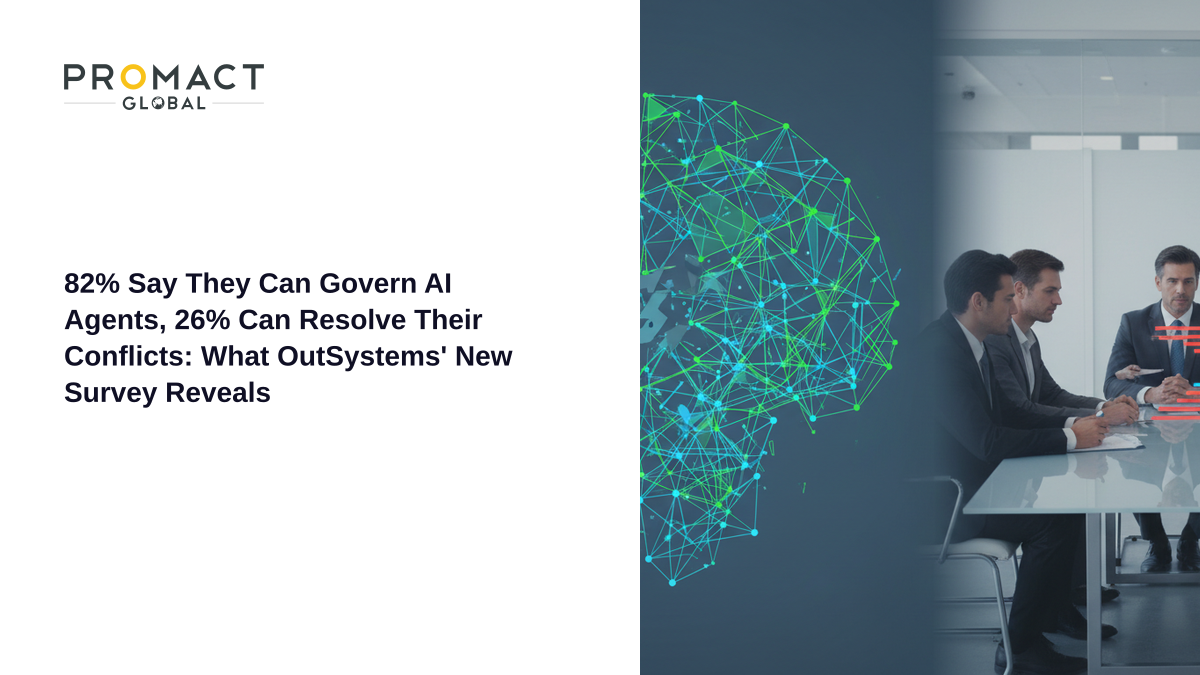
82% Say They Can Govern AI Agents, 26% Can Resolve Their Conflicts: What OutSystems' New Survey Reveals
Ask a room of executives whether their organization can govern AI agents and most hands go up. Ask whether they can resolve a conflict when two of those agents disagree, and most hands come down. That is the uncomfortable picture painted by a new survey from OutSystems, CIO Dive, and KPMG, published in mid-October 2026.
The headline numbers are stark. According to the OutSystems research release, 82% of surveyed executives believe their organizations can keep pace with governing, integrating, and monitoring AI agents. Yet only 26% say they are well prepared to resolve conflicts across agents, systems, and automated workflows.
This post unpacks that gap: what the survey found, why confidence and capability diverge, and the practical steps technology leaders can take before agents become load-bearing parts of the business.
What the Survey Actually Found
The study, titled Engineering Business Outcomes: The Shift to Agentic Systems, was an online survey run by CIO Dive in June 2026. It drew on 858 executives, according to the release. A few findings stand out.
Confidence is high, readiness is thin
The 82% versus 26% split is the core story. Note that the 82% figure measures self-reported belief, not tested capability. It is a perception, and perceptions in a fast-moving field tend to run ahead of operational reality.
Oversight is mostly manual
The survey reports that 83% of organizations rely on existing IT, security, or compliance processes, specialized reviews, or centralized policies and monitoring to oversee agents. Only 5% have automated controls, audit trails, and formal human review points. In other words, most companies are governing a new kind of software with processes designed for the old kind.
Value is still early
Error reduction is the most common success metric, cited by 64% of respondents. And only 12% say agentic AI has accelerated the launch of new products, services, or customer experiences. Agents are mostly being used to make existing work cleaner, not yet to create new revenue.
Regional differences exist
Coverage from IT Brief and others reports that the readiness picture varies by region, with APAC respondents reporting higher preparedness than those in Europe or North America. Treat that as directional, since these are self-assessments.
Why the Gap Exists
Confidence and capability diverge for understandable reasons.
Single agents are easy to govern; fleets are not
Reviewing one agent that drafts emails is manageable. Reviewing dozens of agents that call each other’s tools, share data, and act on overlapping systems is a different problem. Conflicts appear at the seams: two agents updating the same record, one agent’s output becoming another’s untrusted input, or competing instructions from different teams.
We explored this dynamic in AI Agent Sprawl: Why 94% of Enterprises Are Losing Control of Their Own AI Agents, and the OutSystems data reinforces it. Governance that worked at pilot scale quietly stops working at production scale.
Context is fragmented
The survey found that 35% of respondents cite data consistency and context sharing as a major orchestration hurdle. Agents that don’t share a consistent view of the customer, the order, or the policy will inevitably produce inconsistent actions. Conflict resolution is impossible when the agents don’t agree on the facts.
Review after the fact doesn’t scale
KPMG’s Michael Harper argued in the release that “you cannot simply inspect it after the fact,” and that assurance must be engineered from the start, with policy-as-code and runtime guardrails. That matches where the industry is heading. As we covered in The Control Plane Era, vendors and open-source projects are now building enforcement layers that sit between agents and the systems they touch.
The Stakes: Why This Isn’t Just a Governance Footnote
Gartner has predicted that more than 40% of agentic AI projects will be cancelled by the end of 2027, citing rising costs, unclear business value, and inadequate risk controls. The OutSystems findings suggest one of the mechanisms: organizations scale up on confidence, then discover that nobody can explain, audit, or untangle what their agents did.
There is also an accountability dimension. When an agent acts wrongly, someone has to answer for it. Our piece on what happens when your AI agent makes a mistake walks through the legal and operational reality: “the agent did it” is not a defense your customers or regulators will accept.
Security frameworks are catching up too. The OWASP Top 10 for Agentic Applications for 2026, released in December 2025 and developed with input from more than 100 experts, gives teams a shared vocabulary for the risks of autonomous systems.
A Practical Playbook for Closing the Gap
The good news is that the gap is an engineering and operating-model problem, and those are solvable. Here is a pragmatic sequence.
1. Measure readiness, don’t assume it
Replace the survey-style question “Can we govern our agents?” with testable ones. Can you list every agent in production, its owner, and its permissions? Can you replay what it did last Tuesday? Can you shut it off in minutes? If any answer is no, your 82% is really a guess.
2. Define conflict rules before you need them
Decide in advance which agent wins when two disagree, which actions require a human, and which systems are single-writer. Write these down as explicit policies rather than leaving them to prompt wording. For a primer on setting rules, see Why Your AI Needs Rules (And How to Set Them).
3. Enforce at the action layer
Prompts are suggestions; policy enforcement is a control. Putting checks where agents actually act, such as tool calls, API writes, and payments, is far more reliable than hoping the model behaves. We make this case in Beyond Prompt Engineering: Why Action-Layer Governance Is the New Standard.
4. Automate audit trails
The 5% of organizations with automated controls and audit trails are the benchmark. Logging every agent decision with inputs, tools used, and outcomes turns incident response from archaeology into a query.
5. Test agent behavior, not just models
In the survey, 81% rate testing, evaluating, and validating agent behavior as very or extremely important when choosing platforms. Build scenario tests that include multi-agent interactions and adversarial inputs, and run them on every change.
6. Keep your options open
The survey also found 62% value the ability to switch models, vendors, and platforms over time. Governance layers that are portable across vendors protect you from lock-in as the market shifts.
Conclusion: Treat Confidence as a Hypothesis
The OutSystems findings are less an alarm than a calibration check. Executives are right that agents are coming into production and that governance matters. They are overestimating how ready their current processes are for the multi-agent reality.
Actionable takeaways:
- Audit your agent inventory, owners, and permissions this quarter.
- Write explicit conflict-resolution and escalation rules.
- Move enforcement from prompts to the action layer.
- Automate audit trails before scaling to more agents.
- Test multi-agent behavior as a release gate.
Teams that close the gap now will scale agents faster and with fewer surprises than those who discover it in production.
Frequently Asked Questions
What does the 82% versus 26% gap mean?
Most executives believe they can govern, integrate, and monitor AI agents, but only about a quarter say they are well prepared to resolve conflicts across agents, systems, and workflows. It highlights overconfidence relative to operational readiness.
How many executives did the OutSystems survey cover?
The survey was conducted online by CIO Dive in June 2026 and included 858 executives, per the OutSystems release. OutSystems also describes it as over 850 IT decision-makers.
Is the 82% figure a measured result?
No. It reflects executives’ own beliefs about their organizations, not an audited assessment of their governance capabilities.
What is policy-as-code for AI agents?
It means expressing rules about what agents may do as versioned, testable code that is enforced at runtime, rather than as documents or prompt instructions that rely on the model complying.
Where should a small team start?
Start with an inventory of every agent, its owner, and its permissions, then add logging and a kill switch. Those basics make every later governance step easier.
Sources
- OutSystems / PR Newswire: The Agentic AI Era Is Here, Enterprise Readiness Is Not - the October 16, 2026 release with the survey findings
- OutSystems: Engineering Business Outcomes: The Shift to Agentic Systems - the report landing page
- IT Brief Australia: OutSystems warns of AI agent governance readiness gap - coverage including regional breakdown
- w.media: Over 40% of agentic AI projects could face the axe by end of 2027 - report on Gartner’s prediction
- OWASP GenAI Security Project: Top 10 for Agentic Applications for 2026 - security risk framework for agentic systems
- Policy-as-Prompt (arXiv) - research on turning governance rules into runtime guardrails
Have a project like this in mind?
Tell us what you're building — we'll help you scope it and ship it.
Talk to usKeep reading
October 20, 2026
The Agentic Insider: What Microsoft's Guardian Agents Mean for Governing AI Agents Like Employees
October 19, 2026
Proofpoint's $6.3B Varonis Bet: Why Securing AI Agents Now Starts With Securing the Data They Can Reach
October 16, 2026