
October 18, 2026
From Pilot to Production: What ServiceNow's AI Workflow Factory Means for Enterprise AI ROI
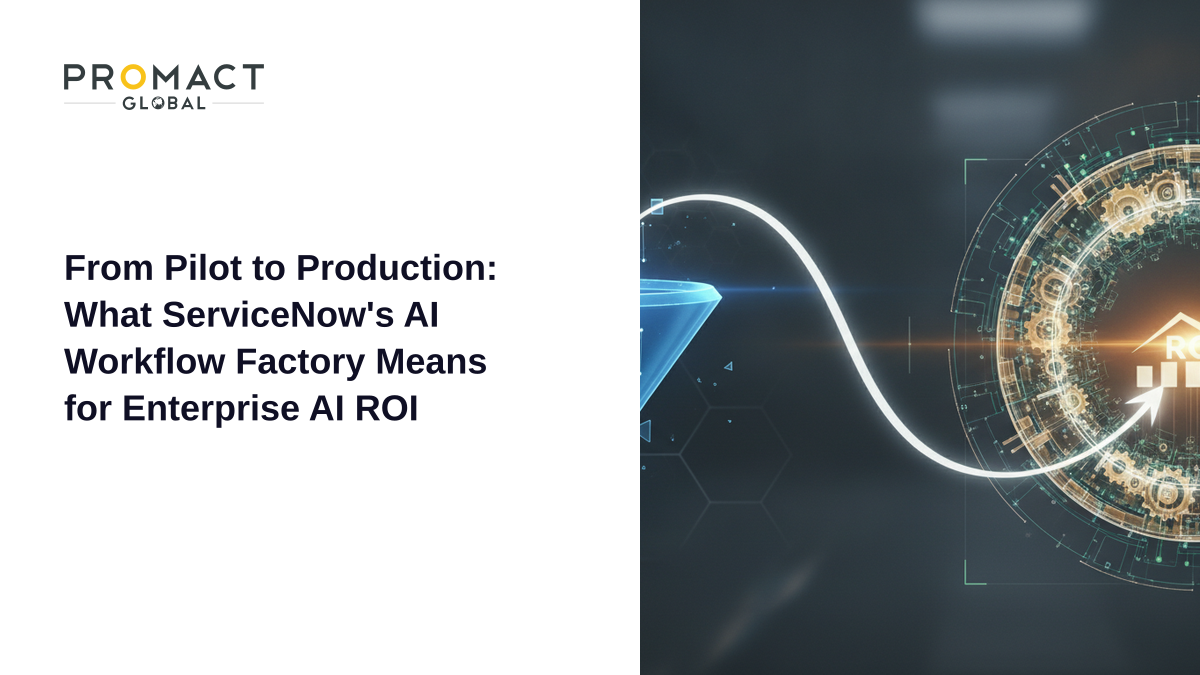
Most enterprises don’t have a shortage of AI pilots. They have a shortage of AI pilots that ever become production workflows. On October 6, 2026, at its World Forum in Mumbai, ServiceNow announced AI Workflow Factory and Autonomous Engineer, a pairing designed to attack exactly that gap: find the processes worth improving, build the fix with AI, and run it at scale under one governed loop.
This post breaks down what ServiceNow actually shipped, what is still vendor claim rather than proven result, what independent analysts say you should worry about, and how to evaluate any “AI builds your workflows” pitch before you sign.
What ServiceNow Announced
The loop: mine, build, run
AI Workflow Factory is positioned as a continuous workflow-improvement loop rather than a single product. According to ServiceNow’s release, it links three stages:
- Process Mining identifies which business processes should change, tied to the KPIs business units already track.
- Autonomous Engineer and Build Agent help teams build the workflow improvements and control quality.
- App Engine runs the improved workflows at scale.
Two governance pieces wrap the loop. AI Control Tower governs AI workflows, decisions, and agent actions in one view, and Action Fabric extends that governed loop to third-party AI agents and tools.
Autonomous Engineer: unattended coding, with approvals
The headline component is Autonomous Engineer, which supports unattended coding for planning, building, and testing implementation work. InfoWorld’s coverage notes that it creates an implementation plan and, after human approval, carries out development and testing. ServiceNow says developers keep control of critical decisions.
Availability
AI Workflow Factory is described as globally available now. Autonomous Engineer is only available through an Early Access program on request. That distinction matters: the build-it-for-you half of the story is not yet generally available.
The numbers worth treating carefully
ServiceNow’s release cites its 2026 Enterprise AI Maturity Index showing enterprise AI investment in India grew 119% in one year, and notes that more than 100 billion workflows run on its platform each year. The one concrete use case in the announcement, a 20% increase in case deflection across several business units, is a hypothetical illustration, not a named customer result. InfoWorld notes that the announcement cites no quantitative results, benchmarks, or adoption figures.
Why This Matters: The Pilot-to-Production Gap
Enterprise leaders are under pressure to show returns from agentic AI. Gartner has predicted that over 40% of agentic AI projects will be canceled by the end of 2027, citing rising costs, unclear business value, and inadequate risk controls. Notice what that list does not include: model quality. The failures are about selecting the right work, proving value, and controlling risk, which are the three things the Workflow Factory loop claims to address (Process Mining for selection, KPIs for value, Control Tower for risk).
That is also why the platform framing is attractive. If mining, building, running, and governing all live in one system, the handoffs where pilots usually die get shorter. It echoes a trend we covered in Built In, Not Bolted On: agents are becoming a feature of the enterprise platform rather than a separate project.
What Independent Analysts Are Cautioning
The most useful part of the InfoWorld piece is the skepticism from Sanchit Vir Gogia, chief analyst at Greyhound Research. Several of his points should be on every buyer’s checklist.
Faster building doesn’t fix process ownership
Building workflows faster does not resolve unclear process ownership or the need to redesign the process itself. Data and integration, he says, remain the “connective tissue.” An AI that automates a broken process produces a faster broken process.
Delegation has no universal safe percentage
Gogia argues that “no universal percentage describes how much enterprise development can safely be delegated.” The right answer depends on task clarity and reversibility, with independent validation before release. This lines up with the thinking in our piece on why the on-call engineer is becoming an approver, not an investigator: moving humans from doing to approving only works if approval is meaningful.
Beware self-validating tests
He also cautions about cases where implementation and generated tests reflect the same reading of a requirement. If the same AI misunderstands the requirement and then writes the tests, the tests will pass and the workflow will still be wrong. Independent validation is the answer.
Governance portability is not guaranteed
Support for open protocols does not mean equivalent enforcement or portable controls. Gogia’s advice is that enterprises should be able to switch governance platforms without losing their governance records. That is the same lock-in question raised by the control plane debate around WSO2’s open-source Agent Manager.
Production responsibility stays with you
Even when implementation runs unattended, responsibility for what runs in production stays with the enterprise. No vendor announcement changes that.
A Practical Evaluation Framework
Whether you’re looking at ServiceNow or a competitor, use these five questions before committing.
- Where does the work come from? Ask how the tool decides which processes to improve, and whether that decision is tied to KPIs your business already trusts.
- What needs human approval? Plans, code, deployments, and retirements should each have an explicit, logged approval point.
- Who validates the output? Require validation that is independent of the agent that built the change.
- Can you leave? Test whether you can export governance records and policies if you change vendors.
- What does it cost after launch? Gogia’s point about recurring platform costs is practical: count savings that continue after a workflow reaches production, and count the cost of retiring workflows that stop paying off.
For teams weighing whether to buy a platform or assemble their own tooling, our analysis of the AI build-vs-buy trap is a useful companion. And for the governance side, the Agent Fleet Era covers why oversight, not capability, is the real constraint.
Conclusion: Actionable Takeaways
ServiceNow’s announcement is a sign of where the market is heading: from “AI that assists” to “AI that builds and runs the workflows,” wrapped in governance. But the part that is generally available today is the loop, while the autonomous builder is still in early access, and the public evidence for outcomes is thin.
- Start with process, not tooling. Use process mining (from any vendor) to pick two or three high-volume, reversible workflows.
- Pilot autonomous building on reversible work first. Keep human plan approval and independent validation in the loop.
- Demand portability. Insist on exportable governance records before consolidating on one platform.
- Ask for named customer results. A hypothetical 20% improvement is a marketing example, not evidence.
- Budget for the whole lifecycle, including monitoring and retiring workflows.
Frequently Asked Questions
What is ServiceNow AI Workflow Factory?
It is a continuous loop that uses Process Mining to find workflows worth improving, AI tools to build them, and App Engine to run them at scale, governed through AI Control Tower. ServiceNow announced it on October 6, 2026.
Is Autonomous Engineer generally available?
No. According to ServiceNow, Autonomous Engineer is available through an Early Access program on request, while AI Workflow Factory itself is described as globally available.
Does Autonomous Engineer work without any human involvement?
ServiceNow describes unattended coding for planning, building, and testing, but also says developers keep control of critical decisions. InfoWorld reports that it carries out development and testing after a human approves its implementation plan.
Are there proven results from customers?
The announcement does not name a customer. The 20% case-deflection figure is a hypothetical example, and InfoWorld notes the announcement cites no quantitative results or benchmarks.
What is the biggest risk of AI-built workflows?
Analyst Sanchit Vir Gogia points to automating poorly designed processes, self-validating tests that share the same misreading of a requirement, and governance controls that are not portable between platforms.
Who is responsible if an AI-built workflow fails in production?
You are. Even when implementation runs unattended, production responsibility stays with the enterprise, so approval, validation, and rollback processes need to be yours.
Sources
- ServiceNow Newsroom - Official press release announcing AI Workflow Factory and Autonomous Engineer
- InfoWorld - Coverage with analyst commentary from Greyhound Research
- CIO.com - Syndicated coverage of the launch and its enterprise implications
- Futurum Group - Analyst summary of the launch and partner adoption
- Techstrong.ai - Key takeaways on Autonomous Engineer’s capabilities and availability
- Gartner - Prediction that over 40% of agentic AI projects will be canceled by end of 2027
Have a project like this in mind?
Tell us what you're building — we'll help you scope it and ship it.
Talk to usKeep reading
October 17, 2026
Did the Agent Do What You Asked? What Amex's Intent Intelligence Framework Means for AI Commerce
October 14, 2026
Treat the Model as Untrusted: What Kaspersky's Cyber Immunity Guidance Means for Enterprise AI Agents
October 13, 2026