September 5, 2026
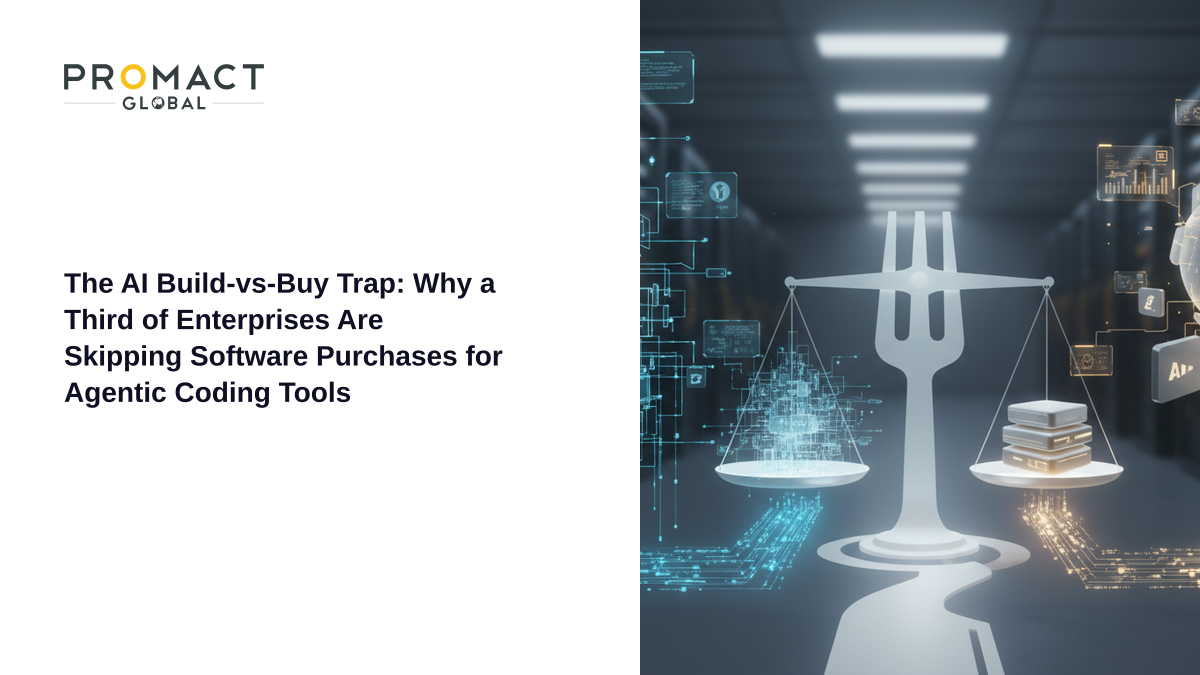
The AI Build-vs-Buy Trap: Why a Third of Enterprises Are Skipping Software Purchases for Agentic Coding Tools
Enterprise software buyers used to ask vendors for a demo. Increasingly, they’re asking their own engineers whether they even need the vendor. According to McKinsey’s newly published State of AI: Global Survey 2026, 32% of organizations have decided against buying at least one software product or feature because they could build the functionality in-house with agentic coding tools. Among the “high performers” who attribute at least 5% of their EBIT to AI, that number is nearly 50%.
That’s a real shift in how procurement decisions get made — and on the surface, it looks like a win for speed and cost control. But a second set of numbers, from MIT and Gartner, tells a less flattering story about what happens after the build decision is made. This post walks through both sides: why the build-it-yourself instinct is spreading so fast, what the failure data actually says about it, and how enterprise leaders can make the call without getting burned.
The New Default: Build Because You Can
McKinsey’s survey — 1,719 respondents across 97 countries, fielded in May and June 2026 — found the build-over-buy instinct is strongest exactly where you’d expect: technology companies (41%), healthcare payers and providers (39%), and professional services and energy firms (38%) are all skipping software purchases at above-average rates. The logic is straightforward. If a coding agent can produce a working internal tool in an afternoon, paying for a SaaS subscription — with its own onboarding, negotiation cycle, and per-seat pricing — starts to look like an unnecessary tax.
This isn’t happening in isolation. The same survey found that 40% of large enterprises are now scaling AI agents in one or more business functions, up sharply from 27% a year earlier, and roughly one in five organizations are actively scaling coding agents specifically. It’s part of a broader move away from the experimentation phase that defined 2024 and 2025, discussed in our earlier look at how vibe coding is reshaping the build-vs-traditional-development calculus for smaller teams — the same dynamic is now playing out at enterprise scale, just with bigger budgets and bigger blast radii.
The Economics Aren’t as Simple as “Free”
It’s tempting to read the build trend purely as a cost-saving story, but McKinsey’s own data complicates that. High-performing organizations — the ones building the most aggressively — report being constrained by AI operating costs, including token spend, roughly three times more often than their peers. Coding agents that run continuously against large codebases and internal tools accumulate inference costs that don’t show up until the invoice arrives. That dovetails with a trend we covered in the AI coding agent price war: the sticker price of an agent has very little to do with what it actually costs to run one against real enterprise workloads.
The Failure Data Nobody’s Putting in the Business Case
Here’s where the build-vs-buy conversation gets uncomfortable. Two independent research efforts — one from MIT, one from Gartner — have looked specifically at what happens to agentic AI projects after they’re greenlit, and both point the same direction: in-house builds fail at a much higher rate than most executives assume.
MIT’s Buy-Beats-Build Finding
MIT’s Project NANDA published The GenAI Divide: State of AI in Business 2025 after systematically reviewing more than 300 disclosed enterprise AI initiatives and conducting over 50 structured interviews across industries. Its headline number — that 95% of generative AI pilots fail to deliver measurable P&L impact — got most of the attention. But the more actionable finding was buried underneath it: internally built AI systems succeeded only about 33% of the time, compared to roughly 67% for tools purchased from external vendors and integrated through partnerships. In other words, the same organizations skipping vendor purchases to “save money” by building in-house are, on average, choosing the option that’s twice as likely to fail.
That gap tends to come down to maintenance, not initial capability. A vendor product comes with a team whose job is to keep the model current, patch security issues, and support the integration long after launch. An internal tool built in a sprint by a coding agent often doesn’t have anyone assigned to do the same thing six months later — a dynamic we’ve also seen play out in the governance space, where nobody owns cleanup once an agent fleet grows past a team’s ability to track it.
Gartner’s Cancellation Forecast
Gartner reached a similar conclusion from a different angle. In its widely cited June 2025 prediction, the firm forecast that more than 40% of agentic AI projects will be canceled before the end of 2027, driven by escalating costs, unclear business value, and inadequate risk controls. Analyst Anushree Verma put it bluntly: most agentic AI projects “are early stage experiments or proof of concepts that are mostly driven by hype and are often misapplied.”
The reality-check numbers back this up. Deloitte’s 2026 Tech Trends research found that while 30% of organizations are exploring agentic AI and 38% are actively piloting it, only 11% have systems actually running in production. Gartner’s own 2026 CIO and Technology Executive Survey — covering more than 2,500 CIOs worldwide — found that just 17% of organizations have deployed AI agents to date, even though more than 60% expect to do so within two years, making agentic AI the most aggressively forecast technology in the survey. There’s a wide gap between intention and execution, and the build-it-yourself instinct is walking straight into it.
Where Building In-House Actually Works
None of this means the build option is wrong — it means it’s being applied indiscriminately. The organizations getting real value from internally built agentic tools share a pattern: narrow scope, a specific internal user, and a clear owner after launch. A coding agent that automates a well-defined internal workflow — generating boilerplate, triaging support tickets against existing documentation, drafting first-pass code reviews — has a bounded failure mode and a short feedback loop. A coding agent asked to replace an entire category of vendor software, with all the edge cases and compliance requirements that category has accumulated over a decade, does not.
This is also where the governance conversation and the build-vs-buy conversation converge. An enterprise that has already invested in agent oversight — tracking what each agent can access, who’s accountable for it, and how it’s audited, the kind of structure discussed in our piece on enterprises losing control of their own agent sprawl — is far better positioned to make a build decision safely than one treating each agentic project as a one-off experiment.
What to Do Before You Skip the Next Software Purchase
A few practical filters can keep the build-vs-buy decision honest:
Price the maintenance, not just the build
Before comparing an agent’s build time to a vendor’s subscription fee, estimate who owns the internal tool in twelve months — security patches, model updates, and the inevitable edge case nobody tested for. If the honest answer is “nobody, specifically,” that’s a strong signal to buy.
Match the deployment pattern to the failure data
Reserve in-house builds for narrowly scoped, internally facing tools with a clear owner and a short list of things that can go wrong. Route anything customer-facing, compliance-sensitive, or core to the business toward vendor solutions or a much longer internal validation cycle.
Build governance before you build agents
Don’t let the build decision get made project-by-project with no central visibility. The enterprises with the best track records treat agent oversight as infrastructure, not an afterthought bolted on once something breaks.
Track total cost, including tokens
Factor ongoing inference costs into the build-vs-buy comparison from day one, not after the first surprising invoice. High performers are already hitting this wall three times more often than everyone else.
Conclusion
The build-vs-buy pendulum is swinging fast, and the McKinsey data shows it’s swinging hardest at the organizations that can least afford a misstep — the “high performers” doubling down on in-house agentic builds. The MIT and Gartner numbers aren’t an argument against building; they’re an argument against building without the same rigor a vendor evaluation would demand. Enterprises that price in maintenance costs, scope their builds narrowly, and put governance in place before scaling will capture the upside this shift promises. Everyone else is likely to become part of next year’s cancellation statistics.
Frequently Asked Questions
What percentage of enterprises are skipping software purchases to build with AI agents instead?
McKinsey’s State of AI 2026 survey found that 32% of organizations have decided against buying at least one software product or feature because they could build the functionality internally using agentic coding tools. That figure rises to nearly 50% among AI “high performers.”
Is building AI tools in-house actually riskier than buying them?
According to MIT Project NANDA’s research, internally built AI systems succeed about 33% of the time, compared to roughly 67% for vendor-purchased tools that are integrated through partnerships. The gap is largely attributed to ongoing maintenance and support, which vendor products include and internal builds often lack.
Why does Gartner expect so many agentic AI projects to be canceled?
Gartner’s forecast points to escalating operating costs, unclear business value, and inadequate risk controls as the main drivers behind the more than 40% of agentic AI projects it expects to be canceled by the end of 2027.
Does this mean enterprises should stop building AI tools internally?
No — it means the decision needs the same scrutiny as any vendor evaluation. Internal builds tend to succeed when they’re narrowly scoped, have a clear long-term owner, and sit within an existing agent governance framework, rather than being treated as one-off experiments.
How big is the gap between AI agent adoption plans and actual deployment?
Fairly wide. Gartner’s 2026 CIO survey found only 17% of organizations have deployed AI agents so far, even though more than 60% expect to within two years. Deloitte’s Tech Trends 2026 research similarly found only 11% of organizations have agentic systems actually running in production, versus 38% still in pilot stages.
What should a CFO or CIO ask before approving an in-house agent build over a vendor purchase?
At minimum: who owns the tool’s maintenance in a year, what the fully loaded token/inference cost looks like at scale, whether the use case is narrow enough to fail safely, and whether existing agent governance can extend to cover it before it ships.
Sources
- The State of AI: Global Survey 2026 - McKinsey - McKinsey’s annual global AI survey, source of the 32% build-over-buy statistic and enterprise agent-scaling figures.
- MIT report: 95% of generative AI pilots at companies are failing - Fortune - Coverage of MIT Project NANDA’s “GenAI Divide” report, including the 33% vs. 67% build/buy success rate finding.
- Gartner Predicts Over 40% of Agentic AI Projects Will Be Canceled by End of 2027 - Gartner - Gartner’s original press release and analyst commentary on agentic AI project cancellations.
- AI Comes of Age: Deloitte’s 17th Annual Tech Trends Report - Deloitte - Deloitte’s 2026 Tech Trends press release, source of the 11% production-deployment figure.
- AI Agent Adoption 2026: What the Data Shows - Joget - Summary of Gartner’s 2026 CIO and Technology Executive Survey findings on AI agent deployment rates.
- The Build-vs-Buy Shift: 32% of Enterprises Bet on Agentic Coding Tools - Yahoo Finance - Additional reporting and breakdown of the McKinsey build-vs-buy findings by industry.
- A Third of Companies Skipped Buying Software and Built It - Digital Applied - Detailed breakdown of McKinsey’s build-over-buy statistics, including high-performer segmentation.
Have a project like this in mind?
Tell us what you're building — we'll help you scope it and ship it.
Talk to usKeep reading
October 21, 2026
82% Say They Can Govern AI Agents, 26% Can Resolve Their Conflicts: What OutSystems' New Survey Reveals
October 20, 2026
The Agentic Insider: What Microsoft's Guardian Agents Mean for Governing AI Agents Like Employees
October 19, 2026