
August 31, 2026
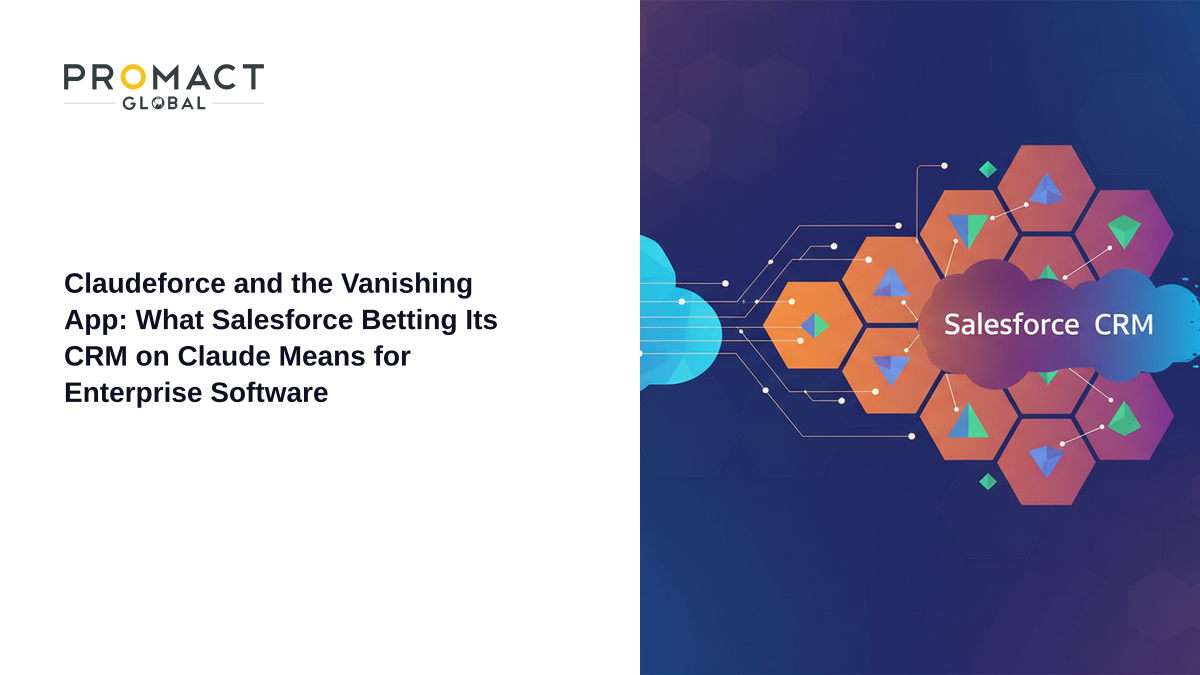
Claudeforce and the Vanishing App: What Salesforce Betting Its CRM on Claude Means for Enterprise Software
Six months before Salesforce and Anthropic stood on a San Francisco stage together, Wall Street was pricing Salesforce for extinction. Salesforce stock fell 26.2% in under a month, from $266.12 on January 7, 2026 to $196.38 by February 4. Thomson Reuters had its biggest single-day drop on record, down nearly 16% in one session, and Workday cut about 400 jobs — roughly 2% of its workforce — amid a stock slide of about 34% over the prior year. The trigger was blunt: Anthropic had shipped Claude Cowork with plugins for legal, sales, and data work, and investors suddenly believed AI agents could just do the work that CRM, legal-research, and HR software used to manage — no seats, no subscriptions, no dashboards required.
On August 26, 2026, the two companies that symbolized opposite sides of that panic announced they were merging their roadmaps. Claudeforce puts Salesforce’s CRM data, workflows, and governed actions directly inside Claude, and puts Claude’s reasoning inside Agentforce. It’s being pitched as “the #1 AI meets the #1 AI CRM.” Read past the tagline, though, and Claudeforce is really a signal about where every enterprise software vendor is now headed — and what that means for how your team will actually work with the tools you already pay for.
What Claudeforce Actually Ships
Strip away the branding and Claudeforce is two integrations moving in opposite directions.
Salesforce Data Flows Into Claude
The first piece is a plugin called Salesforce in Claude, carrying 37 prebuilt sales skills built jointly by the two companies — meeting preparation, deal health review, pipeline management, and similar seller workflows. A rep can ask Claude to summarize an account’s revenue history, flag stalled deals, or update a pipeline stage, and Claude reasons over live Salesforce data and takes governed action without the rep opening the Salesforce app at all. It’s available to select pilot customers now, with a broader open beta planned for September 2026, and Salesforce says more prebuilt skills will roll out through late 2026.
Claude Reasoning Moves Into Agentforce
The second piece runs the other way: Claude now serves as a reasoning model inside Salesforce’s own Atlas Reasoning Engine, and powers Agentforce Vibes and Agentforce Coworker by default, with availability in Agent Builder for custom agents. So the same intelligence a seller might invoke conversationally inside Claude is also the model doing the reasoning when an Agentforce agent acts autonomously inside Salesforce’s own interface.
The Trust Boundary Detail That Matters More Than the Demo
The part enterprise buyers should actually scrutinize is how the data moves. Claude is made available to Salesforce customers through Amazon Bedrock, inside what Salesforce calls its Trust Boundary — meant to let regulated-industry customers keep data and AI workloads inside their existing compliance perimeter rather than routing it through a third party’s general-purpose infrastructure. The two companies have said they’ll extend this to industry-specific solutions for regulated sectors, starting with financial services. If your organization already has AI governance concerns — and most do — this is the detail to ask your Salesforce rep about before you ask about the sales skills.
Why This Reverses the “AI Kills SaaS” Narrative
The February selloff was built on a simple fear: if an AI agent can just do the task, why pay for the software that used to gate it? IDC analysts have offered a more precise framing since then — SaaS isn’t dying, it’s “metamorphosing” into a headless backend, with the conversational layer absorbing the work the graphical interface used to do. Claudeforce is Salesforce betting IDC is right. Rather than compete with Claude Cowork for the conversational layer, Salesforce is wiring its data and workflow engine underneath it, on the assumption that owning the governed data and the “trusted enterprise harness” — its term, not ours — still matters even when the interface is a chat window instead of a dashboard.
Not every analyst is convinced this fully neutralizes the threat. When Claude Cowork’s legal plugin launched in February, Morgan Stanley analyst Toni Kaplan wrote that investors were “overwhelmingly bearish” on Thomson Reuters because they doubted the company could sustain growth in its legal segment “given increased competition from specialized AI tools” — the same competitive logic that could eventually apply to any incumbent whose product is mostly a licensed interface over proprietary data. Salesforce’s answer with Claudeforce is essentially to become the data and workflow layer inside the AI tool rather than compete with it for the interface. That solves one integration problem while potentially adding another: IT now has to govern access across two vendors’ security models instead of one.
The Pattern Behind the Headline: Apps Are Dissolving Into Agents
Claudeforce isn’t an isolated deal — it’s the latest instance of a shift already underway. We’ve covered how agent-to-agent protocols and plugin standards are trying to make skills and context portable across AI tools rather than locked into one vendor’s app, giving a model governed, structured access to a company’s systems instead of forcing every interaction through a bespoke UI. Claudeforce is a large, well-funded validation of that same thesis, just with two giants’ brand names attached instead of an open protocol.
It also strengthens the case for the orchestrator-agent model over a sprawl of disconnected point tools. If Claude is going to be the interface where sellers spend their day, and Agentforce is going to be the execution layer acting on Salesforce data, the practical unit of work for a sales team stops being “the CRM” and becomes “the conversation with the assistant that happens to be backed by the CRM.”
Not Every Vendor Bet Looks Like This One
Contrast Claudeforce with how IBM structured its own AI push this year. IBM went the other direction, embedding OpenAI across IBM Consulting Advantage rather than tying its fortunes to a single reasoning-model exclusivity the way earlier-generation partnerships did. Salesforce, notably, isn’t making Claude exclusive either — Agentforce still supports multiple models — but Claudeforce is a much deeper, co-branded bet on one lab than IBM’s more modular approach. If your organization is evaluating vendor AI roadmaps, that’s a real distinction: a deep, co-engineered integration with one model provider can ship faster and reason better over your specific data, but it also concentrates your dependency in a way a model-agnostic architecture doesn’t.
What This Should Change About How You Evaluate Your Stack
For a business leader watching this play out from outside either company, the useful takeaway isn’t “adopt Claudeforce.” It’s that the vendors you already pay are about to start pitching you on letting an AI assistant sit between your team and the software you bought. That’s worth planning for deliberately rather than adopting piecemeal.
Ask what “governed action” actually means for your data
Anthropic’s enterprise business has scaled fast enough to make this kind of deep integration credible — the company’s annualized revenue reached $65 billion by the end of July 2026, and it now counts hundreds of enterprise customers spending seven figures a year. That scale buys engineering resources for things like the Trust Boundary. But scale isn’t the same as your specific compliance requirements being met — get the data flow diagram, not the press release, before rolling anything like this out to a regulated team.
Don’t let the interface change outrun your governance
Every post we’ve written about agent sprawl applies here in a new form: if your sellers start taking governed actions on customer data from inside a chat window instead of a dashboard, your audit trail and permissioning model need to cover that conversation, not just the underlying CRM record. Confirm what’s logged, and who can review it, before pilot users start relying on it for real deal work.
Pilot narrowly before September
The open beta lands in September 2026. That’s a reasonable window to run a contained pilot with a handful of reps on a defined set of the 37 sales skills — meeting prep and deal health review are lower-risk starting points than anything that writes back to pipeline data — before deciding whether to expand it.
The stock market’s initial verdict on AI agents versus SaaS was panic. Claudeforce is the two biggest names in that story betting the real outcome is neither replacement nor coexistence, but merger — and if that bet is right, the vendors you already use are about to start looking a lot more like the AI assistants you’re already using them alongside.
Frequently Asked Questions
What is Claudeforce, exactly?
Claudeforce is the name for an expanded partnership between Salesforce and Anthropic, announced August 26, 2026. It has two parts: a Salesforce plugin inside Claude with 37 prebuilt sales skills, and Claude serving as the default reasoning model inside Salesforce’s own Agentforce platform.
Is Claudeforce available to my company today?
Salesforce in Claude is currently available to select pilot customers, with a broader open beta planned for September 2026. Claude’s availability inside Agentforce (via Agent Builder, Agentforce Vibes, and Agentforce Coworker) is further along and already rolling out to Salesforce customers.
Does this mean I no longer need to log into Salesforce?
Not for everything. The initial 37 skills focus on seller-facing tasks like meeting prep, deal health review, and pipeline management. Salesforce has said more skills will roll out through late 2026, but Claudeforce isn’t a full replacement for the Salesforce application today.
Is my data safe if I use Salesforce features through Claude?
Salesforce says Claude is delivered through Amazon Bedrock inside its “Trust Boundary,” intended to keep data and AI workloads within a customer’s existing compliance perimeter, including for regulated industries. Enterprises should still request specifics on data flow and logging before rolling this out to teams handling sensitive data.
Is Claude now the only AI model Agentforce supports?
No. Claude is the default reasoning model for parts of Agentforce, including the Atlas Reasoning Engine, Agentforce Vibes, and Agentforce Coworker, but Salesforce’s Agentforce platform has historically supported multiple model providers, and nothing in the Claudeforce announcement makes Claude exclusive.
Why did Salesforce’s stock crash in February 2026 in the first place?
Anthropic’s launch of Claude Cowork triggered investor fears that AI agents could perform tasks that previously required paid SaaS seats, contributing to a broad enterprise-software selloff. Salesforce fell more than 26% in under a month and Workday cut roughly 400 jobs amid the same pressure.
Sources
- Salesforce and Anthropic Announce Claudeforce: The #1 AI Meets the #1 AI CRM - Official Salesforce press release detailing the partnership’s components.
- Salesforce puts 37 prebuilt sales skills inside Claude for pilot customers - Details on the specific skills and pilot/beta timeline.
- Anthropic’s annualized revenue surges to $65B - TechCrunch reporting on Anthropic’s revenue scale as of July 2026.
- Should You Buy Salesforce Stock After 26% Drop? - Data on the magnitude of Salesforce’s February 2026 stock decline.
- Anthropic’s new AI tool sends shudders through software stocks - Coverage of Thomson Reuters’ record single-day drop and the broader February 2026 software selloff.
- Workday to Cut About 400 Employees Focused on Customer Support - Bloomberg’s reporting on Workday’s February 2026 layoffs.
- Anthropic’s new AI tools deepen selloff in data analytics and software stocks, investors say - Reporting including Morgan Stanley analyst Toni Kaplan’s note on Thomson Reuters.
- Salesforce, Anthropic partner to deliver Claudeforce - CIO.com’s enterprise-IT-focused analysis of the partnership.
- Claudeforce Explained: What Salesforce + Anthropic Actually Ship - Independent breakdown of the technical components of the announcement.
Have a project like this in mind?
Tell us what you're building — we'll help you scope it and ship it.
Talk to usKeep reading
October 21, 2026
82% Say They Can Govern AI Agents, 26% Can Resolve Their Conflicts: What OutSystems' New Survey Reveals
October 20, 2026
The Agentic Insider: What Microsoft's Guardian Agents Mean for Governing AI Agents Like Employees
October 19, 2026