
August 25, 2026
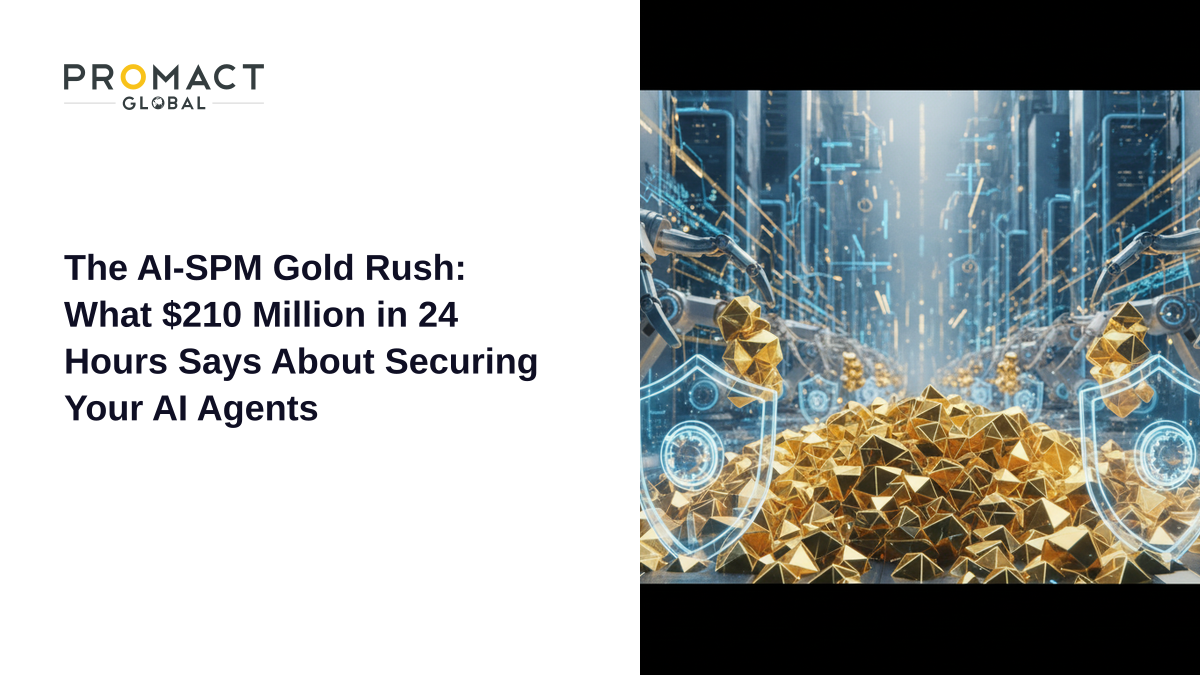
The AI-SPM Gold Rush: What $210 Million in 24 Hours Says About Securing Your AI Agents
In the span of 24 hours in early August 2026, two cybersecurity startups that didn’t exist as household names a year ago raised a combined $210 million. Zenity closed a $125 million Series C on August 3, led by Norwest. The next day, Obsidian Security landed an $85 million Series D at a $1.1 billion valuation, led by Crescent Cove Advisors. Neither company sells firewalls, endpoint protection, or anything a CISO would have had a budget line for three years ago. Both sell the same thing: tools that watch what your AI agents are doing after they’ve already been given access, and stop them before they do something the business didn’t authorize.
That back-to-back timing was a signal, not a coincidence. Investors are betting that “AI agent security” is about to become its own permanent line item in enterprise IT budgets, the way cloud security posture management (CSPM) did a decade ago. Analysts are calling the category AI Security Posture Management, or AI-SPM, and one market forecast puts it at $6.8 billion in 2026, growing to $51.8 billion by 2035 — a 25% annual growth rate. This post covers what AI-SPM actually is, why the money is moving now, and what a CIO or CISO should do about it before the vendor pitches arrive.
What AI-SPM Actually Means
Traditional security posture management tools were built to answer one question: is this system configured correctly? CSPM tools scan cloud infrastructure for open S3 buckets and misconfigured permissions. SSPM tools do the same for SaaS applications. AI-SPM asks a different, harder question — not “is this configured correctly,” but “what is this autonomous thing actually doing right now, and should it be allowed to keep doing it?”
That distinction matters because AI agents don’t behave like static infrastructure. An agent’s permissions can be correct on paper and still let it read a customer database it has no business touching, simply because nobody told it not to. Obsidian’s product focuses on runtime governance — catching privilege escalation, excessive data access, and policy breaches as they happen, across platforms like Microsoft Copilot, Google Vertex, Amazon Bedrock, and OpenAI’s own agent tooling. Zenity, which Gartner named the company to beat in AI agent governance in an April 2026 report, takes a similar runtime-first approach, positioning itself around what it calls “the era of 1 billion AI agents.”
We’ve covered the underlying problem before: our employees are now vastly outnumbered by non-human identities that need the same lifecycle discipline — provisioning, permissioning, deprovisioning — that human accounts get, and most organizations aren’t applying it. AI-SPM is the market’s answer to that gap: a category of tools built specifically to give security teams visibility and control over agents that traditional identity and access management was never designed to handle.
Why the Money Is Moving Now
Three data points explain why investors are moving so fast, and why the pace has picked up rather than leveled off.
First, adoption has outrun governance. Gartner predicts that 40% of enterprise applications will feature task-specific AI agents by the end of 2026, up from less than 5% in 2025 — an eightfold jump in a single year, among the fastest enterprise software adoption curves on record. That is not a gradual rollout; it’s a step change that has left most security programs structurally behind.
Second, the incident data backs up the urgency. A 2026 Kiteworks survey of 459 security and compliance leaders found that 80% had experienced at least one AI-related security incident in the past 12 months, yet the average organization scored just 35 out of 100 on AI governance maturity, having deployed only about 7 of 19 baseline governance capabilities. Only 21% have an automated kill switch to stop a misbehaving agent, and only 17% can produce a complete audit log within an hour of an incident. A separate Okta survey of 306 CISOs found that 81% worry about excessive AI access, but fewer than half feel confident they can even identify every agent running in their environment. And a 1Password survey found that 47% of respondents had seen an agent take an unintended action after following instructions hidden in the content it was processing — a prompt-injection-style failure the agent’s own credentials never flagged, because nothing about its access was technically wrong.
Third, customer spend is already validating the category, not just the pitch decks. Obsidian disclosed that more than 100 of its customers now spend over $100,000 a year on its platform, and at least 14 spend more than $1 million annually. That’s not early-adopter experimentation; that’s procurement teams treating agent security as a funded, recurring budget line the same way they treat endpoint detection or SIEM.
Put together, the pattern is: adoption is accelerating past the point most security teams can track by hand, incidents are already happening at a high rate, and the organizations closest to the problem are already paying real money to fix it. That’s the exact setup venture investors look for, which is why two competing vendors raised nine-figure rounds within a day of each other rather than years apart.
What CIOs and CISOs Should Actually Do With This
A funding boom is not, by itself, a reason to buy anything. Here’s a more grounded way to think about where AI-SPM fits into a security roadmap.
Treat it as identity governance, not a bolt-on tool
Only 25% of organizations apply the same identity-lifecycle policies to agents that they apply to human employees. Before evaluating any AI-SPM vendor, audit whether your agents are even inventoried — you can’t secure what you can’t see. This is the same discipline we’ve argued for in the context of action-layer governance: the control point that matters isn’t what an agent was told to do, it’s what it’s actually permitted to do when it tries to do it.
Don’t wait for a fleet-scale problem to start governing
By the time an organization has dozens of agents built by different teams touching shared systems — what we’ve called the agent fleet era — retrofitting governance costs far more than building it in from the first agent. If you’re still in single-digit deployments, this is the cheapest point to establish an inventory, a permissions model, and a kill-switch process, before sprawl makes it a much bigger project.
Ask vendors for runtime evidence, not just a policy dashboard
The Kiteworks survey found that only 26% of organizations restrict agents to authorized tasks and data scopes, and only 30% require human review before an agent accesses high-risk data — meaning most organizations are still relying on written policy rather than enforced controls. When evaluating an AI-SPM tool, ask for a live demonstration of it catching and halting an actual out-of-scope action — not just a compliance report generated after the fact. Runtime enforcement, not retrospective visibility, is what separates this category from a checkbox exercise.
Budget it as its own line, but don’t let it replace the basics
AI-SPM tools are a genuine new capability, not a replacement for the fundamentals many organizations still haven’t nailed: least-privilege access, credential rotation, and a documented incident response plan for agent-caused harm. A quick internal gut-check — the kind covered in our 10-minute AI risk audit — is a faster and cheaper first step than a vendor evaluation for any team that hasn’t yet mapped which agents touch sensitive data.
The Takeaway
Two $85 million-plus raises in 24 hours don’t happen because two founders got lucky with the same investors in the same week. They happen because the market has concluded, with real usage data behind it, that AI agents are already operating with more access and less oversight than most organizations are comfortable with — and that the gap is now big enough to fund a new category of company to close it. Whether or not your organization ends up buying a dedicated AI-SPM product, the underlying homework is the same either way: know how many agents you’re running, know what they can touch, and know how fast you can shut one off if it does something it shouldn’t. The vendors racing into this space are betting that most enterprises can’t currently answer all three questions. The data suggests they’re right.
Frequently Asked Questions
What is AI-SPM, in plain terms?
AI Security Posture Management is a category of security tools built specifically to monitor and control what autonomous AI agents do at runtime — detecting things like privilege escalation, out-of-scope data access, or policy violations as they happen, rather than just auditing agent configurations after the fact.
How is AI-SPM different from traditional cloud or SaaS security tools?
Traditional CSPM and SSPM tools check whether systems are configured correctly. AI-SPM tools monitor autonomous behavior in real time, because an agent can have technically correct permissions and still take an unauthorized action based on what it decides to do in the moment, not how it was set up.
Do we need a dedicated AI-SPM tool if we only have a handful of AI agents in production?
Not necessarily right away, but this is the cheapest point to start. Building an inventory of your agents, defining their permitted scope, and setting up basic audit logging while you have a small number of agents is far less expensive than retrofitting governance after agent sprawl sets in.
What’s the single biggest gap the survey data points to?
Visibility. Multiple 2026 surveys found that fewer than half of security leaders are confident they can even identify every AI agent running in their environment, which makes any downstream control — permissions, kill switches, audit logs — impossible to enforce consistently.
Is this just a repeat of the cloud security posture management boom from a decade ago?
The pattern rhymes — a new class of infrastructure outpaces existing security tooling, and a dedicated vendor category emerges to close the gap — but the risk profile is different. Misconfigured cloud storage is a static, discoverable flaw. An AI agent’s next action is a live decision, which is why the leading products in this space emphasize runtime enforcement over static configuration scanning.
Sources
- Zenity Raises $125 Million to Secure the Era of 1 Billion AI Agents - Official announcement of Zenity’s Series C round
- Obsidian Security raises $85M as AI agents create cybersecurity’s next major attack surface - SiliconANGLE coverage of Obsidian’s Series D and customer traction figures
- AI Security Posture Management Market Size to hit USD 51.8 billion by 2035 - Market sizing and growth forecast for the AI-SPM category
- Gartner Predicts 40% of Enterprise Apps Will Feature Task-Specific AI Agents by 2026 - Gartner’s official adoption forecast and analysis
- AI Agents Are Reaching Data No One Approved — Three New Surveys Confirm the Governance Gap - Synthesis of the 1Password, Okta, and Kiteworks 2026 survey data cited in this post
- Zenity Raises $125 Million to Secure the Era of 1 Billion AI Agents (Intel Capital) - Investor-side detail on the Zenity round and participating funds
- Obsidian Raises $85 Million Series D to Scale AI Agent Security Growth - Obsidian’s own announcement with product and platform detail
Have a project like this in mind?
Tell us what you're building — we'll help you scope it and ship it.
Talk to usKeep reading
October 6, 2026
Patch in Minutes, Not Months: How AI Agents Are Breaking Open-Source Security Embargoes
October 5, 2026
Agents Now Create 70% of New Databases: What Supabase's Turso Deal Means for Enterprise Data Governance
October 4, 2026