September 10, 2026
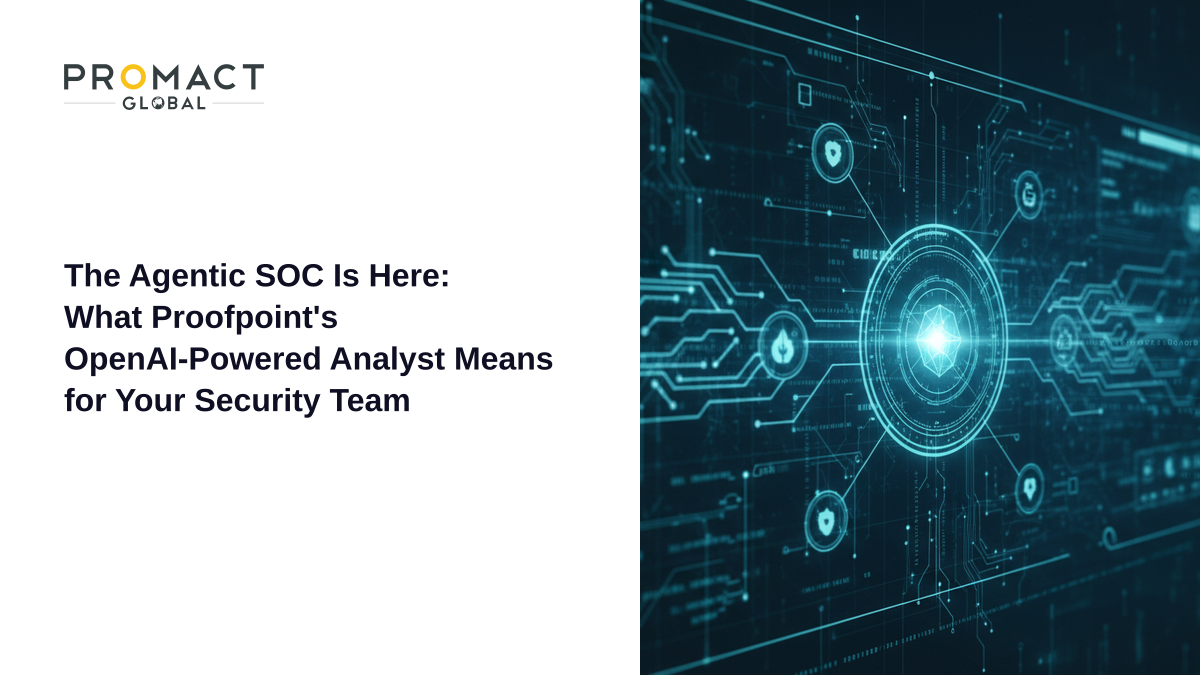
The Agentic SOC Is Here: What Proofpoint's OpenAI-Powered Analyst Means for Your Security Team
Security operations centers have a math problem long before they have an AI problem. The average enterprise SOC processes more than 10,000 alerts a day, and nearly half of them — 46%, according to the Microsoft/Omdia State of the SOC 2026 report — turn out to be false positives. Analysts drown in noise, real threats slip through the cracks, and the industry has a 4.8 million-person shortage of people qualified to do the work in the first place.
That is the backdrop for one of the more consequential enterprise AI announcements of the month: on September 3, 2026, Proofpoint introduced its SOC Analyst Agent, an agentic tool built on OpenAI’s cyber-tuned Daybreak models that turns plain-language questions into structured, traceable investigation findings. It’s not an isolated product launch. It’s the first visible output of a much bigger OpenAI initiative, and it lands in the middle of a security industry that is racing — cautiously — to hand more of the SOC workload to AI. This post covers what Proofpoint actually shipped, why the timing makes sense given the state of SOC burnout, how it compares to what CrowdStrike and Microsoft are already doing, and what security and IT leaders should be asking before they let an agent anywhere near an incident queue.
What Proofpoint Actually Announced
The SOC Analyst Agent lets security teams ask natural-language questions about the data flowing through Proofpoint’s products and get back structured findings and recommended next steps, rather than a wall of raw logs. According to Proofpoint’s own announcement, it is designed explicitly to “reduce the manual work involved in SOC investigations while keeping consequential remediation decisions in human hands.” The agent is currently in private preview, with general availability expected by the end of Q3 2026.
What makes this more than a single-vendor feature release is where the underlying model comes from. Proofpoint is the first named partner to ship a product built on OpenAI’s Daybreak Defense Network, which the company describes as a $1 billion commitment to put frontier-grade cybersecurity models into the hands of defenders, including under-resourced organizations like hospitals, schools, and local governments that would never otherwise afford this tier of tooling. Proofpoint joined the network in June 2026.
Daybreak Blue, Daybreak Red, and Trusted Access
OpenAI is running a tiered model for defenders. Daybreak Blue covers common defensive tasks using OpenAI’s mainline models — GPT-5.5 with Trusted Access for Cyber is the workhorse most partners will use for day-to-day investigation. Daybreak Red is reserved for vetted organizations doing more sensitive, technically demanding defensive work, where the model needs sharper offensive-security knowledge to be useful without becoming a liability if misused. The network already spans more than 35 enterprise products and partner-operated services, with partners that include IBM, CrowdStrike, Accenture, EY, KPMG, Palo Alto Networks, Cisco, Cloudflare, Sophos, Fortinet, and Okta. Proofpoint’s SOC Analyst Agent is simply the first of that cohort to put a finished, customer-facing product in front of security teams.
Why This Is Landing Now, Not Two Years Ago
Agentic AI didn’t create the SOC staffing crisis — it’s arriving in the middle of one that has been building for years. Seventy-six percent of SOC teams cite alert fatigue as a top operational challenge, and burnout affects 71% of security professionals, with 35% specifically blaming repetitive manual triage. The knock-on effects are measurable: up to 40% of alerts go uninvestigated entirely, 75% of analysts say they no longer have time for proactive threat hunting, and manual alert triage is estimated to cost U.S. organizations $3.3 billion a year in labor alone.
That’s the same structural pattern behind the AI SRE agent shift, where on-call engineers are moving from investigator to approver as agents take over first-pass triage. Security operations is arguably an even better fit for that shift: SOC work is high-volume, pattern-heavy, and mostly about correlating evidence across systems before a human ever has to make a judgment call — exactly what large language models are good at, and exactly the kind of workload that has been quietly training this generation of agents through products like CrowdStrike’s Charlotte AI, which its maker says has been trained on millions of real decisions made by Falcon Complete MDR analysts.
The Agentic SOC Isn’t a One-Vendor Story
Proofpoint’s move is notable, but it’s joining a field that’s already moving fast. At RSAC 2026, CrowdStrike, Cisco, and Palo Alto Networks all shipped agentic SOC tooling within the same conference week. CrowdStrike’s Charlotte AI evolved from a conversational assistant into what the company calls a full “agentic workforce,” with dedicated agents for detection triage, response, and workflow automation that reason about incidents and recommend containment actions based on company policy rather than following static playbooks. One analyst comparison cited by CrowdStrike found that building an equivalent detection agent took six to eight hours in Microsoft Copilot versus roughly four minutes in Charlotte AI’s no-code AgentWorks — a gap that says as much about how fast this tooling category is maturing as it does about any single vendor.
Microsoft, for its part, has been pushing Security Copilot deeper into enterprise contracts: as of July 2026, Microsoft 365 E5 customers get an allotment of 400 Security Compute Units per 1,000 licensed seats at no additional cost, a pricing move clearly aimed at making agentic security assistance a default rather than an add-on purchase. And the broader industry push toward “agentic everything” isn’t limited to security — Accenture and Google Cloud stood up a 1,000-person forward-deployed engineering group in September 2026 specifically to help enterprises move agentic AI projects from pilot to production, a pattern that echoes exactly what’s happening inside the SOC right now.
The competitive pressure matters for buyers: this is not a market where you’ll be choosing between “an AI SOC tool” and “no AI SOC tool” much longer. It’s a market where several credible vendors will each claim measurable reductions in mean time to detect and respond, and the differentiator will be less about raw model capability and more about how tightly the agent is integrated with the telemetry you already collect.
The Part Every Vendor Keeps Repeating — And Why It Matters
Read enough of these announcements and a phrase recurs almost verbatim: keep the human in the loop for anything consequential. Proofpoint says its agent keeps “consequential remediation decisions in human hands.” CrowdStrike frames Charlotte AI’s agents as reasoning and recommending, not unilaterally acting on containment. That’s not just cautious marketing language — it’s a direct response to the same governance gap this publication has flagged before: giving an autonomous system write access to your environment without a clear approval gate is how a helpful triage agent becomes an incident of its own.
It’s also, frankly, a trust problem as much as a technical one. Security teams are being asked to believe an AI system’s summary of an incident is accurate enough to act on — which runs headlong into the hallucination risk that’s becoming a real enterprise liability in any AI system making claims about facts. A hallucinated root-cause summary in a marketing deck is embarrassing. A hallucinated root-cause summary that convinces an analyst to close out a real intrusion as a false positive is a breach. That’s precisely why Proofpoint’s language about “structured, traceable” findings matters as much as the natural-language interface itself — traceability is what lets a human analyst verify the agent’s reasoning instead of just trusting its conclusion.
There’s a quieter identity dimension here too. Every agent added to the SOC stack is itself a new non-human identity with credentials, API access, and permissions that need to be governed — part of why the non-human identity problem is becoming its own security discipline, separate from whatever the agents themselves are being deployed to defend against.
What This Means for Your Business
If you run or advise a security team, the practical takeaways from this wave of announcements are fairly concrete:
- Evaluate on integration depth, not demo quality. An agent is only as useful as the telemetry it can see. Proofpoint’s advantage is its existing footprint in email and collaboration security data; CrowdStrike’s is endpoint telemetry. Pick based on where your actual exposure lives.
- Insist on an audit trail, not just an answer. Ask any vendor to show you exactly how the agent arrived at a finding, not just the finding itself. If it can’t show its work, don’t let it touch remediation.
- Define the approval gate before you deploy, not after. Decide in advance which actions an agent can take autonomously (querying, correlating, drafting a report) versus which require a human sign-off (isolating a host, disabling an account, notifying a customer).
- Budget for the non-human identity overhead. Every new SOC agent needs its own credential lifecycle, least-privilege scoping, and monitoring — treat it like onboarding a new hire with elevated access, not installing a plugin.
- Watch general availability dates closely. Private previews look impressive in vendor demos; GA timelines (Proofpoint’s is targeted for end of Q3 2026) are when procurement and security teams should actually start testing against their own data.
None of this means slowing down. The staffing math doesn’t favor waiting — a workforce gap in the millions doesn’t close on its own, and the vendors racing into this space are doing so because the demand is real. It means being deliberate about where the agent’s judgment ends and a human’s begins.
Frequently Asked Questions
What is Proofpoint’s SOC Analyst Agent?
It’s an agentic AI tool, announced September 3, 2026, that lets security teams ask natural-language questions about Proofpoint security data and receive structured, traceable investigation findings and recommended next steps, while keeping remediation decisions with human analysts.
What are OpenAI’s Daybreak models?
Daybreak is OpenAI’s cybersecurity-focused model initiative, offering “Daybreak Blue” (mainline models like GPT-5.5 with Trusted Access for Cyber, for common defensive tasks) and “Daybreak Red” (specialized models for vetted organizations doing more sensitive defensive work), delivered through a partner network called the Daybreak Defense Network.
When will the SOC Analyst Agent be generally available?
Proofpoint has it in private preview now, with general availability targeted for the end of Q3 2026.
How is this different from CrowdStrike’s Charlotte AI or Microsoft Security Copilot?
All three push toward an “agentic SOC” where AI handles first-pass triage and investigation, but they differ in the telemetry each is built on — Proofpoint on email and collaboration security data, CrowdStrike on endpoint data via Falcon, and Microsoft on its broader security and identity stack — plus pricing and integration models.
Will AI agents replace SOC analysts?
Not in the near term. Every major vendor in this space, including Proofpoint, explicitly frames these agents as reducing manual triage work while keeping consequential decisions — like containment or remediation — in human hands. The realistic shift is analysts moving from manual investigators to reviewers and approvers of AI-generated findings.
What should a business ask before adopting an AI SOC agent?
At minimum: how the agent’s findings are traced back to source data, what actions it can take autonomously versus what requires human approval, how its own credentials and access are governed, and how it performs against your actual telemetry during a pilot rather than a vendor demo.
Sources
- Proofpoint Brings OpenAI GPT Cyber Models into Security Operations - Proofpoint’s official announcement of the SOC Analyst Agent.
- Proofpoint SOC Analyst Agent Uses OpenAI Cyber Models - Channel Insider’s coverage, including GA timeline.
- Daybreak | OpenAI for cybersecurity - OpenAI’s overview of the Daybreak cybersecurity model initiative.
- Daybreak for Frontline Defenders: $1B to protect essential services - OpenAI’s announcement of its $1 billion Daybreak funding commitment.
- Behind OpenAI’s US$1bn Daybreak Push for Frontline Defenders - Cyber Magazine’s breakdown of Daybreak Blue/Red and partner network scale.
- Agentic AI SOC: Solving Talent Shortage & Alert Fatigue in 2026 - SOC alert fatigue, burnout, and staffing-gap statistics cited throughout.
- How AI-leading Security Teams Are Building the Agentic SOC - CrowdStrike’s account of Charlotte AI’s evolution into an agentic workforce.
- RSAC 2026: Agentic SOC tools ship from CrowdStrike, Cisco, Palo Alto Networks - VentureBeat’s competitive roundup of agentic SOC launches at RSAC 2026.
- Accenture and Google Cloud Expand Partnership to Scale Agentic Transformation - Accenture’s announcement of its Gemini Enterprise Business Group.
- OpenAI is putting $1 billion behind Daybreak for defenders - Help Net Security’s coverage of the Daybreak initiative’s scope and goals.
Have a project like this in mind?
Tell us what you're building — we'll help you scope it and ship it.
Talk to usKeep reading
October 21, 2026
82% Say They Can Govern AI Agents, 26% Can Resolve Their Conflicts: What OutSystems' New Survey Reveals
October 20, 2026
The Agentic Insider: What Microsoft's Guardian Agents Mean for Governing AI Agents Like Employees
October 19, 2026