September 18, 2026
Anthropic's $2 Trillion IPO: What Going Public Means for Enterprises Betting on Claude
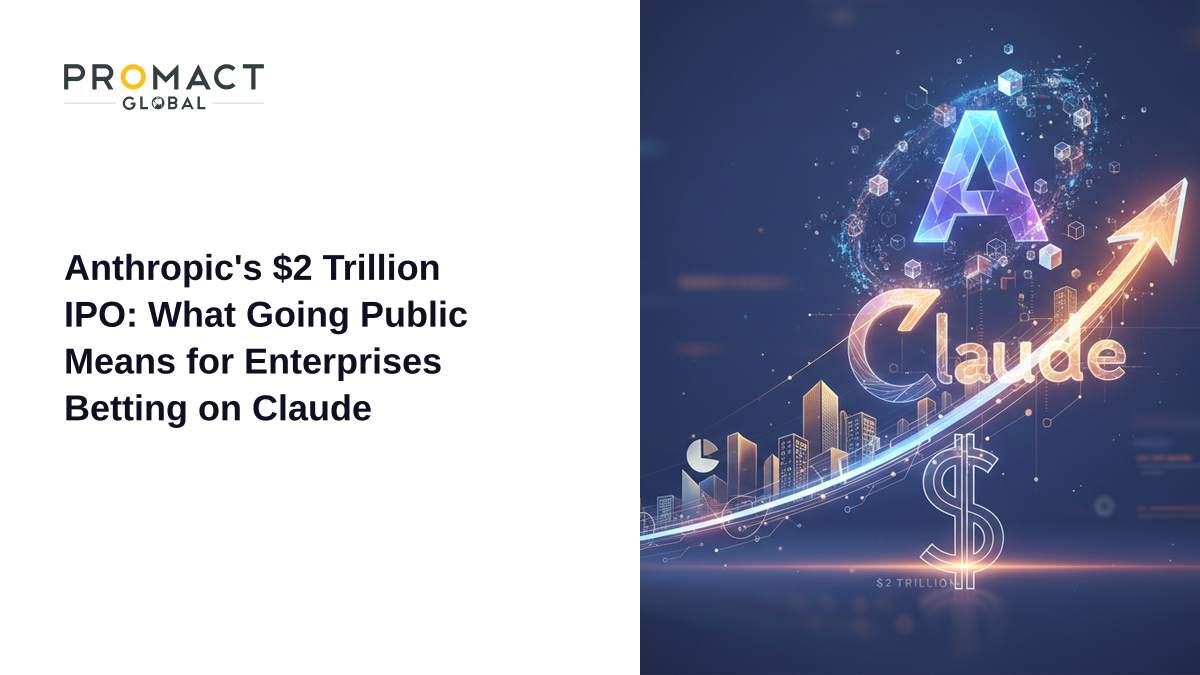
Anthropic just did something almost no frontier AI lab has done: it told investors it turned a profit. The company’s second-quarter 2026 revenue topped $11.5 billion, a roughly fourteen-fold jump from a year earlier, and it logged a $559 million adjusted operating profit — its first profitable quarter since founding. That milestone arrives just as Anthropic pushes toward a Nasdaq listing that bankers and reports now peg at a valuation as high as $2 trillion, with a possible listing as early as October 2026. If it happens, it would be one of the largest technology IPOs ever — and one of the very few times an enterprise AI vendor’s internal finances become public record.
That matters well beyond Wall Street. Anthropic has quietly become the AI vendor of choice inside a lot of enterprises: corporate card and bill-pay data from Ramp shows 43.5% of tracked US businesses now pay for Anthropic models or tools, ahead of OpenAI’s 39.7%. If your company runs Claude anywhere in its stack — through Salesforce’s Claudeforce push, a coding assistant, or a direct API contract — an IPO changes the kind of company you’re depending on. This post walks through what Anthropic actually announced, why going public changes the calculus for enterprise buyers specifically, how the move compares to OpenAI’s very different IPO posture, and what to actually do about it before the listing happens.
What Anthropic Announced
Anthropic confidentially submitted a draft S-1 registration statement to the SEC back in June 2026, and by September the process had visibly accelerated. Reports now describe Goldman Sachs, JPMorgan, Morgan Stanley, and Citigroup as lead underwriters, with the offering targeted for the window before the U.S. midterm elections in November. Nvidia is reportedly in talks to anchor the deal with up to $10 billion of its own money — a move that would lock in a chunk of shares before the stock trades publicly and tie Nvidia’s fortunes even more tightly to Anthropic’s.
None of this is finalized. Anthropic hasn’t filed a public S-1, the valuation figures floating around (reports range from $2 trillion to as high as $2.3 trillion) haven’t been locked in, and the raise size cited by different outlets ranges from $60 billion to $100 billion. Treat the specifics as directional until Anthropic files publicly. What’s solid is the direction: Anthropic is deliberately building a financial track record — two consecutive profitable quarters, a documented revenue ramp — specifically to present to public-market investors, and that track record is the part enterprise buyers should pay attention to.
The Profitability Milestone — and Its Fine Print
Posting a profit before an IPO isn’t just good optics — it’s a genuine signal about the underlying business, since most frontier AI labs are burning cash at scale. OpenAI, for comparison, is projected to lose roughly $14 billion in 2026 alone and doesn’t expect profitability until 2030. Anthropic’s path looks different: annualized revenue reportedly reached roughly $65 billion by late July, driven heavily by enterprise API usage and coding-agent products rather than a consumer subscription base.
That said, the $559 million figure deserves a closer read before you treat it as proof of durable financial health. It’s an adjusted operating profit, meaning it excludes costs like stock-based compensation — not the GAAP net income a public-company balance sheet will eventually have to report. Critics, including newsletter writer Ed Zitron, have argued the figure flatters a quarter where compute costs happened to run lower than they will going forward. Most tellingly, Anthropic told its own investors that it does not expect every future quarter, or the full year, to stay profitable, citing continued heavy spending on frontier model research and compute capacity. For a vendor you’re planning to depend on for years, that combination — real revenue growth, a genuine but narrow and self-acknowledged profitability window — is a more useful signal than either the “profitable!” headline or the skeptics’ “accounting trick!” framing alone. It’s precisely the kind of nuance that’s been impossible to verify for any private AI lab until now, and it’s exactly what a public S-1 will force into the open on a recurring basis.
Why an IPO Changes Vendor Risk, Not Just Vendor Valuation
Enterprises have spent the last two years making multi-year AI vendor bets — on model APIs, on embedded partnerships like Claudeforce, on coding agents — largely without access to the kind of financial detail that normally informs a vendor risk assessment. Private AI labs don’t publish audited financials, revenue breakdowns by product line, or customer concentration disclosures. An IPO changes that overnight.
What Public Filings Will Actually Expose
Once Anthropic files a public S-1, procurement and vendor-risk teams get something they’ve never had for a frontier AI lab: real numbers. Revenue by segment, customer concentration, cash burn on compute, and management’s own risk-factor disclosures all become a matter of public record, updated quarterly once the company lists. That’s a genuine upgrade for anyone doing the kind of contractual and financial diligence we wrote about after OpenAI’s Cursor acquisition dispute — where the lesson was that AI vendor contracts need to account for ownership and control changes you can’t fully predict. A public company can’t hide a customer-concentration problem or a compute-cost spiral the way a private one can.
What Public-Market Pressure Could Change
The flip side is that public ownership introduces a new set of stakeholders whose interests don’t automatically match yours. Quarterly earnings calls create pressure to show margin expansion, which can push pricing up, push free-tier features behind paywalls, or reprioritize roadmap work toward whatever segment analysts reward — increasingly the enterprise and coding-agent business, based on Anthropic’s current revenue mix. Activist investors, once Anthropic has public shareholders, can also push for strategic changes a private company insulated by founder control wouldn’t face. None of this is unique to Anthropic — it’s the standard tradeoff of any vendor going public — but it’s new for an AI lab, and enterprises that have gotten used to Anthropic operating with private-company flexibility should expect that to shift.
Anthropic vs. OpenAI: Two Very Different IPO Postures
The contrast with OpenAI sharpens the picture. OpenAI CEO Sam Altman has said publicly that ongoing debates over AI safety make 2026 an “ill-advised moment” to go public, and OpenAI has effectively ruled out an IPO this year despite its own restructuring into a more conventional for-profit entity. That leaves Anthropic positioned to be the first frontier lab to face public-market quarterly scrutiny — a first-mover position that carries both credibility and exposure. If Anthropic’s stock performs well post-listing, it validates enterprise AI as a public-market business and likely accelerates OpenAI’s own IPO timeline. If it stumbles — on a bad quarter, a safety incident, or a valuation correction — it becomes the cautionary tale the entire sector gets measured against, including for vendors that aren’t even public. Enterprises weighing Claude against GPT-based tools, a decision we’ve covered in the context of the broader model arms race, now have to factor “which vendor is under public-market pressure and when” into that comparison, not just model capability and price.
What Enterprise Buyers Should Actually Do
None of this means enterprises should treat an Anthropic IPO as a reason to pause Claude deployments — a profitable, well-capitalized public company is, if anything, a more durable vendor than a private one burning investor cash indefinitely. But it does mean a few concrete things belong on your list before the listing happens, not after.
First, revisit your AI vendor contracts specifically for change-of-control and material-adverse-event clauses — the same review we recommended after the Cursor acquisition saga, because an IPO is exactly the kind of corporate event those clauses are meant to cover. Second, once Anthropic’s S-1 goes public, have finance or procurement actually read the risk-factors section; it will tell you more about customer concentration, compute-cost exposure, and competitive risk than any vendor briefing will. Third, don’t treat “profitable” as “permanently priced the way it is today” — build a pricing-change scenario into your budget planning, the same discipline we’ve written about for AI investment strategy more broadly. And fourth, keep at least a credible fallback vendor evaluated and ready, not because Anthropic looks unstable, but because single-vendor dependency on any company facing its first quarterly earnings call is a risk worth hedging regardless of how strong that company’s numbers look today.
Conclusion
Anthropic turning a profit before its IPO is a genuinely good sign for enterprises already committed to Claude — it suggests a business that can fund itself rather than one perpetually dependent on the next funding round. But going public is a structural change, not just a valuation headline. It hands enterprise buyers real financial transparency for the first time, and it hands Anthropic a new set of shareholders whose quarterly expectations will shape pricing and roadmap decisions in ways private ownership didn’t. The enterprises that come out ahead won’t be the ones that panic or the ones that ignore the listing entirely — they’ll be the ones that read the S-1 when it drops, stress-test their contracts now, and treat “our AI vendor just went public” as the vendor-risk event it actually is.
Frequently Asked Questions
Has Anthropic actually filed for an IPO?
Anthropic confidentially submitted a draft S-1 registration statement to the SEC in June 2026, which lets it proceed toward a public listing after SEC review. As of mid-September 2026, no public S-1 has been filed and no final valuation, raise size, or listing date has been confirmed — reported figures are based on banker and investor discussions, not official filings.
How is Anthropic profitable when other AI labs are losing money?
Anthropic’s Q2 2026 revenue topped $11.5 billion, roughly fourteen times higher than the same quarter a year earlier, driven heavily by enterprise API and coding-agent usage. That scale allowed it to post a $559 million adjusted operating profit — a contrast with OpenAI, which is projected to lose around $14 billion in 2026. But it’s worth noting this is an adjusted figure that excludes costs like stock-based compensation, and Anthropic itself has told investors it doesn’t expect every future quarter to stay profitable.
Should my company pause its Claude deployment because of the IPO?
No. A profitable, well-funded public company is generally a more financially durable vendor, not a less stable one. The practical response is to review your contracts and pricing assumptions now, not to delay or reverse deployment decisions.
What should I actually look for once Anthropic’s S-1 becomes public?
Focus on the risk-factors section, customer concentration disclosures, and compute-cost trends. These will tell you more about how dependent Anthropic’s revenue is on a small number of large customers, and how exposed its margins are to rising GPU costs, than any public marketing material.
Why hasn’t OpenAI also filed for an IPO?
CEO Sam Altman has said publicly that ongoing debates over AI safety make this an inopportune time for OpenAI to go public, and the company is projected to keep losing money for several more years. Anthropic’s stronger revenue-to-burn ratio has put it on a faster path to a listing.
Does an IPO mean Anthropic’s prices will go up?
Not necessarily and not immediately, but it raises the likelihood over time. Public companies face quarterly pressure to show margin improvement, which can translate into price increases, reduced free-tier access, or renegotiated enterprise terms. Building a pricing-change scenario into your budgeting is a reasonable precaution.
Sources
- Anthropic’s “Profitability” Swindle - Ed Zitron’s critical analysis of Anthropic’s adjusted operating profit figure.
- Anthropic tells investors it will be profitable for second straight quarter - The Irish Times on Anthropic’s own guidance that future quarters may not stay profitable.
- Anthropic moving forward with $2 trillion IPO on Nasdaq - Yahoo Finance coverage of the IPO timeline and valuation talk.
- Anthropic reports first profitable quarter as revenue tops $11.5B - Coverage of Anthropic’s Q2 2026 financial results.
- Anthropic Targets October Nasdaq Listing At $2 Trillion Valuation - Benzinga on the listing timeline and second profitable quarter.
- Anthropic expects profit this quarter ahead of potential $2 trillion IPO - Business Standard on the pre-IPO profitability push.
- Nvidia May Invest Up to $10 Billion in Anthropic’s IPO - Bloomberg reporting on Nvidia’s anchor-investor discussions.
- Anthropic Could Land Nvidia as $10 Billion IPO Investor - PYMNTS on underwriters and deal structure.
- Anthropic vs OpenAI Business Adoption in 2026: What the Ramp Data Shows - Analysis of Ramp’s corporate spending data on enterprise AI vendor adoption.
- OpenAI Vs Anthropic IPO: How They Compare And What We Know - Forbes comparison of the two companies’ financial profiles and IPO posture.
- OpenAI’s 2026 IPO Delay: Anthropic Impact - TechRepublic on why OpenAI has ruled out a 2026 listing.
Have a project like this in mind?
Tell us what you're building — we'll help you scope it and ship it.
Talk to usKeep reading
October 21, 2026
82% Say They Can Govern AI Agents, 26% Can Resolve Their Conflicts: What OutSystems' New Survey Reveals
October 20, 2026
The Agentic Insider: What Microsoft's Guardian Agents Mean for Governing AI Agents Like Employees
October 19, 2026