May 15, 2026
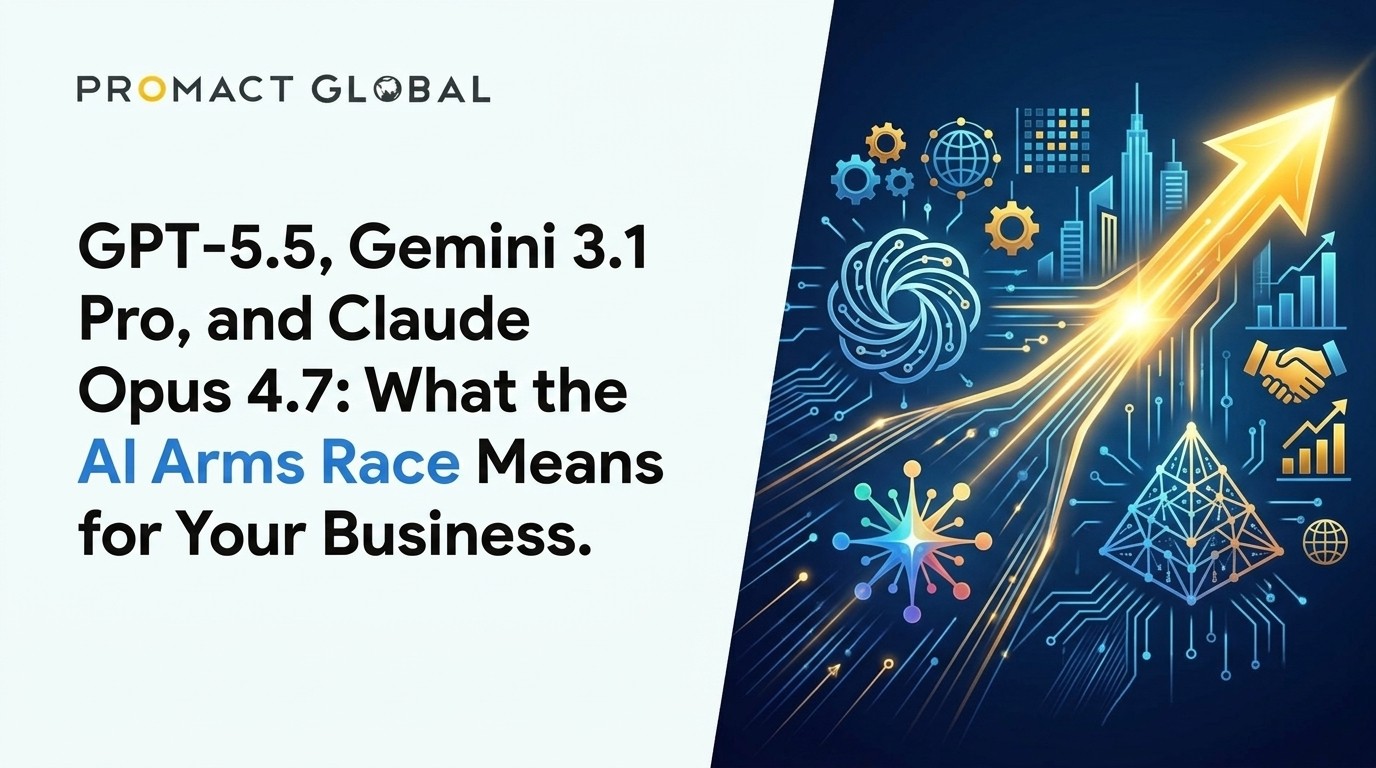
GPT-5.5, Gemini 3.1 Pro, and Claude Opus 4.7: What the AI Arms Race Means for Your Business
The AI Race Is Moving Faster Than Most Businesses Can Track
If you have been following the AI space over the last twelve months, you have probably noticed something: the announcements never seem to stop. New models, new benchmarks, new record scores on tests most people have never heard of. It can feel like watching Formula 1 cars blur past at 300 km/h. Exciting, but hard to tell which one actually matters for getting work done.
The good news is that you do not need to follow every lap of this race to make smart decisions. What you need is a clear, honest look at the top contenders right now: GPT-5.5 from OpenAI, Gemini 3.1 Pro from Google DeepMind, and Claude Opus 4.7 from Anthropic. Each of these models was released or significantly updated in early 2026, and together they represent the strongest options available at this moment.
This article is for business owners, product teams, and decision-makers who want to understand what these models actually do, where they shine, and where they fall short. We will keep the technical jargon to a minimum and focus on what genuinely matters: how to compare AI models in 2026 and choose the one that fits your work.
Why This Moment Matters More Than You Think
For a long time, AI models were judged on how well they answered questions or wrote text. That was useful, but limited. What has changed in 2026 is that the best models are now capable of something far more significant: they can take on multi-step tasks, use external tools, write and run code, browse the web, and work through complex problems with minimal hand-holding.
In the software industry, this is called “agentic” behavior. Think of it less like a search engine that answers questions and more like a capable team member who can be handed a vague problem and trusted to figure out the path forward. That shift changes the conversation around AI completely. Businesses are no longer just asking “can this help me write emails?” They are asking “can this manage my customer support pipeline, flag contract risks, or build a working prototype overnight?”
That is the context in which GPT-5.5, Gemini 3.1 Pro, and Claude Opus 4.7 were all designed and launched. Understanding how to compare AI models 2026 starts with understanding that the game has fundamentally changed.
GPT-5.5: Built for Tasks That Run Themselves
OpenAI released GPT-5.5 on April 23, 2026, and the positioning was unusually direct. Rather than leading with benchmark scores, OpenAI described it as a step toward “a new way of getting work done on a computer.” That framing tells you exactly what this model was built for.
GPT-5.5 is OpenAI’s most capable model in the GPT-5 family, specifically designed for long, complex tasks where the model needs to plan, use tools, check its own work, and keep moving forward without constant human guidance. According to OpenAI’s documentation, it excels at writing and debugging code, analyzing data, creating documents, operating software interfaces, and moving across multiple tools until a task is finished.
What sets GPT-5.5 apart is its error recovery. Earlier models would confidently proceed with a flawed plan. GPT-5.5 is better at recognizing when something has gone wrong mid-task and correcting course on its own. It also maintains coherence over long workflows, which matters when you are asking it to handle something that requires dozens of steps from start to finish.
On the math and reasoning side, GPT-5.5 scored 81.2 on the AIME 2025 math test, a notable improvement over the 65.4 scored by the earlier GPT-5.4 model.
Where GPT-5.5 works best: Complex coding workflows, multi-tool automation, data processing tasks, and any work that requires the model to operate independently over an extended period. If your team needs an AI that can run in the background and handle complicated sequences of actions reliably, GPT-5.5 is worth serious consideration.
Where it has limits: Access is restricted to paid tiers, so it is not a budget-friendly option for small teams. It is also newer, which means its behavior on edge cases is still being understood by the broader developer community.
Gemini 3.1 Pro: The Multimodal Workhorse
Google DeepMind released Gemini 3.1 Pro on February 19, 2026, and one number demands attention right away: it scored 77.1 percent on ARC-AGI-2, an abstract reasoning benchmark designed to test something closer to fluid intelligence rather than pattern memorization. That was roughly double the score of its predecessor, Gemini 3 Pro, and the highest of any commercially available model at that price point.
But raw benchmark scores only tell part of the story. What makes Gemini 3.1 Pro genuinely compelling for businesses is its architecture. It supports a one-million-token context window, which means it can process the equivalent of a 750-page book, six hours of audio, or an entire enterprise codebase in a single session. And it handles all of this natively: text, images, audio, and video can all be fed into the same model simultaneously, without needing to convert formats or use workarounds.
For industries where data comes in multiple formats at once, this is a significant advantage. Imagine a legal team reviewing a contract that includes embedded spreadsheets and scanned exhibits, or a product team feeding in user interview recordings alongside written feedback and design screenshots. Gemini 3.1 Pro can work across all of that in one pass, saving time that is normally spent on format conversion and manual summarization.
The model also leads all commercially available models on GPQA Diamond, a benchmark of PhD-level science questions, with a score of 94.3 percent. That suggests it is particularly well-suited for work requiring sophisticated domain knowledge in fields like medicine, engineering, law, and research.
Where Gemini 3.1 Pro works best: Research synthesis, large document analysis, multimodal tasks, and applications where understanding text, audio, and video simultaneously is essential. Businesses already embedded in Google’s ecosystem, including Workspace, Cloud, and Vertex AI, will also benefit from native integrations that make deployment straightforward.
Where it has limits: Some advanced features require Google AI Pro or Ultra subscriptions. Teams outside the Google ecosystem may face additional setup overhead in getting up and running quickly.
Claude Opus 4.7: The Thoughtful Coder
Anthropic released Claude Opus 4.7 on April 16, 2026, and the announcement came with an unusual degree of transparency. Alongside the launch, Anthropic noted that it has an even more powerful model called Claude Mythos Preview, but it is not releasing it publicly yet due to safety concerns. That kind of openness is part of Anthropic’s identity as a company, and it matters when you are deciding which AI provider to trust with sensitive work.
Opus 4.7 itself is a meaningful upgrade over its predecessor. It brings a 13 percent improvement on coding benchmarks, a threefold increase in production tasks successfully completed, and high-resolution vision support up to 3.75 megapixels, which is more than three times the visual processing capacity of earlier Claude models. The model also introduces a new “xhigh” reasoning effort level, giving teams finer control over how deeply the model thinks before responding. This matters in situations where speed is less important than accuracy, such as reviewing financial reports, debugging complex code, or analyzing legal documents for risk.
When teams compare AI models 2026, Claude Opus 4.7 consistently stands out in contexts requiring detailed, long-form work with high accuracy. It verifies its own outputs before reporting back, which reduces the chances of confident but incorrect answers. It also supports a one-million-token context window, and at $5 per million input tokens, the pricing is competitive for the level of capability on offer. The model is available across the Claude API, Amazon Bedrock, Google Cloud Vertex AI, and Microsoft Foundry, making it accessible through cloud infrastructure that many enterprise teams already use.
Where Claude Opus 4.7 works best: Advanced software engineering, legal and financial document analysis, instruction-following tasks where precision is critical, and agentic workflows that require the model to independently check and correct its own work.
Where it has limits: Like the others, it is a premium model priced for serious use cases. Teams that eventually want more capability may also hit a ceiling before Mythos-class systems become broadly available.
How to Compare AI Models 2026: A Practical Decision Framework
Now that you understand what each model brings to the table, the more important question is: which one should your team actually use?
The honest answer is that it depends entirely on your work. Here is a practical framework for thinking through the decision.
If your primary need is automation and task execution: GPT-5.5 is the strongest choice right now. Its ability to handle complex, multi-step workflows independently and recover from errors mid-task makes it the most self-sufficient option for businesses that want AI doing heavy lifting with minimal supervision.
If your work involves large documents, mixed media, or research across formats: Gemini 3.1 Pro’s one-million-token context window and native multimodal processing give it a genuine edge. Teams dealing with diverse, high-volume inputs, especially in healthcare, legal, and research, will find it particularly well-suited.
If accuracy, code quality, and precision matter most: Claude Opus 4.7 is built for exactly that. Its self-checking behavior, improved instruction-following, and strong performance on complex coding tasks make it the model of choice for engineering teams and professional services where mistakes are costly.
It is also worth noting that these are not mutually exclusive choices. Many businesses are moving toward multi-model architectures, where different models are used for different parts of a workflow depending on what each one does best. A startup might use GPT-5.5 for agentic task automation, Gemini 3.1 Pro for processing large research inputs, and Claude Opus 4.7 for reviewing the code that gets generated along the way.
What This Means for Software Product Teams
At a software product engineering company, we see this shift happening in real time across the projects we work on. The teams that get the most out of frontier AI are not the ones who pick a single model and move on. They are the ones who treat each model as a specialized capability and design systems around those strengths.
That means thinking about AI as infrastructure, not just as a productivity shortcut. Just as you would choose a database based on your data structure and access patterns, the right approach when you compare AI models 2026 is to map each model’s strengths to specific tasks in your product roadmap or business workflow.
The pace of improvement in this space is also genuinely remarkable. GPT-5 launched in August 2025. Within eight months, we had GPT-5.5 with substantially improved agentic reliability. Gemini 3 Pro was succeeded by Gemini 3.1 Pro, which doubled its reasoning benchmark score. Claude went through multiple major versions in under a year. The implication for businesses is that any AI strategy needs to be built with flexibility in mind. What works best today may not be the best option six months from now, and locking your architecture too tightly to any single provider makes that adaptation harder.
Building with modular, provider-agnostic patterns where possible is not just good engineering practice anymore. It is increasingly good business strategy in an environment where the competitive landscape shifts this fast.
Final Thoughts
The AI competition between OpenAI, Google, and Anthropic is not slowing down. But from a business perspective, that competition is largely a good thing. It means better tools, lower prices, and more capable models arriving faster than most people anticipated even two years ago.
What matters for your team is not who wins the race. What matters is understanding what each model is built for, how that maps to the problems you are trying to solve, and how to integrate these capabilities into your existing workflows in a way that is reliable and maintainable over time.
GPT-5.5 will handle tasks that used to require a team of people to manage. Gemini 3.1 Pro will process volumes of mixed-format content that would have overwhelmed earlier systems. Claude Opus 4.7 will write and verify complex code with a level of rigor that meaningfully reduces the review burden on your engineering team. The tools are there. The question is whether your team has a strategy for using them well.
Have a project like this in mind?
Tell us what you're building — we'll help you scope it and ship it.
Talk to usKeep reading
October 9, 2026
SAP Buys TechWolf: Why the Grounding Layer, Not the Model, Is Enterprise AI's Next Battleground
October 8, 2026
Oracle Fusion Claw: What a Governed Agent Runtime Inside Your ERP Means for Finance and Operations Teams
October 7, 2026