August 14, 2026
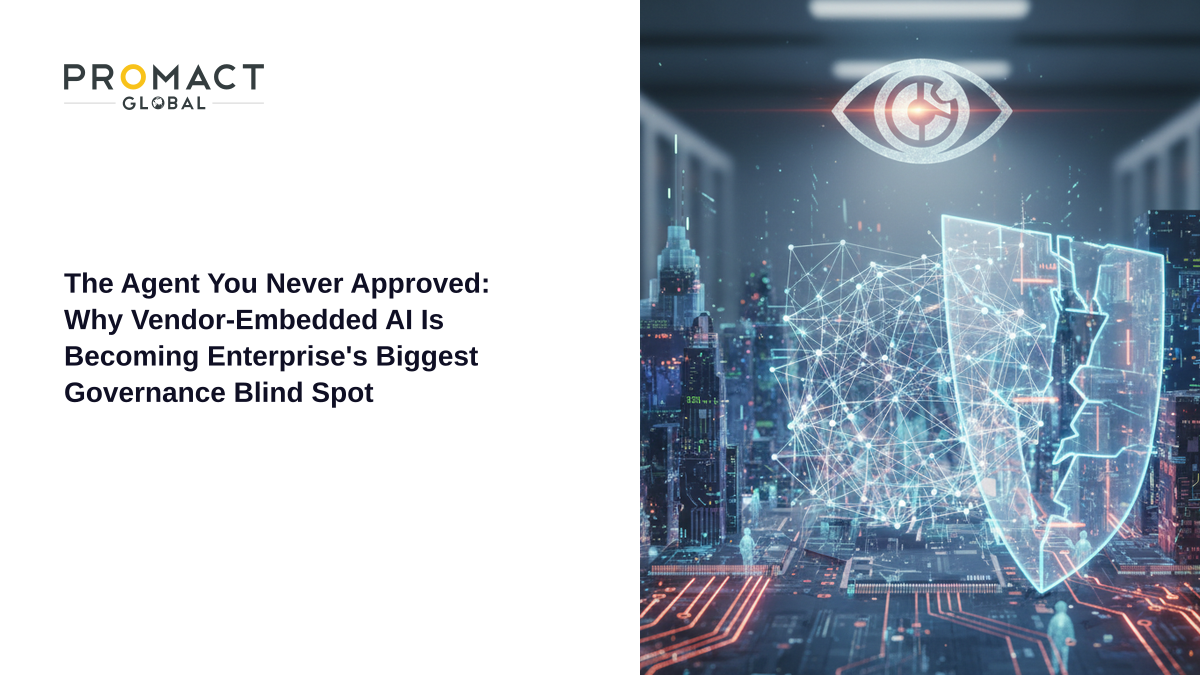
The Agent You Never Approved: Why Vendor-Embedded AI Is Becoming Enterprise's Biggest Governance Blind Spot
Somewhere in your organization right now, a piece of software you’ve been using for years just got an AI agent bolted onto it — and nobody in procurement, security, or legal signed off on it. It arrived in a routine update. It’s on by default. It can read your data, draft documents, and in some cases take action on your systems without a human clicking “approve” first.
This isn’t a hypothetical. It’s the defining enterprise software trend of 2026: vendors are embedding task-specific AI agents directly into the tools businesses already pay for, and the pace is accelerating faster than most governance functions can track. Gartner predicted in August 2025 that 40% of enterprise applications would ship with task-specific AI agents built in by the end of 2026 — up from less than 5% just a year earlier. That prediction is now playing out in real time, and it’s creating a governance blind spot distinct from the “shadow AI” problem most security teams are already tracking.
This post breaks down what vendor-embedded AI actually looks like in practice, why it’s a different risk category than employees signing up for a free chatbot, and what enterprises need to put in place before the next quarterly software update quietly adds an agent to their stack.
The Silent Shift: From Opt-In AI to Default AI
For most of 2023 through 2025, enterprise AI adoption followed a predictable pattern: a team evaluated a tool, ran a pilot, and made a deliberate decision to adopt it. That pattern is breaking down. Software vendors have realized that bundling agents into the base product — rather than selling them as an add-on — drives adoption far faster than waiting for customers to opt in.
The clearest example is Slack. Salesforce didn’t launch a new AI product; it rebuilt Slackbot, a feature that has existed inside Slack for over a decade, into a full agent that can search enterprise data, draft content, and complete tasks on a user’s behalf. The rebuilt Slackbot became generally available to Business+ and Enterprise+ customers in January 2026, and pilot users reported saving 90 minutes to two hours a day. Nobody had to buy a new SKU. The agent simply showed up inside software that was already installed, already trusted, and already exempt from the security review a brand-new vendor would have triggered.
ServiceNow took this further. In its April 2026 commercial restructuring, the company embedded AI, governance tooling, and its Moveworks acquisition across every product tier by default, ending the era of AI as a paid add-on. If a company runs ServiceNow, it now runs ServiceNow’s agents — whether or not anyone formally evaluated them.
This is a related but distinct problem from the one covered in our earlier piece on shadow AI in the enterprise: employees adopting unapproved consumer AI tools on their own initiative. Vendor-embedded AI doesn’t require an employee to go looking for anything. The risk arrives pre-installed, inside software that already passed procurement review — just not a review that accounted for an autonomous agent with data access.
The New Procurement Reality: Agent Gateways and Pay-to-Play Access
The embedding trend isn’t limited to a single vendor’s own agents — it’s reshaping how outside agents are allowed to interact with enterprise systems at all. ServiceNow, SAP, and Workday have each moved to assert control over external AI agent access to their platforms, and PYMNTS reported in mid-2026 that all three are converting that control into a new revenue line rather than an open standard.
Workday built an Agent System of Record and an Agent Gateway that opens its platform to external agents on a per-call basis. SAP requires outside agents to route through its Business Accelerator Hub to access core business rules and data. Both approaches mean that even agents your organization builds internally — using the orchestration patterns we described in The Agent Fleet Era — now have to clear a vendor-controlled tollgate before they can act on data living inside these platforms.
For enterprise IT and finance teams, this changes two things at once. First, the traditional software contract renewal conversation now needs an AI-specific line item, because vendors are pricing agent access separately from seat licenses — a shift we outlined in more detail in our guide to enterprise AI agent pricing models. Second, the “who can talk to our data” question used to have a short, known list of answers (your employees, your integrations). Now it includes every agent a vendor decides to embed or admit through its gateway, on a timeline the vendor controls, not the customer.
Why Existing Contracts Don’t Cover This
Most enterprise software agreements were negotiated before agentic features existed inside the product, which means data processing addenda, security exhibits, and liability clauses were written for a tool that reads and displays data — not one that can independently draft, send, or execute actions. Legal and procurement teams renewing contracts in 2026 are discovering that the agent capability shipped in a routine feature update, months after the underlying contract was signed and the security review closed.
Why This Converges With — and Isn’t the Same as — Shadow AI
Governance and security researchers are increasingly describing vendor-embedded AI and employee shadow AI as two branches of the same underlying problem: AI activity happening outside a clear approval and inventory process. The consequences are measurable. IBM’s 2025 Cost of a Data Breach Report found that shadow AI was a factor in 20% of breaches and added an average of $670,000 to the cost of an incident, driven largely by longer detection times and broader, harder-to-track data exposure. That figure was measured on employee-adopted tools — but the underlying mechanism (AI systems operating on enterprise data without a documented inventory entry) applies just as directly to an agent a vendor switched on by default.
Auditors are starting to treat this as a distinct category of vendor risk rather than a subset of general shadow AI. EisnerAmper’s guidance for auditors on hidden vendor risk argues that organizations now need an AI-specific vendor inventory: which vendors have added AI capabilities, what data those capabilities can access, and whether that access was disclosed at the time of the original contract or arrived later, unannounced. This is the practical extension of the action-layer governance principle we covered in Beyond Prompt Engineering: it’s no longer enough to govern what an agent is instructed to do — you also have to govern which agents have entered your environment in the first place, and through whose contract.
Regulation is starting to catch up on the disclosure side too. The transparency obligations under Article 50 of the EU AI Act became enforceable on August 2, 2026, requiring clearer disclosure when users are interacting with an AI system — a rule that applies whether that AI system was something the enterprise bought on purpose or something that showed up in a changelog.
The Governance Response: Building an AI Vendor Inventory
Enterprises that are ahead of this shift are treating vendor-embedded AI as its own line item in vendor risk management, distinct from the security risks covered in our earlier piece on AI agent security. In practice, that means three concrete additions to existing vendor and software governance processes:
1. An AI capability register, refreshed at renewal — not just at onboarding
Security and procurement teams are used to reviewing a vendor once, at initial contract signing. Because agent features are now shipped via routine product updates, that single review is no longer sufficient. Renewal cycles, and ideally quarterly check-ins for critical vendors, need to include an explicit question: has this vendor added AI or agent capability since our last review, and what data can it now access?
2. Default-off as a negotiating position
Where possible, enterprises are pushing vendors to ship new agent features as opt-in rather than opt-out, giving security teams a review window before an agent goes live rather than after. This mirrors the “default-off, review, then enable” pattern that mature organizations already apply to browser extensions and third-party integrations.
3. Mapping agent-to-data access, not just agent-to-feature access
The Gartner AI governance platform market — projected to reach $492 million in 2026 and surpass $1 billion by 2030 — exists largely to answer this question at scale: not “what can this agent do,” but “what data can this agent reach, under whose authority, and is that mapped anywhere.” Spreadsheet-based vendor tracking, which many mid-sized enterprises still rely on, doesn’t scale to an environment where a dozen core platforms can each independently add agent capability in a single quarter.
Conclusion: Treat Every Vendor Update as a Potential Governance Event
The shift from opt-in to default-on AI is a genuine convenience win — the productivity gains reported by early Slackbot users are real, and most vendor-embedded agents are built with reasonable security controls. But convenience and governance are separate questions, and 2026 is the year enterprises can no longer assume the two move together automatically.
The practical takeaway is straightforward: stop treating “we already have a signed contract with this vendor” as equivalent to “we’ve reviewed what this vendor’s software can now do.” Build (or buy) an AI capability inventory that gets refreshed at every renewal, push for default-off on new agent features where you have the negotiating leverage to ask for it, and extend existing shadow AI governance programs to explicitly include vendor-introduced agents — not just employee-adopted ones. The agents arriving inside your existing software stack this year won’t wait for a formal evaluation cycle to go live. Your governance process shouldn’t wait for one either.
Frequently Asked Questions
What’s the difference between “shadow AI” and “vendor-embedded AI”?
Shadow AI refers to employees independently adopting unapproved AI tools, such as signing up for a consumer chatbot with a work email. Vendor-embedded AI is agent capability that a software vendor adds directly into a product an enterprise already licenses and has under contract — it doesn’t require any individual employee to seek out or install anything.
Does the Gartner 40% prediction mean nearly half of business software will act autonomously by the end of 2026?
Not exactly. Gartner’s prediction covers enterprise applications that will feature task-specific AI agents — narrow, defined-scope automation, not general autonomous agents making open-ended decisions. It represents a sharp rise from under 5% of applications a year earlier, but the agents involved are still largely scoped to specific tasks rather than fully autonomous operation.
Can our organization simply refuse to let vendors turn on embedded AI features?
Sometimes, but it depends on the vendor and contract terms. Some platforms, like ServiceNow after its April 2026 restructuring, have embedded AI and governance tooling across every commercial tier by default, making it harder to opt out entirely. Where opt-out isn’t available, the priority shifts to visibility and access mapping — knowing what the embedded agent can reach — rather than blocking it outright.
Does our cyber insurance or data breach liability coverage account for vendor-embedded agents?
Many existing policies and vendor contracts were written before agentic features existed in the product, so coverage gaps are common. IBM’s 2025 breach cost data on shadow AI shows the financial exposure is real; the same due-diligence question — has this system’s AI capability been reviewed and disclosed — should be part of both insurance renewal conversations and vendor contract reviews.
What’s the first practical step a mid-sized enterprise should take?
Start with an inventory: list your critical software vendors, and for each one, confirm in writing (via the vendor’s security or trust documentation) which products currently include AI agent features and what data those features can access. This alone surfaces most of the blind spot, since many organizations have never asked the question directly of vendors they’ve worked with for years.
Sources
- Gartner: 40% of Enterprise Apps Will Feature Task-Specific AI Agents by 2026 - Gartner’s original prediction and methodology for the 40% embedded-agent figure.
- Salesforce upgrades Slackbot into true AI-powered agent - MarTech’s coverage of the rebuilt Slackbot’s general availability and capabilities.
- The New AI-Powered Slackbot Is Coming - Reported productivity gains from pilot users of the rebuilt Slackbot.
- ServiceNow Pushes the Envelope on Enterprise AI - Josh Bersin’s analysis of ServiceNow’s April 2026 default-embedded AI restructuring.
- ServiceNow, SAP and Workday Make AI Agents Pay to Play - PYMNTS’ reporting on vendor tollgate and per-call agent access strategies.
- 2025 Cost of a Data Breach Report: Navigating the AI rush without sidelining security - IBM’s data on shadow AI’s contribution to breach frequency and cost.
- The AI You Didn’t Approve: The Auditor’s Role in Managing Hidden Vendor Risk - EisnerAmper’s framework for auditing vendor-introduced AI risk.
- Shadow AI in the Agentic Era: Who Owns The Risk Governance? - ArmorCode’s analysis of the convergence between shadow AI and embedded vendor AI governance.
- Global AI Regulations Fuel Billion-Dollar Market for AI Governance Platforms - Gartner’s forecast for AI governance platform spending through 2030.
- EU AI Act: Transparency Obligations Take Effect 2 August 2026 - Cooley’s legal analysis of Article 50 transparency obligations coming into force.
Have a project like this in mind?
Tell us what you're building — we'll help you scope it and ship it.
Talk to usKeep reading
October 21, 2026
82% Say They Can Govern AI Agents, 26% Can Resolve Their Conflicts: What OutSystems' New Survey Reveals
October 20, 2026
The Agentic Insider: What Microsoft's Guardian Agents Mean for Governing AI Agents Like Employees
October 19, 2026