
September 13, 2026
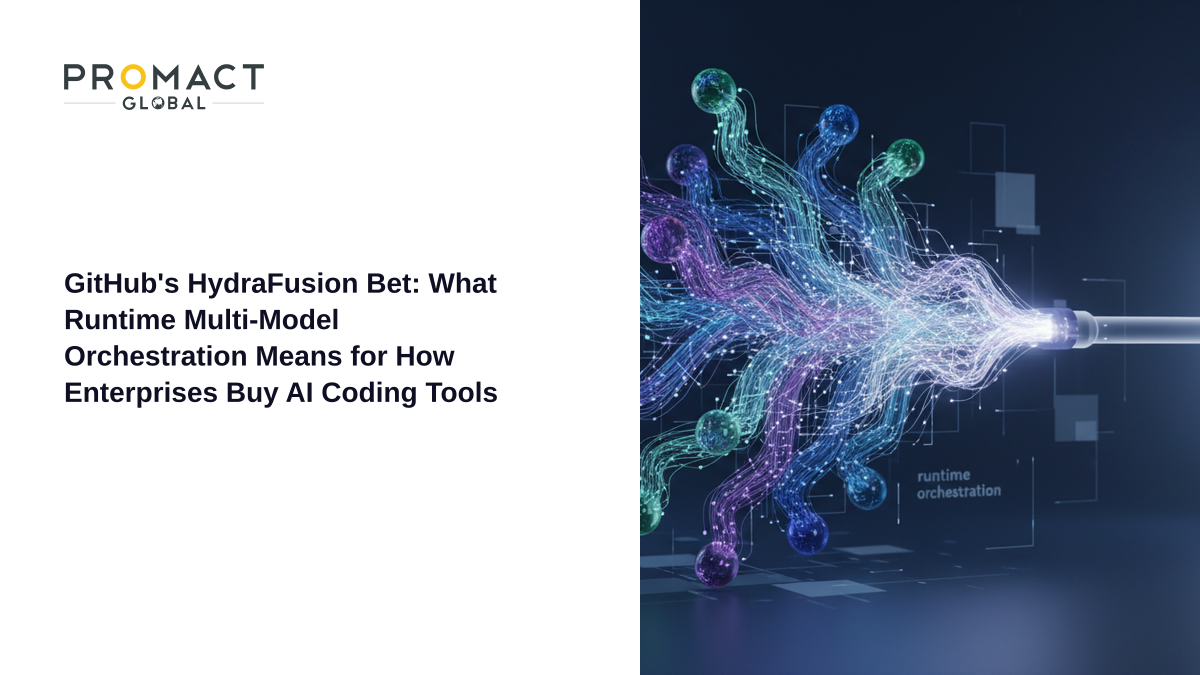
GitHub's HydraFusion Bet: What Runtime Multi-Model Orchestration Means for How Enterprises Buy AI Coding Tools
For the past two years, buying an AI coding tool meant picking a model. GPT-4, then Claude, then whichever frontier release topped the leaderboard that quarter — the decision was model-first, and everything else was configuration. That assumption just broke. On September 4, 2026, GitHub shipped Project HydraFusion as a research preview inside Copilot CLI, and it doesn’t let you pick a model at all. You pick HydraFusion, and it decides — task by task, in real time — which models across which providers actually do the work.
That’s a bigger shift than it sounds. It’s not a new model. It’s an admission, from the company that runs the most widely used AI coding assistant on the planet, that no single model is the right answer to “which AI should write this code.” This post breaks down what HydraFusion actually does, why the benchmark story is messier than GitHub’s own headline suggests, and — more importantly for anyone signing a procurement contract — what it means when the tool you buy quietly stops being one vendor’s model and becomes an orchestration layer over several.
What HydraFusion Actually Does
HydraFusion isn’t a model you select from a dropdown. It’s a routing layer that builds a full execution plan for each coding request, then works that plan across models from multiple providers. According to GitHub’s own announcement, it ships with three workflow patterns:
Single, Cascade, and Critique
- Single sends the task to one model when the orchestrator judges that’s sufficient.
- Cascade starts with a cheaper, faster model and escalates to a stronger one only if a quality gate isn’t met.
- Critique has one model draft and a model from a different family review and revise it before the result ships.
Developers on any GitHub Copilot plan can turn this on today through the /experimental flag in Copilot CLI. Usage is billed at each underlying model’s own token rate — there’s no HydraFusion-specific markup, just the accumulated cost of however many models it decided to involve. GitHub frames this as one of five “operating principles” behind the feature: what it calls complete accounting, meaning every leg of the workflow — drafting, critique, revision, escalation, retry, fallback — rolls up into a single, auditable cost figure per task, per GitHub’s blog post.
That accounting promise matters, because it’s effectively an acknowledgment that without it, nobody — not even GitHub — could tell you what a given HydraFusion task actually cost until after the fact.
The Benchmark Story Is More Complicated Than the Headline
GitHub’s pitch is “frontier quality” at a fraction of the cost of running Claude Opus 5 directly. The published numbers, run across three benchmark suites, do show real savings — but the quality picture is mixed, not uniformly positive.
Where it held up
On TerminalBench 2.1, HydraFusion actually beat Claude Opus 5 on verified task quality — by 4.9 percentage points — while cutting estimated cost by 67%. On CheckpointBench, it landed just 0.1 percentage points below Opus 5 at 65% lower cost. Those are genuinely strong results for a routing system built on cheaper components.
Where it didn’t
On DeepSWE, a benchmark focused on repository-level tasks that require cross-file navigation and end-to-end fixes, HydraFusion’s quality dropped 1.5 points below Opus 5 even as cost fell 36%. VentureBeat’s analysis of the release put it bluntly: cost went down in every benchmark GitHub tested, but quality matched or beat Opus 5 in only one of the three. GitHub itself is candid that the preview is best suited to “first-turn, single-prompt” tasks with substantial, well-scoped context — not the messiest, most ambiguous engineering work, which is exactly the DeepSWE-style task where it lost ground.
That gap is the whole story in miniature: orchestration buys you cost savings reliably, but it doesn’t buy you uniform quality. It buys you a distribution of quality that depends heavily on task shape — and most enterprises don’t currently have the tooling to tell, task by task, which side of that distribution they’re going to land on.
Why This Isn’t Just a GitHub Story
HydraFusion landed in the middle of a broader industry move toward routing-as-a-product rather than model-as-a-product. A week later, on September 11, Sakana AI shipped Fugu Max and Fugu Ultra v2 — a pair of orchestrator models that sit behind a single OpenAI-compatible API and route each request across a pool of open-weight and specialist models, priced 40-60% cheaper on output tokens than Sonnet 5, GPT-5.6 Terra, or Kimi K3. Neither GitHub nor Sakana built this in isolation: it follows the same logic behind Stripe’s $7 billion acquisition of OpenRouter, which turned model routing into billing infrastructure rather than a developer convenience.
The pattern across all three: the vendor relationship you thought you had — “we use Claude” or “we use GPT” — is quietly becoming “we use a routing layer that uses whatever it decides, from whoever it decides, priced however that mix works out.” Gartner’s forecast that 40% of enterprise applications will carry task-specific AI agents by the end of 2026, up from under 5% in 2025, means this routing-first architecture isn’t a coding-tools curiosity — it’s about to be the default shape of enterprise AI procurement generally.
The Procurement Problem Nobody’s Contract Covers
Most enterprise AI vendor agreements today are still written around a single model or a named set of models: data handling terms, security review, model-specific compliance language. An orchestration layer breaks that template in three concrete ways.
You can’t audit a vendor you can’t see
If HydraFusion decides, mid-task, to escalate from a cheaper model to Opus 5, or route a critique step to a model from an entirely different provider, your data touched a vendor that wasn’t named in your original review. GitHub’s “complete accounting” principle addresses cost transparency, not necessarily data-residency or model-provenance transparency for every leg of that workflow. If your procurement or security team requires a named list of subprocessors, ask the vendor directly whether every model an orchestrator can route to is disclosed and contractually covered — don’t assume it inherits from the primary model’s agreement.
Benchmarks age fast, and a routed benchmark ages faster
The lesson from Microsoft’s ThinkingBox work on AI agent reliability was that one successful run tells you almost nothing about repeatable production performance. That problem compounds with orchestration: HydraFusion’s routing decisions can change as GitHub tunes its quality gates, as underlying model prices shift, or as new models get added to the pool. A benchmark you ran in September may not describe the system you’re using in December, because the system itself is designed to keep changing which models it calls.
”Build vs. buy” now has a third option: rent the router
Enterprises already weighing whether to build in-house agentic coding tools or buy them off the shelf now have a third path: adopt someone else’s orchestration layer and inherit its model-mix decisions wholesale. That can be the right call — nobody wants to build their own routing logic from scratch — but it’s a different risk profile than picking a single frontier model, and it deserves a different evaluation checklist, not the one your team already has on file.
There’s also a portability angle worth flagging: as we covered when Agent Plugins 1.0 shipped, what “ports” between agentic tools is often much narrower than vendors imply. An orchestration layer tuned to one provider’s model pool is one more thing that won’t necessarily travel if you switch tools later.
What to Do About It Now
None of this means avoid multi-model orchestration — the cost savings are real and the direction is clearly where the industry is headed. It means treating “which models can this tool call, and under what terms” as a first-class procurement question, not an implementation detail you find out about later.
Concretely: ask any AI coding vendor for a full list of models their orchestration layer can route to, not just the flagship model in the marketing deck. Request task-type-level benchmark data, not an aggregate score, since quality clearly varies by task shape. Build in a re-evaluation cadence — quarterly, not annual — since the model pool behind an orchestrator is explicitly designed to change. And make sure your data-handling and subprocessor agreements explicitly cover every model the router can reach, not just the one you thought you were buying.
The tools are getting smarter about picking models on your behalf. Your procurement process needs to get just as smart about verifying what that choice actually costs you — in dollars, in quality variance, and in who touches your code.
Frequently Asked Questions
What is GitHub’s Project HydraFusion?
It’s a research preview in GitHub Copilot CLI that routes each coding task across multiple AI models from different providers at runtime, rather than sending every request to one selected model, using workflow patterns called Single, Cascade, and Critique.
How much cheaper is HydraFusion than using a single frontier model?
In GitHub’s own benchmark testing, it cut estimated cost by 36% to 67% compared with using Claude Opus 5 directly, depending on the benchmark, while quality results varied — beating Opus 5 on one benchmark, nearly matching it on another, and falling short on a third.
Is HydraFusion available to all GitHub Copilot users?
Yes. It’s available as an experimental feature, accessed via the /experimental flag in Copilot CLI, to users on all Copilot plans. Usage is billed at each underlying model’s standard token rate.
Does using an orchestration tool like HydraFusion change what I need to check before buying it?
Yes. Because the tool can route your code to multiple model providers rather than one named vendor, you should confirm which models it can call, whether each is covered under your data-handling and subprocessor agreements, and how often that model pool changes.
Is GitHub the only company building this kind of multi-model router?
No. Sakana AI released its own orchestrator models, Fugu Max and Fugu Ultra v2, on September 11, 2026, offering similar runtime routing across a model pool through a single API — suggesting this is becoming an industry pattern rather than a one-off feature.
Should enterprises avoid multi-model orchestration tools until the quality picture is clearer?
Not necessarily avoid them, but pilot them on well-scoped, first-turn tasks first — where GitHub’s own data shows the strongest results — and hold off on repository-level or highly ambiguous engineering work until you’ve validated quality on your own codebase.
Sources
- Project HydraFusion: Frontier quality via multi-model orchestration - The GitHub Blog - GitHub’s official announcement, architecture, and benchmark data.
- GitHub’s HydraFusion cuts AI coding costs in every benchmark. It only matches quality in one. - VentureBeat - Independent analysis of the benchmark results and their limitations.
- GitHub Introduces Project HydraFusion: Runtime Multi-Model Orchestration - MarkTechPost - Technical breakdown of the workflow patterns.
- Sakana AI Launches Fugu Max and Fugu Ultra v2 for Cheaper, Stronger Multi-Agent Orchestration - MarkTechPost - Coverage of Sakana AI’s competing orchestration models.
- Gartner Predicts 40% of Enterprise Apps Will Feature Task-Specific AI Agents by 2026 - Gartner’s enterprise AI agent adoption forecast.
- [Research Preview] HydraFusion is live in GitHub Copilot CLI - GitHub Community Discussion - Developer community discussion and availability details.
Have a project like this in mind?
Tell us what you're building — we'll help you scope it and ship it.
Talk to usKeep reading
October 6, 2026
Patch in Minutes, Not Months: How AI Agents Are Breaking Open-Source Security Embargoes
October 5, 2026
Agents Now Create 70% of New Databases: What Supabase's Turso Deal Means for Enterprise Data Governance
October 4, 2026