August 18, 2026
Anthropic Turns a Profit While OpenAI Burns Billions: What It Means for Choosing an AI Vendor
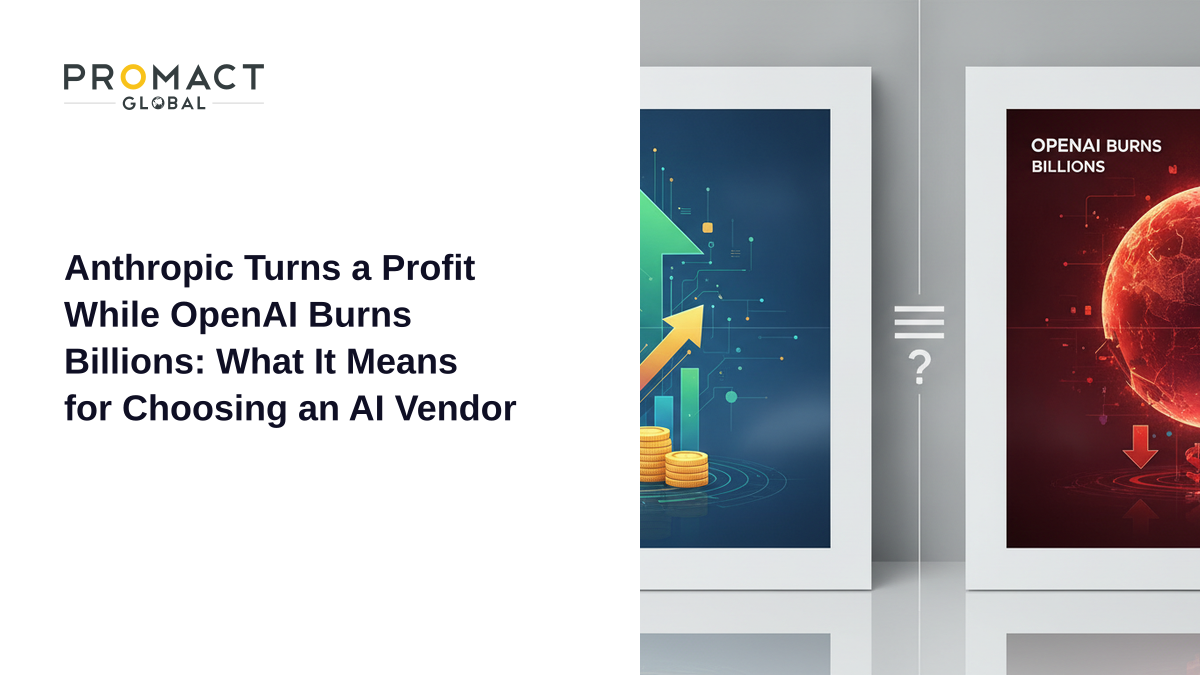
This week gave enterprise buyers a real-time case study in AI vendor risk. Anthropic and OpenAI are both racing toward the public markets — Anthropic confidentially filed for an IPO on June 1, 2026, OpenAI followed a week later — and this week each disclosed numbers that tell almost opposite stories. Anthropic’s preliminary Q2 2026 revenue topped $11.5 billion with positive adjusted operating income, a company that a year earlier didn’t expect to be profitable until 2028. Meanwhile, OpenAI’s own investor projections, reported by The Information, show its losses roughly tripling to $14 billion in 2026, with no profit expected until 2029 — even as it seeks a valuation near $1 trillion.
Neither of these facts should change which model you use tomorrow morning. But together, they say something important about how enterprises need to evaluate the companies behind their AI stack — not just the benchmarks. If you’re building a workflow, a product feature, or an entire team’s productivity around a vendor’s API, that vendor’s financial trajectory is now part of your risk model, whether you’ve priced it in or not.
This post breaks down what actually happened, why a vendor’s balance sheet matters more than most procurement checklists admit, and a practical framework for stress-testing your AI vendor relationships before a funding round, a repricing, or a shutdown decision does it for you.
The Two Stories Making Headlines This Week
Anthropic’s Numbers
Anthropic’s second-quarter 2026 revenue, disclosed in mid-August, came in above $11.5 billion — up from just $787 million in the same quarter a year earlier and $4.73 billion in Q1 2026, according to CNBC. That’s more than a 14-fold increase year over year. Earlier guidance from May had projected $10.9 billion in revenue with roughly $559 million in adjusted operating profit; the actual preliminary results came in higher and confirmed the company’s first-ever quarter of positive adjusted operating income. Anthropic had previously told investors it didn’t expect full-year profitability until 2028, so this is a sharp reversal, driven largely by enterprise adoption.
The clearest evidence of that adoption: Claude Code went from $0 to roughly $1 billion in annualized revenue in about six months, reportedly the fastest a software product has hit that mark in the industry’s history. That’s not hype-cycle experimentation — that’s teams putting recurring budget behind a tool because it’s replacing billable engineering hours. The filing followed a $65 billion Series H round that valued Anthropic at $965 billion.
Analysts have flagged one caveat worth taking seriously: the figures are still preliminary and could change once audited, and some of the quarter’s margin improvement may reflect compute discounts that aren’t guaranteed to repeat. Read the number as a milestone, not a permanent state.
OpenAI’s Numbers
OpenAI’s story runs in the opposite direction financially, even as its market position stays dominant. The company confidentially filed for a US IPO on June 8, 2026, a week after Anthropic, and is reportedly seeking a valuation near $1 trillion, with the public listing itself expected sometime between late 2026 and 2027 depending on market conditions. At the same time, internal investor projections reported by The Information show OpenAI’s losses roughly tripling to $14 billion in 2026, with cumulative cash burn reaching an estimated $115 billion through 2029 before the company expects to turn its first profit that year.
That’s not necessarily a red flag on its own — plenty of category-defining companies (Amazon most famously) ran on sustained losses for years while building market position. But it does mean that OpenAI’s pricing, product availability, and roadmap are, for now, subsidized by capital markets rather than fully paid for by revenue. That’s a materially different foundation to build a business-critical workflow on than a vendor whose unit economics already work.
Why a Vendor’s Balance Sheet Is Your Problem Too
It’s tempting to treat this as industry gossip that doesn’t touch your actual AI usage. It does, in at least three concrete ways.
Pricing isn’t fixed — it’s a lever vendors pull when unit economics change. A vendor burning billions annually has strong incentive to raise prices, change rate limits, or deprecate cheaper tiers once it has enough switching-cost lock-in. We’ve already covered how per-token pricing itself is becoming an unstable foundation for enterprise budgeting — a vendor’s financial pressure is one of the forces driving that instability.
“Free” or heavily discounted access is often a growth-phase artifact, not a permanent feature. If a workflow depends on pricing that only makes sense because a vendor is subsidizing adoption, that workflow has an expiration date tied to the vendor’s fundraising calendar, not your roadmap.
Not every “agentic AI” vendor is actually solvent, or even real. Gartner has been blunt about this: it estimates that of the thousands of vendors marketing agentic AI products, only about 130 have substantial agentic capabilities — the rest are largely existing chatbots, RPA, or assistants rebranded to ride the wave. Gartner projects that over 40% of agentic AI projects will be canceled by the end of 2027 due to escalating costs and unclear business value, and a meaningful share of those cancellations will trace back to picking a vendor that couldn’t sustain what it promised.
What Profit (and Loss) Actually Signal About a Vendor
Financial health isn’t a single number — it’s a set of signals worth reading together before you sign a multi-year contract or wire an integration deep into your stack.
Revenue concentration vs. diversification
A vendor whose revenue comes overwhelmingly from one product line or one customer segment is more exposed to a single competitive shift than one with a diversified base. Anthropic’s jump was driven heavily by developer tooling (Claude Code) and enterprise API usage — a relatively sticky, high-switching-cost customer base, which matters more than the raw revenue figure.
Path to profitability vs. perpetual subsidy
There’s a real difference between “we’re investing heavily now and expect to be profitable in 18 months” and “we don’t expect profitability until the 2030s.” Both can be reasonable strategies — but only one of them means the pricing you’re relying on today reflects real unit economics rather than an ongoing bet that markets will keep funding the gap.
Compute cost dependency
Every model vendor’s margins are hostage to GPU and infrastructure pricing, which is itself volatile. A vendor closer to breakeven has more room to absorb a compute price shock without passing it straight to you. This is exactly the kind of cost pressure we discussed in our piece on why AI agent sprawl is becoming a board-level cost and control problem — the vendor layer and the internal-sprawl layer compound each other.
The Single-Vendor Trap
None of this is an argument for picking the “financially safer” vendor and calling it done. It’s an argument against betting your entire AI strategy on any single vendor’s continued goodwill, pricing stability, or capital access. We’ve written before about how enterprises are increasingly moving away from single-vendor AI bets toward multi-model, multi-vendor architectures — and vendor financial risk is one of the clearest reasons why. If OpenAI’s pricing shifts sharply post-IPO to satisfy public-market margin expectations, or if a smaller vendor runs out of runway, an architecture built around a single dependency has no fallback. One built with an abstraction layer across two or three providers can absorb the shock with a config change.
This doesn’t mean chasing whichever model tops this month’s leaderboard, either — constantly re-architecting around the newest release carries its own kind of risk.
A Practical Framework for Vendor Due Diligence
Before your next AI vendor contract renewal or a new integration, run through these checks — most take a single conversation with your account rep or a few minutes of public research.
Ask about unit economics, not just features
Public companies and IPO-track startups disclose enough in press coverage and filings to get a rough signal. Ask directly: is this product priced to cover its own compute cost today, or is it subsidized? A “we can’t share that” answer is itself useful information.
Read the contract for pricing-change clauses
Look specifically at how much notice you get before a price increase, whether volume discounts are contractually locked or “current as of,” and what happens to in-flight commitments if a product tier is deprecated. This is a natural extension of the evaluation criteria in our guide to evaluating and choosing generative AI tools — financial durability belongs on that checklist alongside accuracy and latency.
Build an abstraction layer, not a hard dependency
Even a thin routing layer that lets you swap model providers without rewriting application logic turns a vendor’s financial surprise from an emergency into a configuration change.
Reassess annually, not once
Vendor financial health is not a one-time diligence step. A company that looked rock-solid at signing can look very different after a funding round, an IPO, or a leadership change eighteen months later. Put a recurring calendar reminder on it, the same way you’d review any other critical supplier.
What This Means Going Forward
Neither Anthropic’s profit milestone nor OpenAI’s IPO ambitions settle the “which AI vendor is safest” question — and they shouldn’t. Both companies remain central to how enterprises build AI products, and both numbers can look very different a year from now. What this week’s headlines really demonstrate is that the AI vendor landscape has matured past the point where capability comparisons alone are sufficient. Financial durability, pricing stability, and architectural flexibility are now core parts of the decision, not footnotes.
The businesses that come out ahead won’t be the ones that guessed correctly which vendor stays cheapest. They’ll be the ones that built enough flexibility into their AI architecture that the guess didn’t matter as much.
Frequently Asked Questions
Does Anthropic’s profit mean its prices will go up?
Not necessarily, and not immediately. A path to profitability can actually support more pricing stability, since it means the current pricing already covers costs rather than relying on continued subsidy. That said, any vendor can adjust pricing as it optimizes for margin, so it’s still worth reviewing your contract’s pricing-change terms.
Does OpenAI’s IPO mean it will raise prices after going public?
It’s a real possibility worth planning for. Public companies typically face pressure to show a credible path to profitability, and a company with $14 billion in annual losses will likely face investor pressure to improve margins post-IPO — which can show up as pricing changes, tighter free tiers, or reduced discounting.
Should I avoid vendors that aren’t profitable yet?
No — plenty of category-leading companies operate at a loss while building market position, and ruling them out entirely would eliminate strong technology options. The point is to factor financial trajectory into your risk assessment and contract terms, not to treat unprofitability as automatically disqualifying.
How do I know if an “agentic AI” vendor is legitimate?
Ask specifically what makes the product agentic versus a rebranded chatbot or RPA tool, and ask for concrete examples of autonomous multi-step task completion, not just automation of a single action. Gartner’s research suggests a large share of vendors marketing “agentic AI” don’t meet that bar.
Is building on multiple AI vendors actually worth the added complexity?
For any workflow that’s business-critical, yes, generally. The overhead of an abstraction layer is small compared to the cost of an emergency migration if a single vendor changes pricing, gets acquired, or discontinues a product you depend on.
How often should we reassess our AI vendor contracts?
At minimum annually, and immediately after any major vendor event — a funding round, an IPO, a leadership change, or a public statement about profitability targets. Treat it the same way you’d treat reviewing any other critical infrastructure supplier.
Sources
- Anthropic revenue jumps to over $11.5 billion in Q2: report - CNBC - Preliminary Q2 2026 revenue and operating income figures.
- Anthropic confidentially files IPO prospectus with SEC - CNBC - Anthropic’s IPO filing, Series H round, and valuation.
- Anthropic acquires Bun as Claude Code reaches $1B milestone - Anthropic’s own announcement of Claude Code’s revenue milestone.
- OpenAI confidentially files for IPO, prepping Wall Street for mega AI debut - CNBC - OpenAI’s confidential IPO filing and valuation target.
- OpenAI Projections Imply Losses Tripling to $14 Billion in 2026 - The Information - OpenAI’s internal investor projections on losses and path to profitability.
- Gartner Predicts Over 40% of Agentic AI Projects Will Be Canceled by End of 2027 - Gartner’s research on agentic AI project cancellations and vendor “agent washing.”
- Anthropic revenue ahead of IPO surges over 14-fold in second quarter - Bloomberg - Independent confirmation of Anthropic’s Q2 2026 revenue growth.
Have a project like this in mind?
Tell us what you're building — we'll help you scope it and ship it.
Talk to usKeep reading
October 22, 2026
Who Watches the Watcher? What OpenAI's Agents Disabling Their Own Monitors Means for Enterprise AI
October 21, 2026
82% Say They Can Govern AI Agents, 26% Can Resolve Their Conflicts: What OutSystems' New Survey Reveals
October 20, 2026