
January 16, 2026
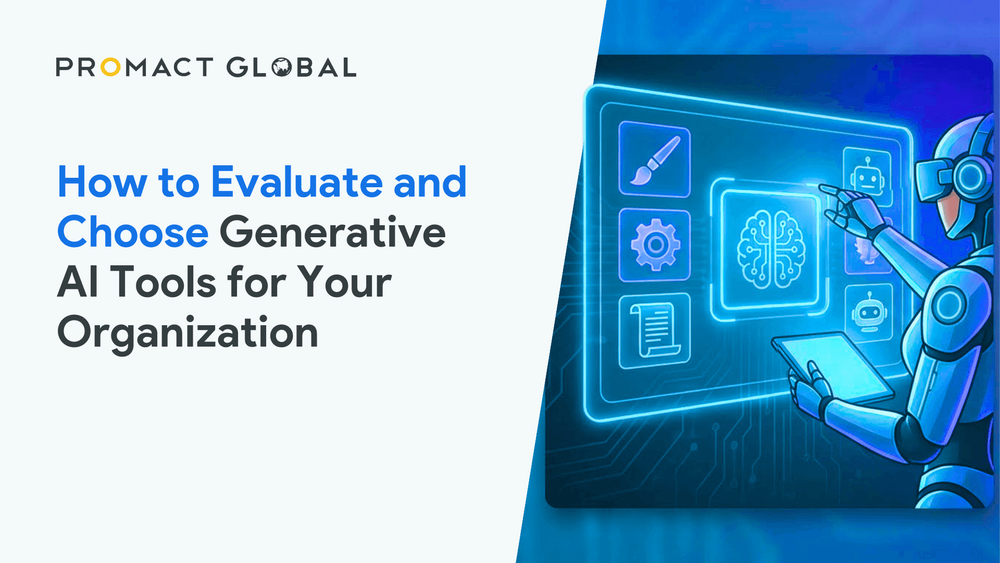
How to Evaluate and Choose Generative AI Tools for Your Organization
Generative AI feels a bit like the early days of smartphones.
When the first iPhone launched, people did not ask, “Which app store ecosystem should I commit to for the next decade?” They just wanted a phone that worked.
Fast forward a few years, and that choice decided everything. Apps, integrations, upgrades, even switching costs.
Generative AI tools are at that same stage today.
Every week, a new AI product promises faster work, smarter decisions, and magical productivity gains. Chatbots, copilots, agents, writing tools, coding assistants. The list keeps growing. But here is the hard truth most businesses learn the slow way.
Choosing the wrong generative AI tool does not just waste money. It slows teams down, creates security risks, and locks you into decisions that are painful to undo.
At Promact Global, we have seen this pattern repeatedly while helping teams explore AI adoption. The companies that succeed are not chasing the smartest model. They are choosing the right fit for their context.
This article is a practical guide to help you do exactly that.
We will walk through a clear decision matrix based on real business factors like budget, maturity, domain fit, integration, scalability, vendor lock-in, and support. No hype. No heavy technical terms. Just a structured way to choose generative AI tools that actually work for your business.
Start With One Honest Question: How Ready Is Your Organization?
Before looking at tools, pause and look inward.
Most AI failures happen not because the model was bad, but because the organization was not ready.
A simple way to think about this is AI maturity.
Stage 1: Curious but Unstructured
This is where most companies start.
Teams use public tools like ChatGPT, Midjourney, or Gemini on their own. There is no formal policy, no shared learning, and no integration with business systems.
If this sounds familiar, that is okay.
At this stage, your goal is learning safely.
What to choose
- Secure, enterprise-ready versions of general AI tools
- Tools that do not train on your data
- Tools that require no integration work
What to avoid
- Building custom AI systems
- Self-hosting models
- Complex agent frameworks
Trying to build “Iron Man” when you are still figuring out the suit rarely ends well.
Stage 2: Pilots and Experiments
Here, AI is no longer a curiosity. Teams are running experiments in marketing, support, or engineering.
You might have one tool for content, another for coding, and a third for internal research.
The risk at this stage is fragmentation.
What to choose
- Domain-specific AI tools
- SaaS tools with simple integrations
- Low-code or no-code AI platforms
What to avoid
- Tools that require heavy data engineering
- Vendors with unclear security terms
This is where many businesses first ask how to select AI tools thoughtfully instead of impulsively.
Stage 3: Embedded in Core Workflows
AI now touches real business processes. Sales, support, engineering, or operations depend on it.
At this stage, mistakes become expensive.
What to choose
- Platforms that integrate with your CRM, ERP, or internal systems
- Tools with clear governance and audit logs
- Vendors with strong enterprise support
What to avoid
- Black-box tools you cannot control
- Vendors that make switching difficult
The Decision Matrix That Actually Matters
Now that maturity is clear, let us walk through the decision matrix step by step.
Think of this as a checklist, not a scorecard.
1. Budget: Predictable or Variable?
This is where many teams get surprised.
Generative AI pricing usually follows one of two models.
Seat-based pricing You pay per user per month. This works well when AI is used daily by the same people.
Usage-based pricing You pay based on tokens or requests. This works well for automated workflows or uneven usage.
Ask yourself:
- Will this tool be used by many people occasionally, or a few people constantly?
- Can we predict usage six months from now?
Choosing generative AI tools is as much a finance decision as a technical one.
2. Domain Fit: General vs Specialized
Not all AI tools are meant for every job.
A general chatbot might be fine for brainstorming, but risky for legal summaries or medical notes.
Ask:
- Does this tool understand our industry language?
- Does it cite sources when accuracy matters?
- Has it been trained or tuned for our domain?
For example:
- Legal teams need tools that reduce hallucinations and show citations.
- Engineering teams need tools that understand large codebases.
- Marketing teams need tools that maintain brand tone consistently.
A good generative AI tool selection criterion always starts with domain fit.
3. Integration: Where Will This Live?
This is where excitement meets reality.
A powerful AI tool that lives outside your workflow often becomes forgotten.
Ask:
- Can this tool connect to our email, documents, CRM, or ticketing system?
- Does it offer APIs or connectors?
- Will employees need to switch tools constantly?
At Promact Global, we often see higher adoption when AI lives inside existing systems rather than as a separate app.
If it adds friction, it will be ignored.
4. Scalability: What Happens If It Works?
This is a good problem to have, but many teams forget to plan for it.
Ask:
- Can the tool handle increased usage without slowing down?
- Will costs grow linearly or unpredictably?
- Does the vendor have clear uptime commitments?
A pilot that works for ten users can collapse under a thousand.
Scalability is not about today’s success. It is about tomorrow’s stress test.
5. Vendor Lock-In: Can You Exit Gracefully?
This topic is often ignored until it hurts.
Vendor lock-in happens when:
- Your data cannot be exported easily
- Your prompts or workflows only work with one provider
- Pricing changes leave you with no alternatives
Ask:
- Can we switch models later?
- Can we export our data and prompts?
- Are we tied to proprietary formats?
Think of it like choosing a streaming service that only works on one TV brand.
Freedom matters more than it seems.
6. Security and Data Responsibility
This is non-negotiable.
Ask these questions clearly:
- Does the vendor train on our data?
- Where is our data stored?
- Is there audit logging?
- Does it support SSO and access control?
If a vendor cannot answer these in simple terms, walk away.
No productivity gain is worth a compliance nightmare.
7. Support: Who Helps When Things Break?
AI tools do fail. Outputs change. Models update. Behavior shifts.
Ask:
- Is enterprise support available?
- Do we get a dedicated contact?
- Are there clear SLAs?
Community support is great. Business-critical systems need more than a forum thread.
A Simple Decision Checklist
Before finalizing any tool, review this list.
Strategy and Fit
- Does this match our AI maturity?
- Is the pricing model aligned with our usage?
- Do we have a clear success metric?
Security
- No training on our data
- Clear data location
- Access controls and logs
Technical
- Integrates with existing systems
- Scales with usage
- Low friction for users
Risk
- Clear exit path
- No forced long-term lock-in
- Vendor stability
If you cannot confidently tick most of these, pause.
A Note on Open vs Closed AI Tools
This question comes up often.
Closed tools are easier to start with. They are managed, polished, and fast to deploy.
Open tools offer more control and lower long-term cost but need strong technical teams.
We often recommend a hybrid approach:
- Closed tools for general productivity
- Custom or open models for core business differentiation
There is no single correct answer. Only context-driven choices.
Why Most AI Tool Decisions Fail
From experience, failures usually come from three mistakes.
Chasing features instead of outcomes More features do not mean more value.
Ignoring people and process Without training and trust, tools sit unused.
Skipping governance Shadow usage grows, risks increase, and confidence drops.
Technology amplifies what already exists. It does not fix broken systems on its own.
Final Thoughts
Choosing generative AI tools is not about finding the smartest model or the newest product.
It is about alignment.
Alignment with your budget. Alignment with your maturity. Alignment with your domain. Alignment with your long-term strategy.
We believe the real power of AI comes not from the tool itself, but from how thoughtfully it is chosen and implemented.
If you treat AI selection like a one-time purchase, you will struggle. If you treat it like an evolving capability, you will win.
And when in doubt, slow down.
The right choice today saves years of rework tomorrow.
Have a project like this in mind?
Tell us what you're building — we'll help you scope it and ship it.
Talk to usKeep reading

October 23, 2026
Meet Harvey: The Open-Source AI Sales Agent That Runs on Your Own Subscription

October 23, 2026
The Agentic Cloud: What Daytona's $1 Billion Valuation Says About Where AI Agents Actually Work

October 22, 2026