
August 15, 2026
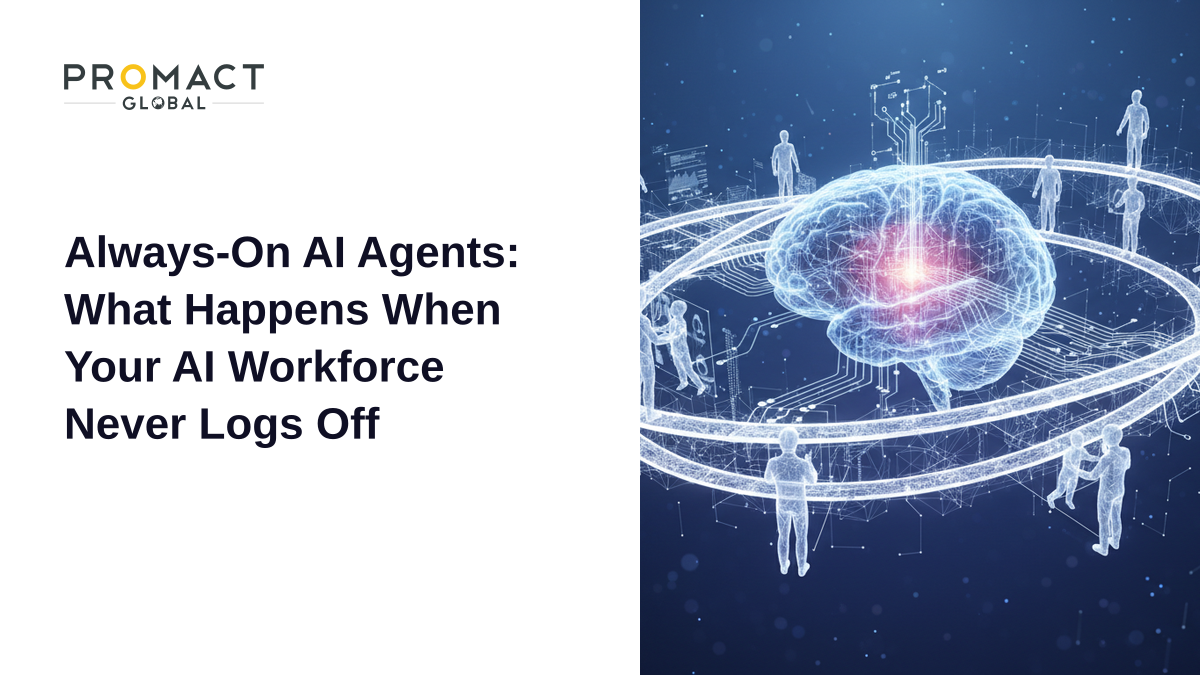
Always-On AI Agents: What Happens When Your AI Workforce Never Logs Off
For years, “AI agent” meant something that woke up when you typed a prompt and went back to sleep when you closed the tab. That model just broke. In the second week of August 2026, three unrelated announcements — from a frontier AI lab, a cloud infrastructure giant, and a global engineering services firm — all pointed at the same shift: AI agents that never log off.
SpaceXAI — the company formerly known as xAI, folded into SpaceX in a 2026 merger — launched Grok Bot on August 11 as a beta product built around agents that run on their own cloud computer, not the user’s laptop, so a task keeps executing after the screen goes dark. The same day, Oracle’s OCI Enterprise AI became one of the first cloud providers to support NVIDIA Nemotron 3.5 Lightning, a model NVIDIA designed specifically for what it calls “always-on agents.” And L&T Technology Services unveiled AgenticIQ, a platform built to run continuous, autonomous multi-agent workflows across engineering and manufacturing operations rather than one-off pilots.
None of these are chatbots that wait for a message. They are closer to shift workers who never clock out. That distinction matters more than it sounds, and it’s worth understanding before your organization signs up for it.
From Session-Based to Persistent: What “Always-On” Actually Changes
Most enterprise AI deployments today are still fundamentally session-based. Someone opens a chat window, gives an instruction, gets a response, and the agent’s “existence” ends until the next prompt. Even tools marketed as autonomous — coding assistants, research copilots — typically run for the length of a task and then stop.
Always-on agents are architected differently. According to reporting on the Grok Bot launch, users can assign one agent as a “chief of staff” that manages a roster of specialist bots handling inbox triage, expense processing, recruiting, or bug fixes — and those bots message each other, share context, and coordinate in group chats without a human relaying information between them. Bots can also learn a workflow by demonstration: shown a task once, they save it as a routine that runs on a recurring schedule.
This is a meaningful departure from the “digital employee you onboard and then direct” model most businesses have been building toward, discussed in our guide to onboarding your first AI agent. An always-on agent isn’t waiting for direction — it is actively watching for triggers, running scheduled routines, and making judgment calls about when to escalate to a human, 24 hours a day.
Why the Infrastructure Is Catching Up Now
Always-on agents have been technically possible for a while. What changed in August 2026 is that the economics finally work. NVIDIA’s Nemotron 3.5 Lightning, the model underpinning OCI’s new offering, is a 30-billion-parameter mixture-of-experts model with only 3 billion active parameters per inference, distilled from NVIDIA’s larger Nemotron 3 Ultra specifically so it’s cheap enough to leave running continuously rather than invoking on demand. Nemotron 3 Ultra itself claims up to 5x faster inference and up to 30% lower cost than comparable open frontier models for long-running agent workloads.
That cost curve is bending across the industry, not just at NVIDIA. Weeks earlier, on July 30, OpenAI cut input pricing on its GPT-5.6 Luna model by 80% — from $1.00 to $0.20 per million input tokens — a move aimed squarely at high-volume, continuous API workloads rather than one-off chat sessions. When inference is cheap enough to run in the background indefinitely, “always-on” stops being a novelty and starts being a default architecture choice.
L&T’s AgenticIQ shows what this looks like applied to a specific vertical: its cloud-agnostic architecture is built so manufacturers can run autonomous multi-agent workflows continuously across engineering, product development, and industrial operations rather than triggering isolated pilots per department — closer to standing infrastructure than a tool anyone opens and closes.
The Governance Gap Nobody Has Closed Yet
Here’s the uncomfortable part: the industry’s ability to deploy always-on agents is currently outrunning its ability to govern them. A 2026 enterprise survey found that 80.9% of technical teams have moved past planning into active testing or production with AI agents, but only 14.4% of those agents went live with full security and IT approval. That gap is exactly what we flagged in our piece on why 94% of enterprises are losing control of their own AI agent sprawl — and an agent that runs continuously, coordinating with other agents, magnifies an ungoverned sprawl problem instead of shrinking it.
The financial stakes back this up. Gartner projects that more than 40% of agentic AI projects will be canceled by the end of 2027, citing escalating costs, unclear business value, and inadequate risk controls as the leading causes — not model quality. That echoes MIT’s widely cited NANDA research, which found 95% of generative AI pilots deliver no measurable P&L impact, with the failure traced to poor integration into existing workflows rather than the underlying AI itself. An agent that’s on all the time and integrated poorly doesn’t fail quietly — it fails continuously, at whatever cadence its schedule runs.
Cost governance specifically needs rethinking under an always-on model. Analysts recommend budgeting roughly 10% to 20% of total AI agent project cost specifically for governance and risk management, a figure that assumes session-based usage patterns most finance teams can already forecast. A persistent agent racking up inference costs and API calls around the clock changes that math, and it’s the same reason enterprise AI governance is becoming the real bottleneck for scaling agent fleets rather than model capability.
What This Means for Your Business
None of this means always-on agents are premature or that your business should wait them out. The cost curve that makes them viable is real, and competitors in engineering, manufacturing, and knowledge work are already adopting them, as L&T’s launch into engineering and manufacturing demonstrates. But treating an always-on agent like a slightly more capable chatbot is the mistake that shows up in Gartner’s cancellation numbers.
A few practical steps for evaluating this shift:
Start with one narrow, high-frequency task. Continuous inbox triage, scheduled report generation, or recurring compliance checks are lower-risk always-on candidates than open-ended decision-making. Match the always-on architecture to work that genuinely benefits from running around the clock — most tasks don’t.
Insist on human-approval gates before you go live, not after. Grok Bot’s own design pauses for approval when an action crosses a defined threshold; make sure any always-on platform you adopt has an equivalent, and that it’s configured, not just available. This is the same principle behind keeping a human “approve” button in the loop on modern AI systems.
Budget for continuous monitoring, not just continuous compute. If an agent runs 24/7, someone needs to review what it did 24/7 — even if that review is itself partly automated. Treat the governance line item as a fixed cost of the deployment, not an optional add-on.
Audit vendor claims about “always-on” against your actual uptime needs. Not every workflow needs a bot that never sleeps; some genuinely just need a faster response the next time someone opens a chat window. Buying persistent infrastructure for a problem that doesn’t require persistence is exactly how projects end up in Gartner’s cancellation bucket.
The shift from session-based to always-on agents is a real infrastructure change, not marketing repositioning — the pricing, the model architecture, and the governance conversation are all moving together. The businesses that get value from it will be the ones that scope it narrowly, govern it deliberately, and resist the urge to make every agent in the fleet run continuously just because the technology now allows it.
Frequently Asked Questions
What makes an “always-on” AI agent different from a regular AI chatbot or assistant?
A regular assistant runs only while you’re actively interacting with it and stops when the session ends. An always-on agent runs on its own cloud infrastructure continuously, executing scheduled routines, monitoring for triggers, and coordinating with other agents even when no human is actively using it.
Is always-on AI agent technology only available to large enterprises?
Not exclusively. Products like Grok Bot are currently bundled into premium consumer and prosumer subscription tiers, while platforms like AgenticIQ and OCI’s Nemotron-backed infrastructure target larger organizations. Pricing and access are still stratified, but the underlying inference cost drops that enable always-on operation benefit smaller deployments too.
What’s the biggest risk of adopting always-on agents right now?
Governance lagging deployment. Industry data shows the large majority of AI agents already in testing or production went live without full security and IT approval, and continuous operation means any gap in oversight compounds around the clock rather than only during active use.
Do always-on agents cost more to run than session-based ones?
It depends on the workload. Continuous operation means continuous inference cost, but newer models built for this use case, like NVIDIA’s Nemotron 3.5 Lightning, are specifically optimized to make persistent operation cheaper per task than repeatedly cold-starting a larger model.
How should a business decide if a task is a good fit for an always-on agent?
Good candidates are high-frequency, well-defined, and benefit from continuous monitoring — like inbox triage or recurring compliance checks. Open-ended, judgment-heavy tasks are poor fits until an organization has governance and approval gates in place, regardless of the underlying model’s capability.
Are always-on agents covered by existing AI regulations?
It depends on jurisdiction and use case. Regulatory frameworks are still catching up to persistent, autonomous agents specifically; businesses operating in regulated industries or under frameworks like the EU AI Act should treat continuous autonomous operation as a higher-scrutiny use case rather than assume existing session-based compliance reviews cover it.
Sources
- xAI Launches Grok Bot, Always-On AI Teammates With Their Own Cloud Computers - Unite.AI - Details on Grok Bot’s architecture, coordination features, and pricing tiers.
- Grok Bot puts always-on AI agents inside workplace apps - Digital Watch Observatory - Coverage of bot coordination, “chief of staff” pattern, and approval gates.
- What’s New in Oracle AI? August 2026 Edition - Oracle Blogs - Confirms OCI Enterprise AI’s support for NVIDIA Nemotron 3.5 Lightning starting August 11, 2026.
- NVIDIA Nemotron 3.5 Lightning on FriendliAI - Technical specifications on Nemotron 3.5 Lightning and Nemotron 3 Ultra performance claims.
- L&T Technology Services Launches AgenticIQ - BusinessWire - Official launch announcement and platform architecture details.
- AI Agent Security in 2026: Enterprise Risks & Best Practices - Beam AI - Survey data on the gap between AI agent deployment and formal security approval.
- Gartner Predicts Over 40% of Agentic AI Projects Will Be Canceled by End of 2027 - Official Gartner press release on agentic AI project cancellation forecasts.
- MIT report: 95% of enterprise AI pilots fail to deliver measurable ROI - Healthcare IT News - Coverage of MIT NANDA’s “GenAI Divide” research on enterprise AI ROI.
- AI Agent Governance: How to Control Costs, Usage, and Risk in Multi-Agent Environments - Bravent - Governance budgeting guidance for enterprise AI agent deployments.
- AI price wars: OpenAI cuts GPT-5.6 Luna prices by 80% - VentureBeat - Details on OpenAI’s July 30, 2026 pricing cut for GPT-5.6 Luna.
- Elon Musk Rebrands Merged XAI And SpaceX As SpaceXAI - Dataconomy - Background on the 2026 SpaceX–xAI merger and rebrand.
Have a project like this in mind?
Tell us what you're building — we'll help you scope it and ship it.
Talk to usKeep reading
October 23, 2026
Meet Harvey: The Open-Source AI Sales Agent That Runs on Your Own Subscription
October 23, 2026
The Agentic Cloud: What Daytona's $1 Billion Valuation Says About Where AI Agents Actually Work
October 22, 2026