August 24, 2026
The Agentic Commerce Land Grab: What It Means When Your AI Agents Can Pay for Things Themselves
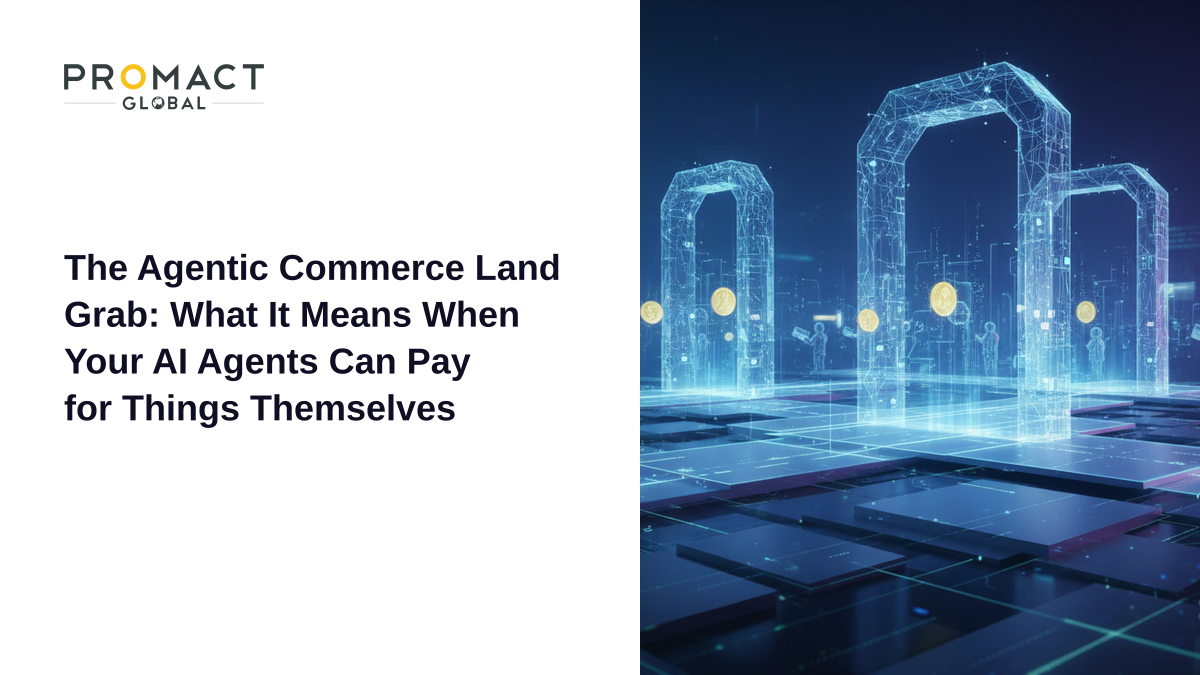
For the last three years, “agentic AI” has mostly meant agents that read, write, and decide. In the last few months, a quieter shift has been underway: agents that pay. Coinbase and Cloudflare have opened a foundation around a stablecoin payment standard called x402. Google’s Agent Payments Protocol has signed up more than 60 launch partners. Visa and Mastercard have each shipped their own agent-payment frameworks. None of this is speculative anymore — the rails are live, and the first production traffic is already running over them.
That matters for a very practical reason: once an AI agent can independently authorize a payment, the conversation about AI governance stops being about what an agent is allowed to say and starts being about what it’s allowed to spend. This post breaks down what’s actually been built, why four incompatible standards emerged at once, and what finance, security, and engineering leaders need to have in place before an agent in their stack gets a wallet.
The Protocol Land Grab: Four Standards, One Race
In the space of about twelve months, four separate agent-payment standards went from announcement to active deployment. That’s unusually fast for financial infrastructure, and it tells you how much money the incumbents think is at stake.
x402: The Stablecoin Rail from Coinbase and Cloudflare
The x402 protocol repurposes the long-dormant HTTP 402 “Payment Required” status code: when an AI agent requests a paid resource, the server responds with 402 and machine-readable payment instructions, the agent signs a stablecoin transaction (almost always USDC), attaches proof of payment, and retries the request — all without a human clicking “buy.” Coinbase contributed the underlying Base blockchain and USDC settlement rails, while Cloudflare built Workers-native middleware so any API already running on its network can accept x402 payments with minimal setup, and the two companies have since launched a joint foundation to govern the standard. Cloudflare has paired the payment rail with related agent-native infrastructure: Kitesurf, a headless browser runtime built specifically for AI agents that uses 3.1-3.8x less CPU and 4.7-7x less memory than Chromium while passing over 215,000 Web Platform Tests, letting agents browse and transact on the open web without the overhead of a full browser instance.
AP2: Google’s Full-Lifecycle Standard
Google took a broader approach with its Agent Payments Protocol (AP2), an open standard that uses cryptographically signed “Intent,” “Cart,” and “Payment” mandates to create an auditable chain of consent from a human’s original instruction through to final settlement. AP2 launched with more than 60 partners at inception — including Mastercard, PayPal, Coinbase, American Express, and Salesforce — and unlike x402, it’s explicitly built to cover both traditional card rails and stablecoin settlement in a single framework.
Visa and Mastercard’s Card-Network Answer
The card networks aren’t ceding this ground. Mastercard’s Agent Pay framework binds a tokenized card credential to a specific agent, a specific merchant scope, and a specific consent policy through what it calls “Agentic Tokens”, so a compromised or misbehaving agent can be shut off without touching the underlying card. Visa’s answer, the Trusted Agent Protocol introduced in October 2025 with more than 10 launch partners, issues a Verified Agent ID alongside a separately signed consumer consent record so merchants can tell a legitimate agent apart from a malicious bot. Visa has since paired the effort with a strategic collaboration with OpenAI, announced in June 2026, to route agent-initiated purchases through real-time fraud monitoring. Notably, Google and Mastercard have since begun contributing pieces of their standards to the FIDO Alliance — an early signal that consolidation, not permanent fragmentation, is the likely endgame.
Why This Is Happening Now
The timing isn’t an accident. Agent adoption inside enterprises has crossed a threshold where manual, human-mediated payment is now the bottleneck rather than the safeguard. Gartner predicts 40% of enterprise applications will feature task-specific AI agents by the end of 2026, up from less than 5% in 2025, and a growing share of those agents are expected to procure their own inputs — API calls, datasets, compute, third-party tools — in real time rather than waiting on a pre-funded account or a human-managed credit card. Pre-paid credits and static API keys work fine for a handful of agents; they break down once an organization is running the kind of agent fleets we covered in our look at why enterprise AI governance is becoming the real bottleneck. Agentic payments are, in effect, the plumbing fix for a scaling problem that already exists.
The New Risk Surface: When Machines Spend Money
Every one of these protocols solves a real friction problem. None of them eliminates the underlying risk that a system now capable of independently spending money is also a system capable of independently spending it wrong.
Fraud at Machine Speed
Security researchers point to a specific, underappreciated assumption baked into most existing fraud models: that a technically authorized transaction reflects genuine user intent. Agentic systems weaken that link, because bad actors can try to poison the signals an agent relies on — spoofed supplier data, manipulated pricing, prompt injection through a compromised tool — to steer a legitimately authorized agent toward a fraudulent counterparty without ever stealing a credential. Because agents can execute thousands of transactions before a single human reviews one, the exposure window compresses from days to minutes.
Know Your Agent
That’s driven a fast-emerging discipline the payments industry has started calling “Know Your Agent” — verifying not just that a payment credential is valid, but that the specific agent presenting it is the one an enterprise actually authorized, scoped to the actual task it’s performing. Analysts argue autonomous payments are becoming a natural entry point for fraudsters precisely because most KYC and fraud tooling was built to verify people, not software processes acting on their behalf. This is the same identity gap we flagged in our piece on the non-human identity crisis — except now it has a direct line to the general ledger.
What Enterprises Should Do Before Turning On Agent Payments
None of this is a reason to avoid agentic commerce. It’s a reason to sequence the rollout deliberately, the same way finance teams sequenced corporate card programs decades ago — controls first, autonomy second.
Spending Controls Aren’t Optional
Treat an agent’s payment authority exactly like a corporate card, with one caveat: an agent doesn’t sleep. Effective agent spending controls define hard caps by category, merchant, and time window, and route anything above a defined risk threshold to a human for real-time approval rather than after-the-fact review. Static, one-time budget allocations don’t hold up against a system that can run continuously — controls need to be enforced at the moment of the transaction, not audited after it clears.
Governance Has to Move to the Action Layer
Reviewing an agent’s prompts and outputs tells you almost nothing about what it’s authorized to actually do. Payment authority is the clearest possible argument for the kind of action-layer governance we’ve written about previously — permissions enforced on the specific API calls and transactions an agent executes, not on the text it generates beforehand. Pair that with the kind of explicit human checkpoint described in our earlier piece on keeping an “approve” button in the loop, scoped to exceptions rather than every transaction, so the control doesn’t just recreate the manual bottleneck agentic payments were meant to remove.
The Business Upside
It’s worth being clear-eyed about why this is worth the operational lift. Agents that can pay for what they need — a dataset, a third-party API call, a specialty compute burst — can complete multi-step workflows end-to-end instead of stalling out at a human approval queue every time a task requires a resource nobody pre-provisioned. For procurement-heavy workflows, that’s the difference between an agent that drafts a plan and one that actually executes it. Treasury and finance teams that get ahead of this — building the controls before the volume arrives, rather than after an incident forces the issue — will be the ones able to say yes to agent autonomy instead of blocking it out of caution.
Frequently Asked Questions
What is agentic commerce?
Agentic commerce refers to AI agents autonomously completing financial transactions — discovering a paid resource, authorizing payment, and settling it — without a human approving each individual purchase. It spans everything from an agent paying a few cents for an API call to one executing a full B2B procurement order.
Is x402 the same thing as AP2?
No. x402 is a narrower protocol focused on instant stablecoin micropayments over HTTP, built by Coinbase and Cloudflare. AP2 is Google’s broader standard covering the full transaction lifecycle — intent, cart, and payment — across both card and stablecoin rails, with backing from Mastercard, PayPal, and others.
Can an AI agent’s payment be reversed if it makes a mistake?
It depends on the rail. Stablecoin transactions settled on-chain through protocols like x402 are generally irreversible once confirmed, which is why spending caps and pre-transaction authorization checks matter more than after-the-fact disputes. Card-network frameworks like Visa’s and Mastercard’s retain more traditional dispute and chargeback mechanics.
Do we need to adopt agent payment protocols right now?
Not necessarily immediately, but enterprises running or planning agent fleets should start evaluating spending-control and identity-verification tooling now, before payment volume through agents becomes material. Retrofitting controls after an incident is far more disruptive than building them in from the start.
How is this different from just giving an agent a corporate card?
A shared or delegated card lacks per-agent identity, scope, and revocability. Frameworks like Mastercard’s Agentic Tokens and Visa’s Verified Agent ID bind payment authority to one specific agent for one specific scope, so a single compromised or misbehaving agent can be cut off without disrupting every other agent or human user on the same account.
Sources
- Coinbase and Cloudflare Will Launch the x402 Foundation - Official announcement of the x402 Foundation and its stablecoin payment standard for AI agents.
- AP2 Protocol Explained: Google’s Agentic Commerce Standard 2026 - Overview of Google’s Agent Payments Protocol, its mandate structure, and launch partners.
- What Is Mastercard Agent Pay? AI Agent Commerce Protocol in 2026 - Explainer on Mastercard’s Agentic Tokens and agent-scoped payment credentials.
- Google and Mastercard Contribute Agentic Commerce Standards to FIDO Alliance - Reporting on Visa’s Trusted Agent Protocol, the OpenAI collaboration, and standards consolidation via FIDO.
- As AI agents start making purchases, security teams must rethink risk - Analysis of fraud risk introduced by autonomous agent payments.
- ‘Know Your Agent’ is a Must When Autonomous Payments Can Be Fraudsters’ Entry Point - Coverage of the emerging “Know Your Agent” identity-verification discipline.
- How to Set Spending Controls for AI Agents - Practical guidance on structuring budget caps and approval thresholds for agent spending.
- Gartner Predicts 40% of Enterprise Apps Will Feature Task-Specific AI Agents by 2026 - Gartner’s official forecast on enterprise AI agent adoption growth.
- Introducing Kitesurf: The agent-first browser that runs in V8 isolates on Cloudflare Workers - Cloudflare’s own benchmarks for its agent-native browser runtime.
Have a project like this in mind?
Tell us what you're building — we'll help you scope it and ship it.
Talk to us