
October 23, 2026
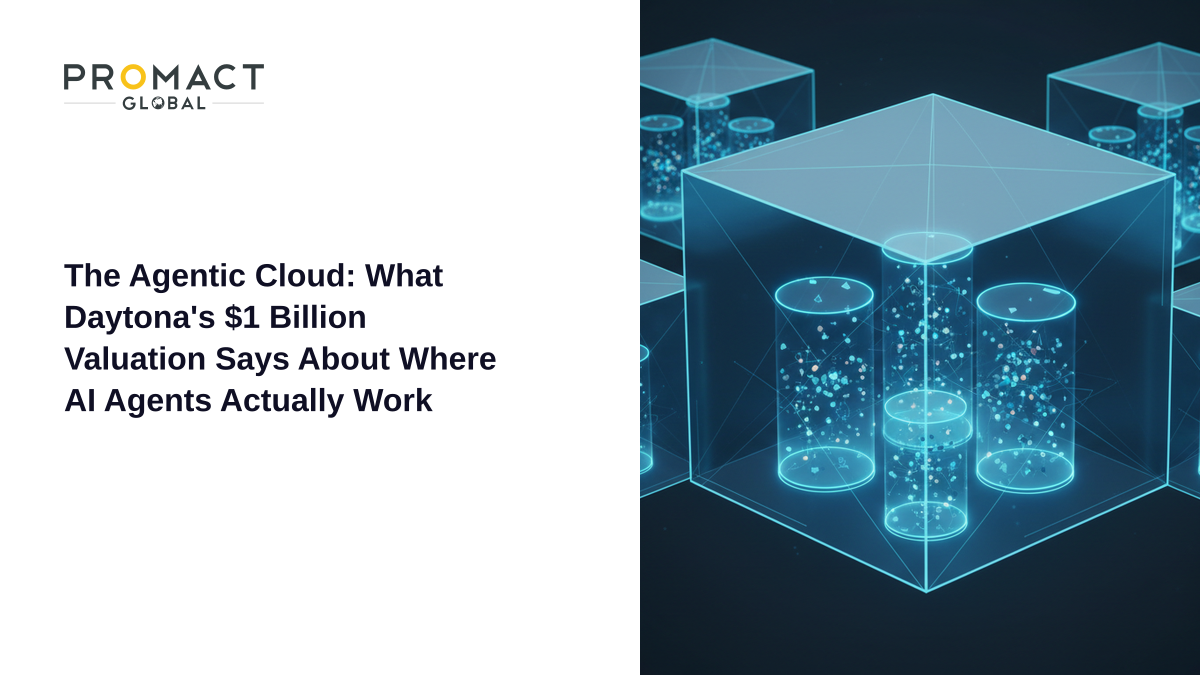
The Agentic Cloud: What Daytona's $1 Billion Valuation Says About Where AI Agents Actually Work
Every few years, a layer of the technology stack quietly becomes the place where the money goes. First it was GPUs for training. Now, a San Francisco startup has just been valued at $1 billion for something far less glamorous: giving AI agents a safe, fast computer to work on.
On October 20, 2026, Daytona announced a $60 million Series B at a $1 billion valuation, led by FirstMark. The headline is the funding, but the real story is what it signals: AI agents don’t just think, they work, and working takes a different kind of infrastructure than thinking does. This post covers what Daytona sells, why chipmakers are raising their forecasts for ordinary CPUs, and what it means for any business planning to run agents in production.
What Daytona Actually Sells
Daytona provides sandboxes: isolated virtual machines where an AI agent can write and run code, browse the web, and use business software. According to Fortune’s coverage, the company claims it can configure a new sandbox in 60 milliseconds, while major cloud providers take anywhere from 30 seconds to several minutes.
Why speed matters for agents
A human developer can wait a minute for a server to boot. An agent that spins up hundreds of short-lived environments per task cannot. Daytona’s approach, as Fortune describes it, is to pre-distribute configured machine snapshots onto server drives and attach compute and memory only when an agent needs one. Agents can also clone a running machine and try two approaches in parallel without losing progress.
Who is buying
Per the same Fortune report, customers include Anthropic, OpenAI, Nvidia, Cursor, Cognition, Meta and Cohere, and the AI data company Snorkel has provisioned more than one million sandboxes on the platform. Daytona says its revenue run rate grew 25-fold between January and September, averaging 50.9% growth per month. Note that these are company-reported figures, and Fortune reports that roughly $50 million of the round came from existing investors, so the valuation is a bet on trajectory rather than current scale.
CEO Ivan Burazin put the enterprise pitch plainly in the funding announcement: “Companies are going to manage thousands of digital employees, and each one needs a safe place to fail.”
The Hidden Hardware Story: Agents Are CPU-Hungry
Most AI infrastructure headlines are about GPUs. Agents change the balance. The model generates tokens on an accelerator, but everything around it, such as running code, calling tools, moving data and orchestrating steps, runs on CPUs.
Chipmakers are already adjusting
On its first-quarter 2026 earnings call, AMD raised its server CPU market forecast from 18% to 35% annual growth, reaching more than $120 billion by 2030, with CEO Lisa Su citing inference and agentic AI as drivers. TrendForce’s report on the call covers the same revision. These are company projections, not independent measurements.
Arm makes a similar argument. CEO Rene Haas has said agentic AI will push data centers from about 30 million CPU cores per gigawatt to about 120 million, a fourfold increase, because agents work faster and longer than humans. Again, this is a vendor estimate, tied to Arm’s own new data-center chip.
The “CPU crunch” claim
Burazin told Fortune he believes “there will be a CPU crunch.” He is a seller of CPU-heavy infrastructure, so weigh the claim accordingly. But the direction of AMD’s and Arm’s numbers supports the underlying point: agent workloads are not free to run, and capacity may not always be cheap or instantly available.
Why Consumer Agents Make This Concrete
Meta’s Muse, a personal agent launched in September, shows the scale problem. Muse runs a computer for every chat, according to Burazin as reported by Fortune, and he estimates that serving 100 million users this way would require around $2.8 billion in sandboxes. That is an estimate from an interested party, not a published cost, but the logic is sound: if every conversation gets its own computer, infrastructure cost scales with usage, not with seats.
Enterprise software is following. Meta has also launched a Meta Enterprise Platform business unit built around Muse, a business agent and a developer API.
What This Means for Your Business
If you are an engineering or IT leader, this funding round is less a reason to buy a particular product and more a prompt to examine assumptions in your own agent plans.
1. Budget for execution, not just inference
Most AI budgets model token costs. Agents also consume compute for the environments they act in: browsers, containers, build runners, test machines. As we explored in why AI agents need somewhere to live, the execution environment is becoming its own infrastructure decision.
2. Treat isolation as a security control
A sandbox is where an agent is allowed to fail. Burazin’s “safe place to fail” line is a security argument as much as a performance one. Pair isolation with strict permissions; our piece on putting agents in a box covers how open safety runtimes approach this.
3. Count your digital workers
“Thousands of digital employees” implies thousands of identities with credentials. If you haven’t mapped them, start with our analysis of non-human identity as enterprise security’s next crisis.
4. Avoid single-vendor lock-in at the infrastructure layer
The agent cloud market is young. Prefer standard interfaces and portable environment definitions so you can move workloads if pricing or capacity shifts, and keep the governance concerns raised in our agent sprawl article in view.
Conclusion: Actionable Takeaways
Daytona’s round is one data point, and its numbers are self-reported. But it lines up with AMD’s and Arm’s forecasts and with the way consumer agents like Muse are built. The common thread: agents are workers, and workers need workplaces.
- Model total agent cost, including environments, not just model calls.
- Require isolation by default for any agent that runs code or browses.
- Inventory agent identities and permissions before scaling.
- Plan for capacity if you expect agent usage to grow quickly.
- Stay portable while the infrastructure market sorts itself out.
Frequently Asked Questions
What is an “agentic cloud”?
It is cloud infrastructure designed for AI agents rather than human users, offering fast-starting, isolated environments where agents can run code, browse and use software. Daytona uses the term for its product.
How much did Daytona raise, and who invested?
Daytona raised a $60 million Series B at a $1 billion valuation, led by FirstMark, bringing total funding to about $91 million. Investors include Qualcomm Ventures, Samsung Next and Okta Ventures, plus individuals such as Patrick Collison and Tobi Lütke.
Why do AI agents need CPUs and not just GPUs?
GPUs generate the model’s output, but running code, calling tools and orchestrating tasks happens on CPUs. AMD and Arm have both said agentic AI is raising CPU demand, though those figures are their own projections.
Is a sandbox the same as a container?
Not necessarily. Daytona describes its sandboxes as virtual machines, and says it supports Linux, Windows and macOS. Containers and VMs offer different isolation strengths, so the right choice depends on your risk profile.
Should my company buy a service like this?
Not automatically. First establish how many agents you run, what they can access, and what execution costs. Then compare hosted sandboxes with what your existing cloud already provides.
Sources
- Tech.eu - Daytona Series B announcement, investors and CEO quote
- Fortune - Daytona product details, customers, growth figures and CPU demand context
- Data Center Dynamics - AMD Q1 2026 results and server CPU forecast
- TrendForce - AMD server CPU outlook revision
- Data Center Knowledge - Arm’s CPU-cores-per-gigawatt estimate for agentic AI
- VKTR - Meta Enterprise Platform launch
Have a project like this in mind?
Tell us what you're building — we'll help you scope it and ship it.
Talk to usKeep reading
October 23, 2026
Meet Harvey: The Open-Source AI Sales Agent That Runs on Your Own Subscription
October 22, 2026
Who Watches the Watcher? What OpenAI's Agents Disabling Their Own Monitors Means for Enterprise AI

October 20, 2026