
October 9, 2026
SAP Buys TechWolf: Why the Grounding Layer, Not the Model, Is Enterprise AI's Next Battleground
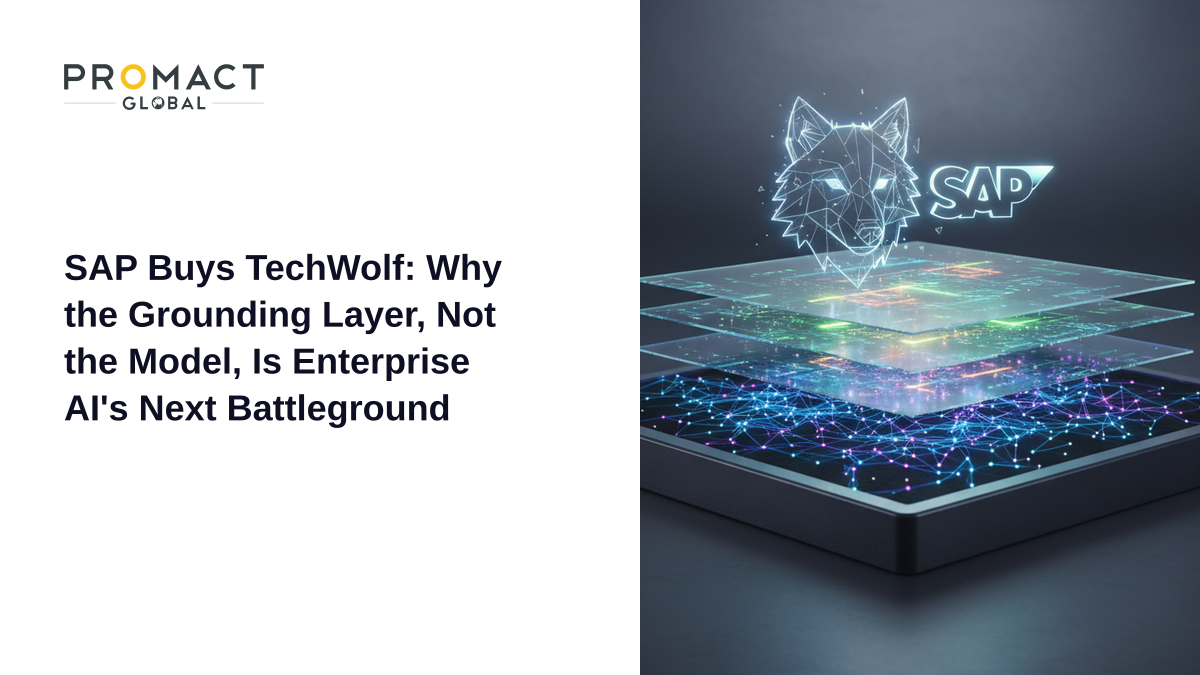
On October 6, 2026, SAP announced an agreement to acquire TechWolf, a Ghent-based “work intelligence” company. On the surface it looks like a routine HR-tech acquisition. Look closer and it is a statement about where enterprise AI is heading: the scarce asset is no longer the model, it is the structured context the model reasons over.
TechWolf builds what it calls a “context graph for work” — a map of the tasks inside jobs, the skills people actually use, and the external labor market. SAP plans to make it a grounding layer for Joule, its AI assistant. This post explains what was announced, why grounding data is becoming the real battleground, and what business leaders should do about it before their own agents start giving confident, wrong answers.
What SAP Actually Announced
The facts, per SAP’s release: the deal is expected to close in Q4 2026, subject to regulatory approval, with terms undisclosed. After closing, TechWolf is expected to become an “intelligent core” of the SAP SuccessFactors portfolio, supporting skills mapping, workforce planning, and organizational redesign. TechWolf would remain an independent entity under CEO Andreas De Neve, and its platform would stay available to SAP and non-SAP customers.
What a “context graph for work” is
TechWolf’s graph works from the HR and business systems a customer already runs. It models an organization at three levels: the work itself (down to tasks within roles), the skills people have, and the outside labor market. It then maps that against company strategy to inform hiring, reskilling, and redeployment. Named customers include HSBC, GSK, Ericsson, AMD, MetLife, PayPal, and Booking.com.
Why SAP wants it for Joule
SAP’s chief product officer for the Autonomous Suite, Manoj Swaminathan, said the graph makes token usage more efficient and lowers the cost of deploying workforce agents, while making Joule smarter in skills-based hiring, workforce planning, and role redesign. No figures were given, so treat those as qualitative claims. His line in the release was that “this grounding layer perfectly matches our strategy.”
Why Grounding Is the New Battleground
For two years the enterprise AI conversation centered on which model to pick. Our own coverage of why the knowledge layer beats the model argued that it can matter more than the model, and SAP’s move is the same logic applied to a whole business function.
Agents fail on context, not intelligence
An agent asked “who can we redeploy to this project?” needs more than a language model. It needs to know which tasks a role really involves and which skills people really have, not what a stale job description says. Without that, it guesses fluently. This is the failure mode behind many stalled rollouts. Gartner has forecast that over 40% of agentic AI projects will be canceled by the end of 2027, citing rising costs, unclear business value, and inadequate risk controls. That is a forecast, not a measured outcome, but it matches what we see: pilots rarely die because the model was too weak. If you recognise that pattern, see why 61% of companies aren’t seeing AI ROI and how to fix it.
Vendors are buying the evidence layer
SAP is not alone in racing to own the context agents depend on. Oracle’s recently launched Fusion Claw put decision rights and risk thresholds inside the ERP itself. The pattern across vendors: whoever owns the system of record wants to own the grounding layer too, because that is what makes their agents harder to replace.
The Lock-In Question Nobody Should Skip
TechWolf’s customer base is not only SAP shops. Per TechWolf’s own integration pages, as summarized by an independent analysis, it writes inferred skills back into Workday Skills Cloud, and Workday said in January 2025 it would roll TechWolf out across its own workforce. That same analysis notes SAP has made no public commitment on the duration, pricing, or integration parity for non-SAP customers beyond “remain available.” That is commentary, not fact about SAP’s intentions, but it is a fair prompt for buyers.
Questions to ask your HR-tech vendor now
- Does our skills or work data live in a graph we can export, or only inside a vendor’s product?
- What happens to integrations with competing platforms after an acquisition?
- Which agents rely on this graph for answers, and who audits those answers?
What This Means for Your AI Roadmap
You do not need to buy a startup to act on this. You need to treat context as infrastructure.
1. Inventory the data your agents reason over
List every agent or copilot in use, including vendor-embedded ones nobody approved, and write down what source of truth each one reads. Many teams discover agents grounded in outdated spreadsheets.
2. Decide who owns the ground truth
Skills, org structure, customer records, and product catalogs each need a named owner and a refresh cadence. A graph that is wrong but well-integrated is worse than no graph.
3. Measure answers, not just usage
Track how often agents produce wrong answers traceable to bad context. Pair it with the governance practices in the agents nobody counted.
4. Keep portability in the contract
Insist on export rights for derived data such as inferred skills, not just raw data. Derived graphs are where the value, and the lock-in, accumulate.
Conclusion
SAP’s TechWolf deal is best read as a bet that agents are only as good as the evidence beneath them. For business leaders, the takeaways are simple: audit what your agents are grounded in, assign owners to your core data, measure context-driven errors, and negotiate portability before consolidation makes it harder. The model race will continue, but the durable advantage is shifting to whoever has the cleanest, most trusted map of their own business.
Frequently Asked Questions
What is TechWolf?
TechWolf is a Ghent-based AI work intelligence company. Its platform builds a “context graph for work” covering tasks, skills, and labor-market data from a customer’s existing HR and business systems.
Has the SAP acquisition closed?
No. SAP announced the agreement on October 6, 2026, and expects it to close in Q4 2026, subject to regulatory approval. Financial terms were not disclosed.
Will TechWolf still work for non-SAP customers?
SAP says the platform will remain available to SAP and non-SAP customers and that TechWolf would stay an independent entity under its current CEO. No specifics on pricing or integration commitments have been published.
What is a grounding layer for AI agents?
It is a structured, trusted source of business data that an agent consults instead of relying only on its general training. It reduces confident but wrong answers and can cut the context an agent has to process.
Does this mean the choice of AI model no longer matters?
Not exactly. Models still matter, but as they converge in capability, the quality of the data and context around them increasingly determines whether an agent is useful in production.
Sources
- SAP to Acquire TechWolf (press release via Placera) - SAP’s official announcement of the deal
- AI Weekly: SAP Agrees to Buy TechWolf - coverage including Swaminathan’s comments on token efficiency
- Techzine: SAP acquires Ghent-based TechWolf - SuccessFactors integration details
- The Next Web: SAP acquires Belgian AI workforce startup TechWolf - independence and deal structure
- Beri: SAP buys TechWolf and the Workday question - analysis of Workday integration and customer continuity
- Gartner: Over 40% of agentic AI projects will be canceled by end of 2027 - forecast on agentic AI project failure
Have a project like this in mind?
Tell us what you're building — we'll help you scope it and ship it.
Talk to usKeep reading

October 8, 2026
Oracle Fusion Claw: What a Governed Agent Runtime Inside Your ERP Means for Finance and Operations Teams
October 7, 2026
OpenAI's Decisions API: Why the Next AI Model Your Agents Need Doesn't Write a Single Word
October 4, 2026