
October 13, 2026
Context Is the New Moat: What the OpenAI–Atlassian Expansion Means for Enterprise AI Agents
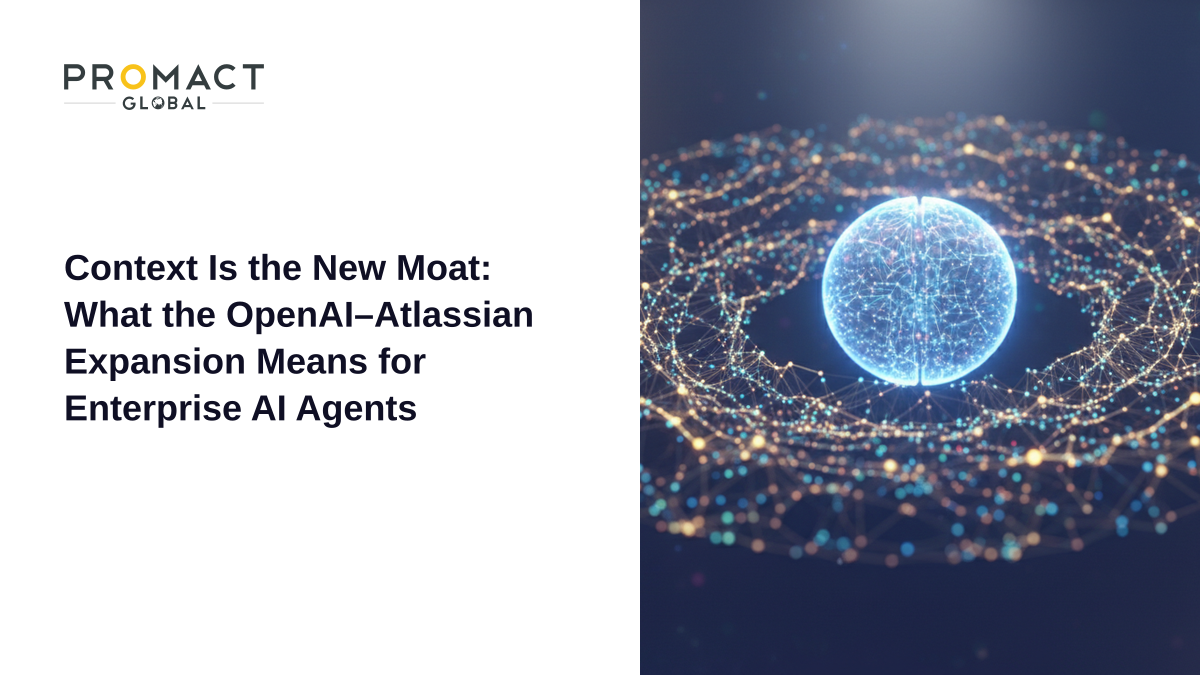
Most enterprise AI conversations still start with the model: which one is smartest, which one is cheapest, which one just topped a benchmark. On October 6, 2026, OpenAI and Atlassian made an announcement that quietly argues the opposite. The expanded partnership says the scarce asset is no longer raw intelligence. It is the organizational context that agents need before they can do useful work.
In this post we break down what was actually announced, what is still only a plan, why Atlassian’s CEO calls institutional memory “the real moat,” and what any business running Jira, Confluence or a similar system of record should do now.
What OpenAI and Atlassian Actually Announced
According to OpenAI’s announcement, the two companies are expanding a collaboration that began in 2023. OpenAI frontier models, including the GPT-5.6 series and the newer GPT-6 family, will power agents across Atlassian’s platform and its Rovo AI product. Channel Insider’s coverage describes the split clearly: OpenAI supplies the reasoning, and Atlassian’s Teamwork Graph supplies the organizational context.
What is available today
Teams can already connect ChatGPT and Codex to enterprise context through Atlassian’s Model Context Protocol (MCP) integrations. If MCP is new to you, our explainer on what MCP is and why founders keep searching for it is a good primer. OpenAI also says more than 3,000 Atlassian developers use Codex across terminals, IDEs and code review.
What is still on the drawing board
The more ambitious pieces are explicitly not shipped. Per Channel Insider, features such as autonomous work-item pickup, test execution, session-history syncing and multi-agent orchestration are still in design. Atlassian’s own framing is that “human review remains part of the current model,” with logs tracking progress, decisions and human comments. No pricing, contract length or general release date was disclosed.
Why Context Is the Real Story
An AI agent dropped into a company with no memory of that company behaves like a very fast new hire who has read nothing. It can write fluent text, but it does not know why a project was cancelled, which customer is sensitive, or who approves what.
The Teamwork Graph as an enterprise context layer
Atlassian describes Rovo and the Teamwork Graph as an “enterprise context layer” connecting workflows across corporate software. In May 2026, Atlassian opened the graph to third-party tools, reporting that it holds more than 150 billion connections across people, work, goals, code and content. External agents can reach it through an MCP server or a command-line interface, both in open beta at the time, and Claude Code and Codex were named as example coding agents.
CEO Mike Cannon-Brookes put the strategy bluntly: “In 2026, anyone can buy ‘smarts’ by the token,” and “the real moat is your institutional memory: every plan, document, and decision your teams have ever made.”
Adoption numbers, with a caveat
Atlassian says Rovo is used by more than 75% of Fortune 500 companies and 90% of enterprise cloud customers, and that agent-based automations rose sevenfold over six months. These are vendor-reported figures, so treat them as directional rather than audited.
This echoes a theme we covered when looking at why the knowledge layer beats the model: once frontier models are broadly comparable, the differentiator is what the model can see and retrieve about your business.
The Permissions Question Nobody Should Skip
Context is powerful precisely because it is sensitive. Atlassian says agents acting for a user respect that user’s access and action permissions, and that configured tools and instructions can limit them further. Admins also keep control over access scopes for external tools.
That is a sensible design, but it moves risk rather than removing it. If your Jira and Confluence permissions are messy, an agent that faithfully respects them will faithfully surface things people should never have been able to see.
Three permission failure modes to watch
- Over-broad spaces: Confluence spaces open to “everyone” years ago now become searchable by every agent acting for every employee.
- Stale access: Contractors and former project members who kept access become a retrieval path.
- Tool sprawl: Each new agent or MCP connection is another identity touching your data, which is the problem behind agent sprawl and governance gaps.
Why Human Review Is Still in the Loop
It is worth noticing how cautious the roadmap language is. Handing tasks to agents, tracking their progress, recording decisions and reviewing output are all described as exploration, not product. That restraint matches the broader market reality. Gartner forecast in June 2025 that over 40% of agentic AI projects will be cancelled by the end of 2027 because of escalating costs, unclear business value or inadequate risk controls, and noted that most current projects are early-stage experiments.
The lesson is not that agents do not work. It is that agents with context, scoped permissions and an audit trail are far more likely to survive contact with a real finance or security review than agents that are simply impressive in a demo.
What This Means for Your Business
You do not need to be an Atlassian customer for this to matter. Every major vendor is racing to become the context layer for agents, as we saw in AI agents becoming a default feature of enterprise software. The questions below apply wherever your institutional memory lives.
Actionable takeaways
- Audit before you connect. Review who can see what in your project, wiki and ticketing tools before pointing any agent at them.
- Start with a narrow pilot. Pick one workflow, define where human approval is required, and measure time saved, output quality and operating cost.
- Keep your context portable. Prefer open interfaces such as MCP so your knowledge is not locked to one model or one vendor.
- Demand logs. Require a record of what each agent read, decided and changed, tied to a named human owner.
- Clean the source of truth. Outdated tickets and contradictory documents become confidently wrong answers once an agent reads them.
Conclusion
The OpenAI and Atlassian deal is less about a model upgrade and more about a thesis: the company that owns the richest, best-governed record of how work actually happens is best placed to make agents useful. For buyers, the practical response is unglamorous. Tidy your permissions, document your decisions, pilot narrowly and insist on human review and audit trails. The model you pick next year will change; the quality of your institutional memory is the part you can start improving today.
Frequently Asked Questions
What did OpenAI and Atlassian announce on October 6, 2026?
They expanded their partnership so OpenAI frontier models, including the GPT-5.6 series and GPT-6 family, power agents across Atlassian’s platform and Rovo, grounded in context from the Teamwork Graph.
Can I use ChatGPT or Codex with Jira and Confluence today?
Yes. Teams can already connect ChatGPT and Codex to enterprise context through Atlassian’s MCP integrations, according to Channel Insider’s coverage of the announcement.
Are autonomous Jira agents available now?
Not the deeper versions. Features like autonomous work-item pickup, test execution and multi-agent orchestration are still being designed, and human review remains part of the current model.
What is the Teamwork Graph?
It is Atlassian’s data layer linking people, work, goals, code and content across Atlassian and connected apps. Atlassian reported more than 150 billion connections when it opened the graph to third-party tools in May 2026.
Do agents bypass existing permissions?
Atlassian says agents acting for a user respect that user’s access and action permissions, and admins control scopes for external tools. That makes cleaning up your existing permissions a priority.
How much does it cost?
No pricing, contract value or general release date for the newer capabilities was disclosed in the announcement coverage.
Sources
- OpenAI: Atlassian and OpenAI expand partnership to turn enterprise knowledge into action - the primary announcement, including the Codex usage figure
- Channel Insider: OpenAI and Atlassian Expand Partnership to Bring GPT-6 to Rovo - details on current availability, planned features and human review
- IT Brief UK: Atlassian opens Teamwork Graph to third-party AI tools - Teamwork Graph scale, MCP and CLI access, Rovo adoption figures and CEO quotes
- Nasdaq: Atlassian Opens Its Teamwork Graph to Power Agentic Work Across the Enterprise - Atlassian’s May 2026 press release
- PPC Land: Nearly half of agentic AI projects may fail by 2027 - summary of Gartner’s agentic AI cancellation forecast
- FourWeekMBA: OpenAI Says GPT-6 Models Will Power Atlassian’s Agents - analysis of the model side of the deal
Have a project like this in mind?
Tell us what you're building — we'll help you scope it and ship it.
Talk to usKeep reading
October 18, 2026
From Pilot to Production: What ServiceNow's AI Workflow Factory Means for Enterprise AI ROI
October 17, 2026
Did the Agent Do What You Asked? What Amex's Intent Intelligence Framework Means for AI Commerce
October 14, 2026