
August 28, 2026
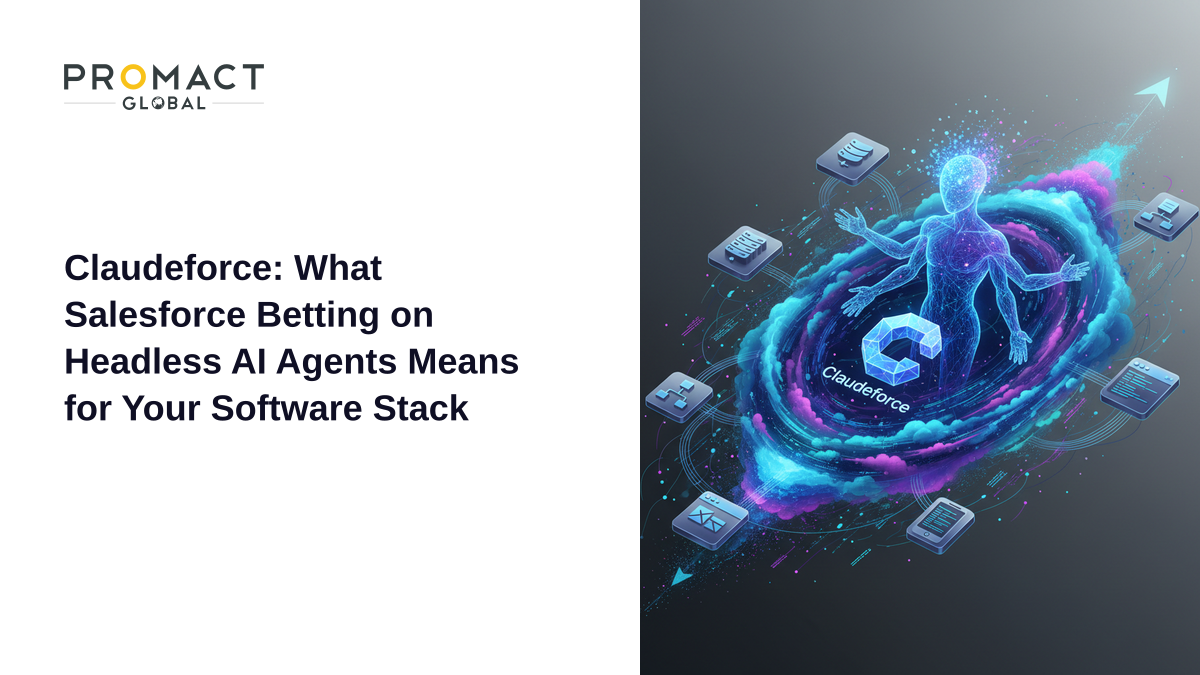
Claudeforce: What Salesforce Betting on Headless AI Agents Means for Your Software Stack
On August 26, 2026, Salesforce reported record quarterly earnings, raised its full-year guidance, and watched its stock jump roughly 22% in a single session — its second-best trading day ever, behind only a rally in August 2020. The earnings beat mattered, but it wasn’t the headline. What actually moved the market was a partnership announcement that landed the same day: Claudeforce, an expanded alliance between Salesforce and Anthropic that puts Claude inside the CRM — and, just as deliberately, puts the CRM inside Claude.
It’s easy to read this as one more AI partnership press release in a year that has produced dozens of them. It isn’t. Claudeforce is a concrete signal about where enterprise software vendors think the next five years are headed: away from screens you log into, and toward agents you delegate to. This post breaks down what Claudeforce actually ships, why the market rewarded it so heavily, and what the underlying bet — and its very real governance catch — means for any business evaluating where to plug AI into its own operations.
What Claudeforce Actually Is
Strip away the branding and Claudeforce is three separate integrations bundled under one name.
1. Claude Inside Salesforce
Claude has quietly served as a foundation model inside Agentforce, Salesforce’s agent platform, since late 2025. Claudeforce formalizes and expands that role: Claude now powers the Atlas Reasoning Engine and is the default model behind Agentforce Vibes and Agentforce Coworker, with Anthropic CEO Dario Amodei framing the goal as making “frontier intelligence… safe, trusted, and deeply capable” for enterprise use, per Salesforce’s official announcement. Notably, inference runs through Amazon Bedrock inside Salesforce’s own security perimeter rather than a direct third-party API call — a detail that matters a great deal to regulated industries like banking and healthcare, as Apex Hours’ technical breakdown notes.
2. Salesforce Inside Claude
This is the genuinely new piece. “Salesforce in Claude” ships as a plugin with 37 prebuilt sales skills — meeting prep, deal health review, pipeline review, and similar tasks — that let a seller work entirely from inside Claude while reasoning over live, permissioned Salesforce data and executing governed actions without switching tabs. One admin connects the org once; every user’s access is scoped automatically to their existing Salesforce permissions. Under the hood, it runs on a hosted Model Context Protocol (MCP) server — the same open standard we’ve written about before as the connective tissue increasingly linking AI agents to real business systems. It’s currently live with select pilot customers, with a broader open beta expected in September 2026.
3. Claude Inside Slack
Claude also becomes the default reasoning layer behind Slackbot, Claude Tag, and Slack Code. Salesforce disclosed that Claude-powered Slackbot usage has already generated 8.1 million annualized productivity hours for its own employees — more than double the prior quarter — a real, if self-reported, data point on what “AI colleague” tools can do at scale inside a 70,000-person company.
The Real Bet: Software Without a Screen
The interesting part of Claudeforce isn’t any single feature — it’s the strategic logic Salesforce is stating out loud. As Patrick Stokes, Salesforce’s president of Applications & Marketing, put it: “When people stop using Salesforce through the traditional human interface and start using it through an agentic interface, it dramatically increases the value of Salesforce” — by his own admission, “a genuinely strange thing for a UI company to say out loud.”
That’s a bet that the login screen — the dashboard, the tab, the click-through workflow — is a transitional technology. In its place: a “headless” enterprise stack where the software does the work through APIs and MCP tool calls, and the interface a human actually touches is whichever AI assistant they already trust, whether that’s Claude, Slack, or something else entirely. It’s the same underlying shift we explored in our piece on vendor-embedded AI — AI capability arriving inside tools you already pay for, rather than as a separate product you have to go choose.
It’s also, notably, a two-way bet. Salesforce isn’t just adding Claude as an internal engine; it’s making its own CRM available as a plugin inside a third party’s product surface. That’s an unusual level of platform interdependence for two companies of this size, and it echoes a portability question we raised when Agent Plugins 1.0 shipped earlier this year: skills and plugins are supposed to be portable across AI tools, but a deep, security-perimeter-level partnership like this one creates real switching costs in the other direction.
Why the Market Actually Cared
Executives have been promising “AI ROI” for two years. What made August 26 different is that the numbers backing it up were no longer projections. Salesforce’s Q2 FY2027 results showed Agentforce annual recurring revenue past $1.5 billion, up more than 240% year-over-year, with 7 billion cumulative “Agentic Work Units” — the company’s term for discrete tasks an agent completes — delivered to date, 3.2 billion of them in this quarter alone, up 97% from the previous quarter. Total revenue came in at $11.3 billion, up 11% year-over-year, with full-year guidance raised to $46.1–$46.4 billion.
Salesforce isn’t the only enterprise software company whose AI bet is now showing up in hard financial numbers rather than pilot anecdotes. Three weeks earlier, Palantir posted 93% year-over-year revenue growth on the back of its AI Platform, with U.S. commercial revenue up 149%; its stock jumped roughly 30% on the report. Two different companies, two different AI strategies, and in both cases the market treated the earnings as real evidence that agentic AI spend is converting into revenue — a notably more concrete signal than the pivot-and-promise story that defined agentic AI’s earlier hype cycle. The ROI is real, but so far it’s concentrated in vendors who’ve moved agentic features past the demo stage and into products customers pay more for.
The Governance Catch Nobody Should Skip
None of this comes free of risk. Salesforce says every action Claude takes through the plugin runs through the user’s existing Salesforce permissions — Claude can see and do only what that specific user is already authorized to — and the two companies have jointly built what they call Enterprise Frontier Safeguards to constrain AI behavior and protect customer data. But security analysts covering the rollout have been blunt about the practical implication: audit your permissions before you pilot, not after. A plugin that lets an AI assistant read live CRM data and execute governed write actions is only as safe as the permission sets behind it — over-provisioned Salesforce profiles, common in many orgs today, become a much bigger liability once an agent, not just a human clicking carefully, is the one exercising them.
This is the same structural risk showing up across the industry. Security researchers at Snyk found in their 2026 agentic AI adoption research that the share of enterprises running full agentic stacks — agent frameworks plus MCP servers — has climbed from roughly 28% to 33% in just six months, often faster than security teams can inventory what’s been connected. Claudeforce doesn’t cause that problem, but it raises the stakes: it’s shipping from two companies enterprises already trust with core business data, which makes fast adoption and slow auditing more likely, not less.
There’s a second, quieter risk worth naming: concentration. Salesforce has made a third party’s model — Anthropic’s Claude — the default reasoning engine across its flagship products, while simultaneously embedding its own CRM as a feature inside that same partner’s product. That’s a mutual dependency, not just a vendor relationship, and it’s worth a line in any five-year vendor-risk review, regardless of how well the two companies get along today.
What This Means for Your Business
You don’t need to be a Salesforce customer, or even in the market for a CRM, to take something useful from this. Three practical takeaways:
- Expect your existing vendors to add an agentic layer, not to be replaced by one. The Claudeforce pattern — AI reasoning embedded inside the tools you already run, accessible from wherever your team already works — is a more likely near-term path than swapping your whole stack for a standalone AI platform.
- Treat permission audits as a prerequisite, not an afterthought, for any agentic pilot. Do this before you turn an AI assistant loose on live business data, not after something goes wrong.
- Watch the revenue numbers, not just the demos, when evaluating a vendor’s AI roadmap. Agentforce’s ARR growth and Palantir’s commercial numbers are early evidence that agentic AI features can move from marketing slide to line item — that’s a much better signal than a keynote demo.
Claudeforce is one partnership between two companies, but it’s a useful preview of the pattern enterprise software is converging on: the interface fades, the agent does the work, and the vendor who wins is the one who gets the plumbing — and the permissions — right first.
Frequently Asked Questions
What is Claudeforce, in one sentence?
Claudeforce is an expanded partnership between Salesforce and Anthropic that embeds Claude as the default reasoning engine across Salesforce’s Agentforce and Slack products, while also making Salesforce data and workflows available as a plugin inside Claude itself.
Is Claudeforce available to all Salesforce customers now?
Not yet. The “Salesforce in Claude” plugin is currently live with select pilot customers only, with a broader open beta expected in September 2026; additional prebuilt skills beyond the initial 37 sales-focused ones are planned for later in 2026.
Does this replace Salesforce’s existing Agentforce platform?
No. Claude becomes the default reasoning model behind parts of Agentforce (like the Atlas Reasoning Engine, Agentforce Vibes, and Agentforce Coworker), but Agentforce itself continues to exist as Salesforce’s broader agent platform — Claudeforce extends and deepens it rather than replacing it.
What is Salesforce actually paying, or getting paid, for this?
Pricing for the plugin is consumption-based, tied to API usage, with a separate Anthropic inference contract for Claude usage. Separately, Salesforce’s Q2 net income included roughly $2.6 billion in gains tied to its existing equity stake in Anthropic — an investment mark-up disclosed in the same earnings report, not revenue from the Claudeforce partnership itself. Salesforce was also reportedly on track to spend around $300 million on Anthropic’s Claude tokens in 2026, primarily for internal software engineering use.
Why did Salesforce’s stock jump so much on the announcement?
The move combined a genuine earnings beat — Agentforce ARR up over 240% year-over-year and raised full-year guidance — with investor enthusiasm for the Anthropic partnership itself, which analysts read as validation that Salesforce’s AI strategy is converting into real usage and revenue rather than staying stuck in pilot mode.
What’s the biggest risk with a partnership like this?
Two, mainly: permission sprawl (an AI agent inheriting over-broad access to live CRM data if profiles aren’t audited first) and vendor concentration (Salesforce now depends heavily on a single external model provider for core reasoning, while that same provider’s product depends on Salesforce data to be useful).
Sources
- Salesforce and Anthropic Announce Claudeforce - Official Salesforce investor relations announcement with executive quotes and product details
- Salesforce Delivers Record Second Quarter Fiscal 2027 Results - Official Q2 FY2027 earnings release with Agentforce ARR and Agentic Work Unit figures
- Stock Market Today, Aug. 27: Salesforce Surges 23% on Anthropic Partnership and Q2 Earnings Beat - The Motley Fool’s coverage of the stock reaction
- Claudeforce Explained: What Salesforce & Anthropic Actually Ship - Technical breakdown of the MCP architecture, permissions guidance, and executive commentary
- Salesforce and Anthropic Launch Claudeforce - Coverage of the governed-action model and integration architecture
- Palantir (PLTR) earnings Q2 2026 - CNBC coverage of Palantir’s 93% revenue growth and stock reaction
- Salesforce (CRM) and Anthropic Team Up Again to Launch Claudeforce - Additional coverage of partnership history and deal terms
- Enterprises Are Blind to Two-Thirds of Their Own AI Attack Surface - Snyk’s 2026 agentic AI adoption research on enterprise agent/MCP growth
Have a project like this in mind?
Tell us what you're building — we'll help you scope it and ship it.
Talk to usKeep reading
October 21, 2026
82% Say They Can Govern AI Agents, 26% Can Resolve Their Conflicts: What OutSystems' New Survey Reveals
October 20, 2026
The Agentic Insider: What Microsoft's Guardian Agents Mean for Governing AI Agents Like Employees
October 19, 2026