November 25, 2026
AI Sales Agent: What It Does and How to Use One
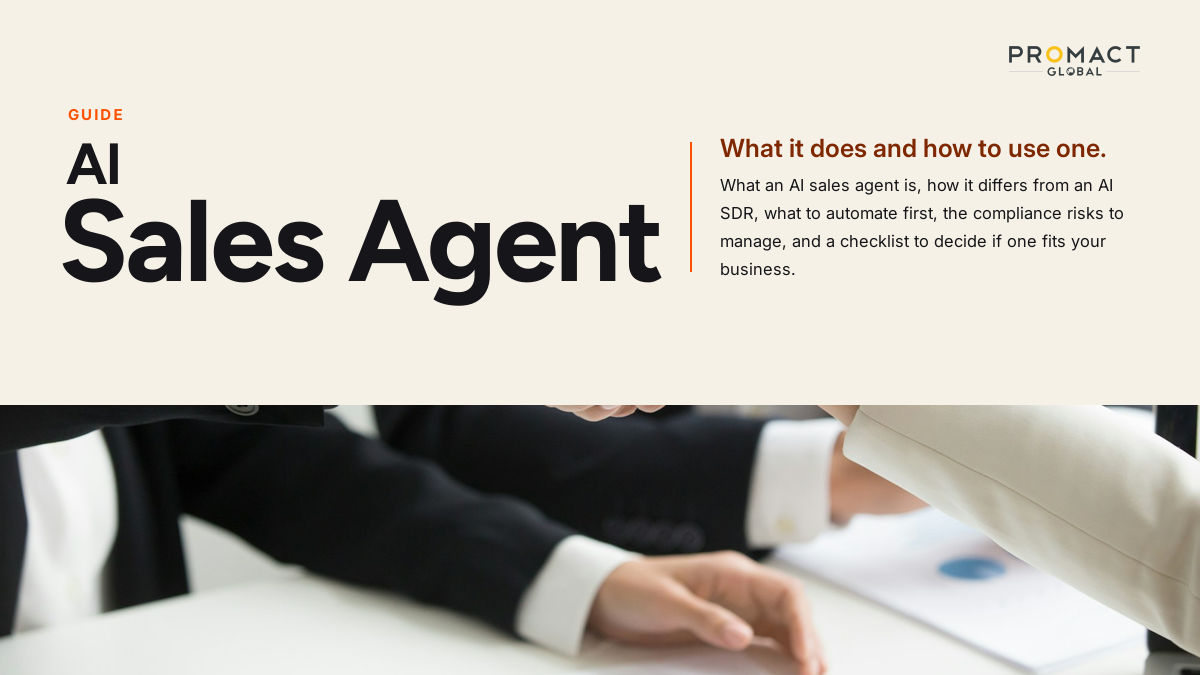
An AI sales agent is software that does sales work on its own: it researches prospects, qualifies leads, drafts and sends outreach, answers questions, books meetings and updates your CRM, then hands the conversation to a human when a deal needs judgment. Unlike a chatbot or a simple email sequence, it decides what to do next based on your data and acts inside your tools. The catch is that the results depend less on which product you choose and more on your data quality, your guardrails and the jobs you give it first.
In this guide, we cover what AI sales agents do, how they differ from AI SDRs and sales assistants, which tasks to automate first, what the research says about adoption and risk, the compliance rules that catch teams out, and a checklist to decide whether one fits your business.
What Is an AI Sales Agent?
An AI sales agent is an autonomous system that perceives sales data, makes decisions and executes multi-step sales tasks such as prospecting, qualification and follow-up. The word “agent” matters: it pursues a goal (“book qualified meetings with mid-market lenders”) rather than waiting for a prompt for each step.
Under the hood, most agents combine four parts: a language model that reasons about the task, access to your data (CRM, email, call notes, product documentation), tools it can use (send email, create a record, check a calendar) and rules that tell it when to stop and ask a person. If you want the full architecture, our guide to AI agent architecture walks through these building blocks.
How Is an AI Sales Agent Different From an AI SDR or a Sales Assistant?
These terms overlap, and vendors use them loosely, but they describe different levels of autonomy. An AI sales assistant helps a human rep, an AI SDR takes over top-of-funnel outreach, and an AI sales agent is the broader category that can span the whole pipeline.
| Type | What it does | Who is in control | Best for |
|---|---|---|---|
| AI sales assistant | Drafts emails, summarises calls, suggests next steps | The rep approves everything | Teams starting out, complex enterprise deals |
| AI SDR | Finds leads, writes and sends outreach, books meetings | The agent acts; humans set targets and review | High-volume outbound with a clear ideal customer |
| Inbound sales agent | Answers website or email enquiries, qualifies, quotes, schedules | The agent acts within scripts and policy | Teams that lose leads to slow response |
| Full-pipeline agent (or multi-agent system) | Prospecting through renewal, coordinated by an orchestrator | Humans own exceptions and closing | Mature teams with clean data and governance |
If you are weighing a conversational front-end against something that acts in your systems, our post on AI agent vs chatbot explains the distinction.
What Can an AI Sales Agent Actually Do?
Today’s agents are strongest at repetitive, data-heavy work around the sale, and weakest at the relationship-heavy parts. Build around the former.
Prospect research: gathers firmographic and news signals about an account and summarises why it might need you, so reps skip the tab-hopping.
Lead qualification: scores inbound enquiries against your criteria and asks the missing questions before a human spends time.
Personalised outreach and follow-up: drafts messages that reference the prospect’s situation and sends timed follow-ups, within the limits you set.
Meeting scheduling: proposes slots, handles reschedules and sends reminders, which removes a surprising amount of back-and-forth.
CRM hygiene: logs activities, updates fields and flags stale deals, so forecasts rest on current data.
Quotes and renewals: assembles standard quotes from your price book and nudges renewals, with approval for anything outside policy.
For examples across functions beyond sales, see our roundup of real AI agent use cases by function.
How Common Are AI Sales Agents, and Do They Work?
Adoption is already mainstream, but proven productivity gains are not guaranteed. In Salesforce’s State of Sales report, 54% of sales teams say they use AI agents today and another 34% expect to within two years, and 87% of sales organisations use some form of AI. Note that Salesforce sells these tools, so treat the figures as self-reported vendor research.
The same report points to the obstacle: 51% of sales leaders with AI say disconnected systems are slowing their initiatives. Independent analysts are more cautious. Gartner predicts that AI agents will outnumber sellers 10 to 1 by 2028, yet fewer than 40% of sellers will say the agents improved their productivity. Its 2026 survey of 210 sales executives warns of “agent sprawl”: more digital activity with little gain in seller impact. Gartner’s advice is to fix data, automation and user experience first rather than reaching for quick fixes.
The lesson is that volume is not the goal. An agent that sends 10,000 messages nobody wanted is a liability, not a productivity gain.
What Should You Automate First?
Start with the narrowest job that has clean data and a clear success measure, then expand. For most B2B teams that is inbound lead response or meeting scheduling, not cold outbound at scale.
Here is a simple way to choose:
| Candidate job | Data readiness needed | Risk if it goes wrong | Suggested order |
|---|---|---|---|
| CRM updates and call summaries | Low | Low | First |
| Inbound lead qualification and booking | Medium | Medium | Second |
| Prospect research briefs for reps | Medium | Low | Second |
| Outbound email to new prospects | High | High (reputation, legal) | Third, with human review |
| Autonomous calling or negotiation | High | Very high | Last, if ever |
Industry context changes the picture. In financial services, an agent might qualify inbound enquiries for a lending or wealth product and route regulated conversations to a licensed adviser. In legal and professional services, it can screen new-matter enquiries and check for conflicts before a partner’s time is used. In manufacturing, it can turn distributor enquiries into draft quotes from the price book for a rep to approve. In each case the agent prepares and qualifies; the person closes.
See where AI agents fit in your operations. Get a clear view of which workflows are ready for automation and which are not. Book a free AI audit
What Are the Risks of AI Sales Agents?
The main risks are damaged sender reputation, legal exposure, wrong or invented claims, and loss of trust. Each has a practical control.
Deliverability and sender reputation: Google tells bulk senders to keep user-reported spam below 0.1% and never reach 0.3%, which its sender guidelines FAQ explains. At 1,000 emails, just three complaints reach 0.3%, so a careless agent can burn your domain quickly. Cap daily volume, send from a separate domain, authenticate with SPF, DKIM and DMARC, and stop sending to anyone who does not engage.
Email law: the FTC’s CAN-SPAM guide states that each non-compliant email can be penalised up to $53,088, that opt-outs must be honoured within 10 business days, and that the law makes no exception for business-to-business email. Your agent needs a working unsubscribe, an accurate sender identity and a suppression list it cannot override. Check the FTC site for the current penalty amount.
Voice and phone: the FCC ruled in 2024 that AI-generated voices count as “artificial or prerecorded” under the TCPA, so calls generally need the called party’s prior express consent. It is not a ban, but it means autonomous voice outreach needs consent records.
Hallucinated promises: an agent can invent a discount, a feature or a delivery date. Ground it in your price book and product documents, and block it from committing to anything outside them.
Privacy and data access: give the agent the minimum CRM access it needs, and log every action. Our AI agent governance framework covers permissions, audit trails and approval rules in detail.
Should You Buy an AI Sales Agent or Build One?
Buy when your process is standard and speed matters; build or customise when your data, pricing logic or compliance rules are specific to you. Many teams do both: a vendor tool for outreach and a custom agent connecting it to their own systems.
| Factor | Buy a tool | Build or customise |
|---|---|---|
| Time to first result | Days to weeks | Weeks to months |
| Fit with your CRM and pricing rules | Limited to what the vendor supports | Designed around your systems |
| Control over data and guardrails | Vendor-defined | You define them |
| Switching cost | Rises with usage | Lower if you avoid proprietary lock-in |
| Best when | Process is standard, volume is high | Regulated, complex or multi-system sales |
Whichever path you take, plan for vendor risk. Our guide to vendor lock-in explains how to keep your prompts, data and workflows portable.
How Do You Measure an AI Sales Agent?
Measure outcomes a CFO would recognise, not activity. Track qualified meetings booked, response time to inbound enquiries, pipeline created per rep hour, cost per qualified lead, and complaint, bounce and unsubscribe rates as guardrails.
Run a four-week pilot against a control group of reps or leads that do not use the agent. Review a sample of the agent’s messages weekly, and set a pause trigger: for example, if complaints approach 0.1% or an invented claim appears, the agent stops until fixed.
How Promact Helps
Promact designs and builds AI agents that connect to the systems your team already uses, with a free workflow audit to find where the hours go before anything is built. Our AI agent solutions are built around backend integration, human approval for uncertain cases and clear audit trails rather than a chat window bolted on. Our work on a scalable B2B e-commerce platform for Hyperpure, which streamlines fresh-produce supply to restaurants across India, reflects the same discipline of connecting ordering, data and operations that a sales agent depends on.
Is an AI Sales Agent Right for Your Business?
An AI sales agent is right for you if most of these signs describe your situation:
- Leads wait too long: enquiries sit for hours or days before anyone replies.
- Reps spend more time on admin than selling: research, data entry and scheduling crowd out conversations.
- Your CRM data is reasonably clean: contacts, stages and ownership are mostly accurate.
- You can define a good lead: your qualification criteria fit on a page.
- You have a person who owns the agent: someone reviews its output and can pause it.
- Your sales are not purely relationship-led: high-trust, six-figure enterprise deals still need people at the centre.
If four or more apply, start with one narrow pilot, such as inbound qualification, and expand once the numbers hold. For a practical next step, book a free AI audit and we will map where an agent would help and where it would not. If you want to see how a full sales pipeline can be assembled, read our guide to building an AI-powered sales pipeline.
Frequently Asked Questions
What is an AI sales agent?
An AI sales agent is software that performs sales tasks such as prospect research, lead qualification, outreach and meeting booking on its own, using your data and tools. It escalates to a human when a conversation needs judgment.
What is the difference between an AI sales agent and an AI SDR?
An AI SDR is a type of AI sales agent focused on top-of-funnel work: finding leads, sending outreach and booking meetings. “AI sales agent” is the broader term and can also cover inbound qualification, quotes and renewals.
Will AI sales agents replace salespeople?
Not in the near term. Gartner expects agents to outnumber sellers 10 to 1 by 2028, yet fewer than 40% of sellers to say they improved productivity, which suggests agents take on tasks rather than whole roles. Relationship-led, high-value deals still depend on people.
Is it legal to use an AI sales agent for cold outreach?
Yes, but the same rules apply as for human outreach. In the US, CAN-SPAM requires honest sender details and honouring opt-outs within 10 business days, with no exemption for B2B email, and AI-generated voice calls generally require prior consent under the TCPA. Rules differ by country, so take legal advice.
How much does an AI sales agent cost?
Pricing varies widely by vendor and by whether you buy a tool or build a custom agent, so we do not quote a single figure. Budget for software, integration work, data cleanup and ongoing review, not just the licence. Our post on AI agent cost breaks down these components.
How do I get started with an AI sales agent?
Pick one narrow job with clean data, such as inbound lead qualification. Set guardrails and a success metric, run a four-week pilot against a control group, and expand only if results hold. Our guide on how to build an AI agent covers the steps.
Sources
- Salesforce - State of Sales Report 2026 - adoption of AI agents among sales teams and obstacles
- Gartner - AI agents will outnumber sellers 10 to 1 by 2028 - forecast and agent-sprawl warning
- Google - Email sender guidelines FAQ - spam complaint thresholds for bulk senders
- FTC - CAN-SPAM Act: A Compliance Guide for Business - penalties, opt-outs and B2B coverage
- FCC - AI-generated voices in robocalls under the TCPA - consent requirement for AI voice calls
Have a project like this in mind?
Tell us what you're building — we'll help you scope it and ship it.
Talk to us