November 1, 2026
Agentic AI vs Generative AI: Key Differences
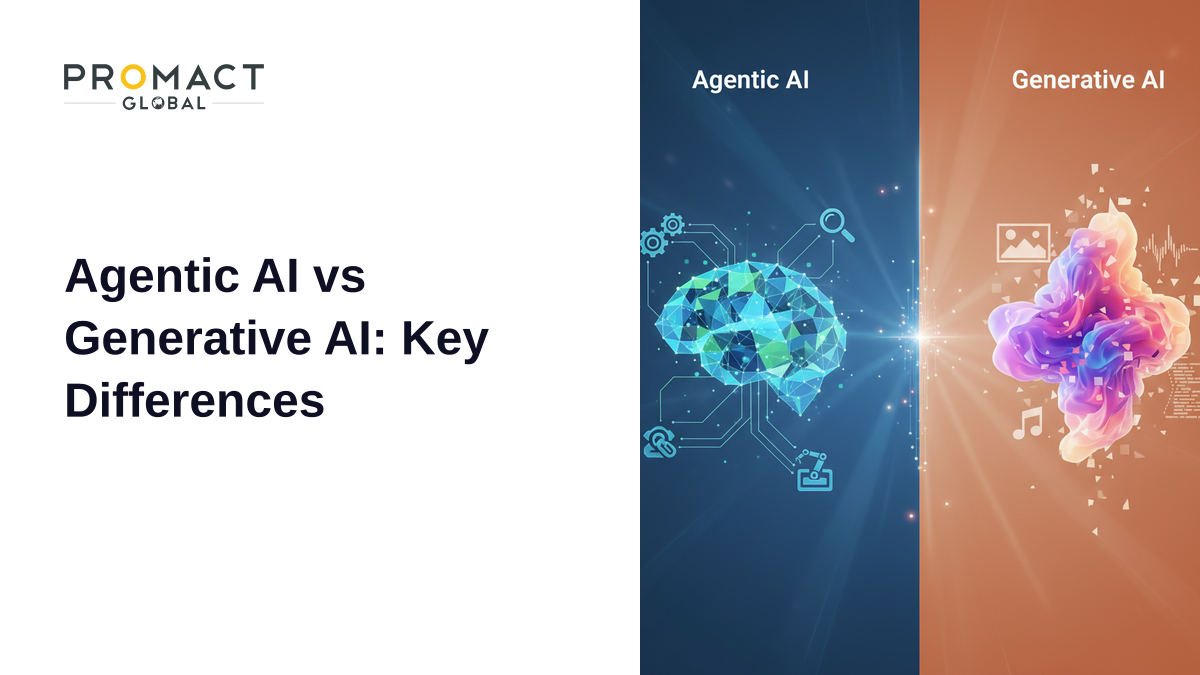
Generative AI creates content when you ask for it. Agentic AI pursues a goal: it plans the steps, uses your tools, checks its own results and acts, with a human approving the risky parts. In practice agentic AI is usually built on top of generative AI, so the real question for a business is not which one to pick, but when a model that only writes is enough and when you need one that also does.
This guide explains the difference in plain words, compares the two side by side, shows where each one pays off, and gives you a simple way to decide before you spend a budget.
What Is the Difference Between Agentic AI and Generative AI?
IBM’s comparison frames it around purpose: generative AI produces new content such as text, images, audio, video or code in response to an input, while agentic AI works toward a goal by planning steps, choosing actions and carrying out multi-step tasks.
A useful shorthand is output versus outcome. Ask a generative tool to “draft a reply to this complaint” and you get a draft. Give an agentic system the goal “resolve this complaint” and it can read the customer’s history, check the order system, issue a refund inside your policy limits, send the reply and log what it did.
| Generative AI | Agentic AI | |
|---|---|---|
| Main job | Creates content from a prompt | Achieves a goal through multiple steps |
| Starts when | A person writes a prompt | A person (or an event) sets a goal |
| Autonomy | Reactive, one response at a time | Plans, acts, checks and retries |
| Connects to your systems | Only if tools are wrapped around it | Designed to call tools, APIs and data sources |
| Typical output | A draft, summary, image or snippet of code | A completed task: a ticket closed, an invoice matched |
| Main risk | A wrong or made-up answer | A wrong action with real consequences |
| Human role | Reviews each output | Sets limits and approves risky steps |
| Cost and speed | One model call | Many calls, so higher cost and latency |
Is Agentic AI Built on Generative AI?
Mostly, yes. IBM notes that agentic AI generally builds on generative AI rather than replacing it: a generative model interprets requests and communicates results, while the agentic layer handles planning, reasoning, tool use and evaluating next steps.
Think of the language model as the brain and the agentic layer as the hands, memory and checklist around it. That is why the two terms get blurred, and why many vendors blur them on purpose. Gartner calls this “agent washing”: rebranding assistants, chatbots and RPA as agentic AI. It estimates that only about 130 of the thousands of vendors claiming agentic capability are delivering the real thing.
If you want the full background on the agentic side, see our definitive guide to agentic AI for business leaders. For how generative AI compares with older predictive systems, read generative AI tools vs traditional AI.
How Do You Tell a Workflow From a Real Agent?
Anthropic’s engineering team draws a helpful line in Building Effective Agents. Workflows are systems where language models and tools are orchestrated through predefined code paths. Agents are systems where the model dynamically directs its own process and tool use.
That distinction matters for your budget. Anthropic’s advice is to find the simplest solution possible and only add complexity when needed, because agentic systems often trade latency and cost for better task performance. For many applications, it says, optimizing single model calls with retrieval and examples is usually enough.
A quick test you can run on any product demo:
- Does the system decide its own next step, or follow a fixed script?
- Can it use real tools in your environment, not just chat?
- Does it check its own result and recover when something fails?
If the answer to all three is no, you are looking at generative AI or a workflow, whatever the label says.
When Should You Use Generative AI?
Choose generative AI when the value is in the content itself and a person will review it before anything happens.
- Drafting emails, proposals, product descriptions and reports
- Summarizing long documents, meetings or support threads
- Answering questions over your documents (retrieval-based assistants)
- Generating code suggestions, test cases or images for a human to approve
These use cases are cheaper, faster to launch and easier to govern, because a person sits between the model and the outcome.
When Should You Use Agentic AI?
Choose agentic AI when the value is in finishing a multi-step process across several systems, and the steps are too variable for a fixed script.
- Matching invoices to purchase orders and chasing mismatches
- Triaging and resolving routine support tickets end to end
- Qualifying inbound leads, enriching them and booking meetings
- Monitoring a process and taking corrective action when it drifts
Here the human moves from doing the work to setting the rules and approving exceptions. Our guide to AI agents for business covers the best first workflows in more detail.
A Real Example From Promact: AI That Summarizes vs. AI That Acts
One of our own projects shows where the line sits. For Vanto Group, a leadership-consulting firm, we built a unified platform for their client programs. One piece was AI-powered document summarization that converts weekly client submissions into structured metrics, which the case study credits with a 40% reduction in time spent on weekly client reports.
That is a generative AI job: the model reads and rewrites, and a consultant stays in control. It did not need an agent. Had the goal been “chase late submissions, reschedule sessions and update milestones automatically”, that would have been an agentic job, with the extra permissions, testing and oversight that come with it. Matching the tool to the task is most of the skill.
What Are the Risks of Each Approach?
| Risk | Generative AI | Agentic AI |
|---|---|---|
| Wrong output | Common, but visible before use | Can compound across steps |
| Data exposure | Prompts may contain sensitive data | Agents may reach many systems with real credentials |
| Cost | Predictable per request | Can grow quickly with long multi-step runs |
| Accountability | Author of the final output is clear | Needs logs and clear ownership of each action |
| Mitigation | Human review, retrieval grounding | Least-privilege access, approval gates, audit trails |
With a generative tool, an inaccurate draft can simply be rejected. With an agent that has write access, the record may be changed before anyone sees it. Our article on what happens when your AI agent makes a mistake walks through the legal and operational side.
Gartner is cautious about the hype: it predicts that more than 40% of agentic AI projects will be canceled by the end of 2027 because of escalating costs, unclear business value or inadequate risk controls. It remains positive long term, forecasting that at least 15% of day-to-day work decisions will be made autonomously through agentic AI by 2028, up from 0% in 2024.
McKinsey’s State of AI in 2025 shows the same gap between interest and scale: about 62% of respondents said their organizations were at least experimenting with AI agents, but only 23% were scaling agents anywhere in the enterprise.
How Do You Decide Which One You Need?
Use this checklist per workflow, not per company:
| Question | If yes, lean toward |
|---|---|
| Is the final output a document, message or analysis a person will review? | Generative AI |
| Does the task span 3+ systems and many steps? | Agentic AI |
| Are the steps predictable enough to script? | A workflow (with generative AI inside) |
| Would a mistake be costly or hard to reverse? | Add approval gates, or stay generative |
| Is the volume high enough to justify build and run cost? | Agentic AI |
Most companies end up with a mix: generative AI for content work, scripted workflows for predictable processes, and agents for the few high-volume, multi-step jobs where autonomy pays.
Conclusion: Start Small, Add Autonomy Deliberately
Generative AI is the engine and agentic AI is what you build around it when you want work finished, not just drafted. Your next steps:
- List three workflows and mark each as “needs content” or “needs completion”.
- Start with generative AI or a scripted workflow wherever a human review step is acceptable.
- Pilot one agent on a low-risk, high-volume process, with limited permissions, logging and a human approval step for exceptions.
- Measure cost per completed task and error rate before expanding.
If you are weighing an agent pilot, our team helps companies scope and build them safely through AI agent solutions, starting with a single workflow.
Frequently Asked Questions
What is the main difference between agentic AI and generative AI?
Generative AI creates content in response to a prompt, while agentic AI pursues a goal by planning steps, using tools and acting on its own within set limits. One produces output, the other aims at an outcome.
Is agentic AI better than generative AI?
Neither is better in general. Generative AI is simpler, cheaper and easier to control for content work, while agentic AI suits multi-step processes across systems. Many agentic systems use a generative model inside.
Are AI agents the same as agentic AI?
Not exactly. An AI agent is a single system that takes actions toward a goal, while agentic AI is the broader approach of building systems with that kind of autonomy, including teams of agents. In everyday use the terms often overlap.
Is ChatGPT generative AI or agentic AI?
A basic chat conversation is generative AI. When the same model is given tools, memory and the freedom to plan and carry out tasks, it is being used in an agentic way. It depends on how it is set up.
What are the biggest risks of agentic AI?
The main risks are wrong actions with real consequences, excess access to systems, runaway costs and unclear accountability. Limited permissions, approval gates and audit logs reduce them.
Sources
- IBM: Agentic AI vs. generative AI - definitions, key differences and how the two relate
- Gartner: Over 40% of agentic AI projects will be canceled by end of 2027 - cancellation forecast, agent washing, 2028 outlook
- Anthropic: Building Effective Agents - workflows vs agents and when to add complexity
- McKinsey: The state of AI in 2025 - agent experimentation vs scaling
- Promact case study: Vanto Group platform - AI-powered summarization example
Have a project like this in mind?
Tell us what you're building — we'll help you scope it and ship it.
Talk to us