

May 28, 2026
Generative AI Tools vs Traditional AI: A Strategic Business Guide
The New Dual Landscape of Enterprise Intelligence
The conversation in boardrooms has shifted. Ten years ago, the discussion focused on predictive analytics and optimising logistics. The goal was simple. Companies wanted to use data to make smarter decisions, faster. Today, the demand has evolved. Leaders now ask if software can write marketing emails, design product prototypes, or autonomously handle customer support.
This shift represents a fundamental bifurcation in the world of artificial intelligence. It is no longer just about analyzing the past. It is about creating the future. For business leaders, the challenge lies in distinguishing between these two powerful technologies. The market is flooded with buzzwords, making it difficult to separate the "hype" from the "how-to."
This guide dives into the core of Generative AI tools vs Traditional AI. It strips away the complex jargon to reveal the mechanical, economic, and strategic differences. It serves as a roadmap for enterprises looking to move beyond experimentation and into value generation.
Generative AI Tools vs Traditional AI: What’s the Difference?
To understand the difference, one must look at the objective of the software. For the last decade, the enterprise ecosystem was dominated by what experts call Discriminative AI, or Traditional AI.
Traditional AI acts as a sophisticated critic. Imagine an art appraiser walking through a gallery. They look at a painting and classify it. They say, "This is a Van Gogh," or "This is a forgery." They do not paint the picture themselves. Their job is to analyse existing data and place it into a category.
These models work as boundary detectors. They draw a line in the sand. If a bank uses Traditional AI for fraud detection, the model looks at a transaction and asks, "Is this fraudulent?" It gives a yes or no answer based on historical patterns. It is built for optimisation, efficiency, and discrete decision-making.
Generative AI acts as the artist. It does not just categorise data; it learns the recipe for how data is created. Instead of identifying a picture of a horse, it learns the texture of the fur, the shape of the muscles, and the lighting patterns. Once it understands these correlations, it can synthesise an entirely new image of a horse that has never existed before.
This is the primary distinction. Traditional AI analyses to predict. Generative AI synthesises to create.
The Mathematical Foundation
While the output feels like magic, the engine is probability. Traditional AI focuses on conditional probability. It looks at the input (X) and predicts the label (Y). It asks, "Given this credit card swipe, what is the probability it is fraud?" It does not need to understand the concept of a credit card swipe; it only needs to know which variables push the transaction across the "fraud" boundary.
Generative AI models the joint probability. It attempts to understand the relationship between the data and the label simultaneously. It learns the entire distribution of the data. This allows it to sample from that knowledge and produce new content. It is the difference between a student who memorizes the answers (Traditional) and a student who understands the subject deeply enough to write a new essay on it (Generative).
The Economic Reality: Cost and Latency
For an IT service provider, the most common misconception from clients is that Generative AI is simply a "better" version of Traditional AI. This is false. It is a different tool with a vastly different economic profile.
The Cost of Intelligence
Traditional AI is economically efficient. Training a robust model to predict customer churn might take a few hours on a standard server. The cost in cloud compute credits is often negligible, sometimes less than one hundred dollars.
Generative AI is compute-bound and resource-intensive. Training a foundation model like GPT-4 requires clusters of thousands of GPUs running for months. Estimates place the training cost of such models between sixty million and one hundred million dollars.
Even running these models, known as inference, is expensive. A traditional model is like a calculator; it answers instantly. A Generative AI model is like a writer; it generates a response word by word. This requires high-end hardware with massive memory to store the model's parameters.
The Speed Barrier
Latency is the silent killer of AI projects. In high-frequency trading or real-time ad bidding, decisions must be made in microseconds. Traditional AI excels here. It can process a request and return a prediction in less than ten milliseconds.
Generative AI is inherently slower. The metric used is "Time to First Token." It often takes hundreds of milliseconds just to start responding, and seconds to finish a paragraph. For a chatbot, a three-second delay is acceptable. For an autonomous vehicle deciding to brake, it is catastrophic.
Implications for Business: When to Use Which?
Choosing the right tool is a matter of matching the technology to the problem. It is a strategic decision based on the nature of the data and the desired outcome.
The Structure vs. Creativity Heuristic
The simplest way to decide is to look at the data structure.
Use Traditional AI when the data is structured. If the business problem involves rows and columns, SQL databases, or Excel sheets, Traditional AI is the superior choice.
- Tasks: Forecasting inventory levels, scoring credit risk, or detecting defects on an assembly line.
- Why: It offers higher accuracy for tabular data, runs faster, and is fully explainable. In regulated industries like finance, being able to explain why a loan was denied is a legal requirement.
Use Generative AI when the data is unstructured. If the input is text, images, audio, or code, Generative AI shines.
- Tasks: Summarising legal documents, generating marketing copy, writing software code, or powering conversational customer service agents.
- Why: It can handle the nuance and ambiguity of human language in a way that rigid traditional models cannot. It navigates the "grey areas" where rules do not exist.
The Pop Culture Analogy
Think of the movie Minority Report. The "Precogs" analyze streams of data to predict a specific future event: a crime. They provide a definitive, factual output. This is Traditional AI. It is about precision and prevention.
Now consider JARVIS from Iron Man. JARVIS talks to Tony Stark, synthesises information, suggests plans, and even displays a personality. He creates solutions rather than just predicting outcomes. This is Generative AI. It acts as a creative partner and a synthesiser of knowledge.
The Risk Profile: Hallucination vs. Bias
Implementing these technologies introduces distinct risks that every CIO must manage.
Generative AI Risk: The Reality Gap
The biggest risk with Generative AI is hallucination. Because these models optimize for probability rather than truth, they can confidently fabricate information. A chatbot might invent a refund policy that does not exist simply because the words sound plausible together. Unlike traditional models that might flag a "low confidence" score, Generative AI often fails loudly and convincingly.
There is also the issue of intellectual property. These models are trained on internet-scale data. If a model generates code identical to a protected repository, it raises complex legal questions regarding copyright infringement and "memorization" of training data.
Traditional AI Risk: The Bias Trap
Traditional AI is prone to algorithmic bias. It learns strictly from historical data. If a company has a history of hiring bias against a specific demographic, the model will learn that pattern and automate it. It does not question the data; it reinforces the status quo. This can lead to what is known as "automating inequality," which carries significant legal and reputational liability.
Additionally, traditional models are brittle. They suffer from "data drift." If consumer behavior changes suddenly, such as during a global pandemic, the model’s accuracy degrades rapidly because the new world no longer resembles the history it was trained on.
The Future Architecture: Composite AI
The future of enterprise IT is not a binary choice between Generative AI Tools vs Traditional AI. It is about integration. Leading organisations are moving toward "Composite AI" or "Agentic" architectures.
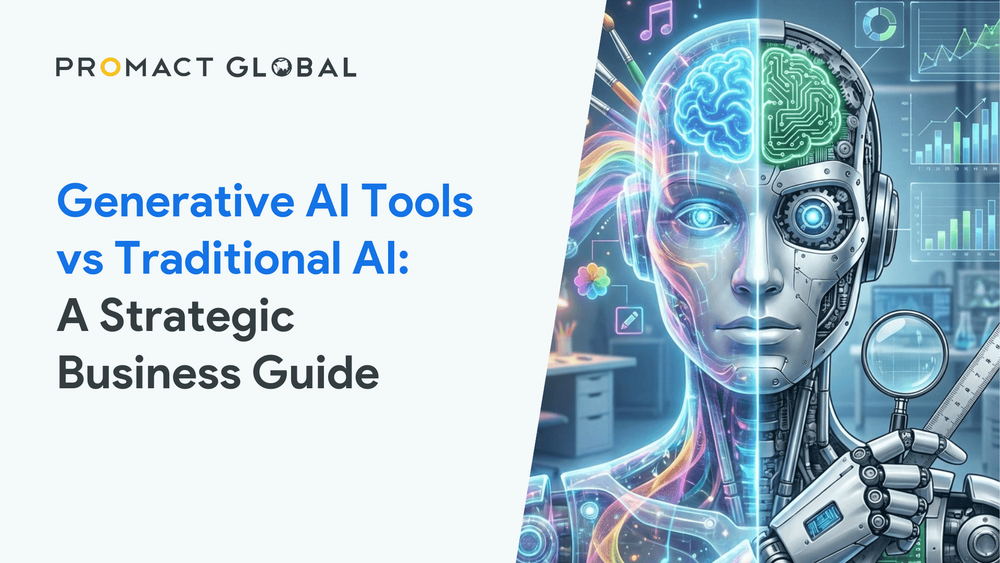
In this model, the two types of AI work in tandem, much like the left and right hemispheres of the human brain.
The Agentic Workflow
Imagine a loan underwriting process.
- The Orchestrator (Generative AI): A user asks, "Assess the risk for Client X." The Generative AI understands the request and formulates a plan.
- The Analyst (Traditional AI): The system calls a specific Traditional AI model to crunch the numbers. This model queries the database and returns a precise risk score of 0.85.
- The Synthesis (Generative AI): The Generative AI takes that number and combines it with a review of compliance documents. It writes a natural language report: "Client X has a high risk score of 85%, primarily driven by recent payment delinquencies".
This approach leverages the reasoning and flexibility of Generative AI with the precision and speed of Traditional AI. It solves the hallucination problem by grounding the "creative" model in facts provided by the "analytical" model.
Synthetic Data Generation
Another powerful hybrid application is using Generative AI to fix the data scarcity problems of Traditional AI. Training a fraud detection model requires thousands of examples of fraud, which are rare. Generative models can be used to synthesize realistic "fake" fraud data. These synthetic records are then used to train the Traditional model, improving its accuracy without compromising user privacy.
Conclusion
For the enterprise, the path forward involves a "Whole Brain" strategy.
Traditional AI is the left brain. It is analytical, precise, efficient, and reliable for defined tasks. It should be deployed for core operational processes where unit economics and accuracy are paramount.
Generative AI is the right brain. It is creative, expansive, and communicative. It is best used for augmenting human productivity, handling ambiguity, and creating novel content.
The businesses that succeed in the next era will not be those that simply buy the latest generative tools. Success belongs to those who architect a system where the rigorous precision of the discriminator guides the boundless potential of the generator. This is the new standard for intelligent enterprise.