September 6, 2026
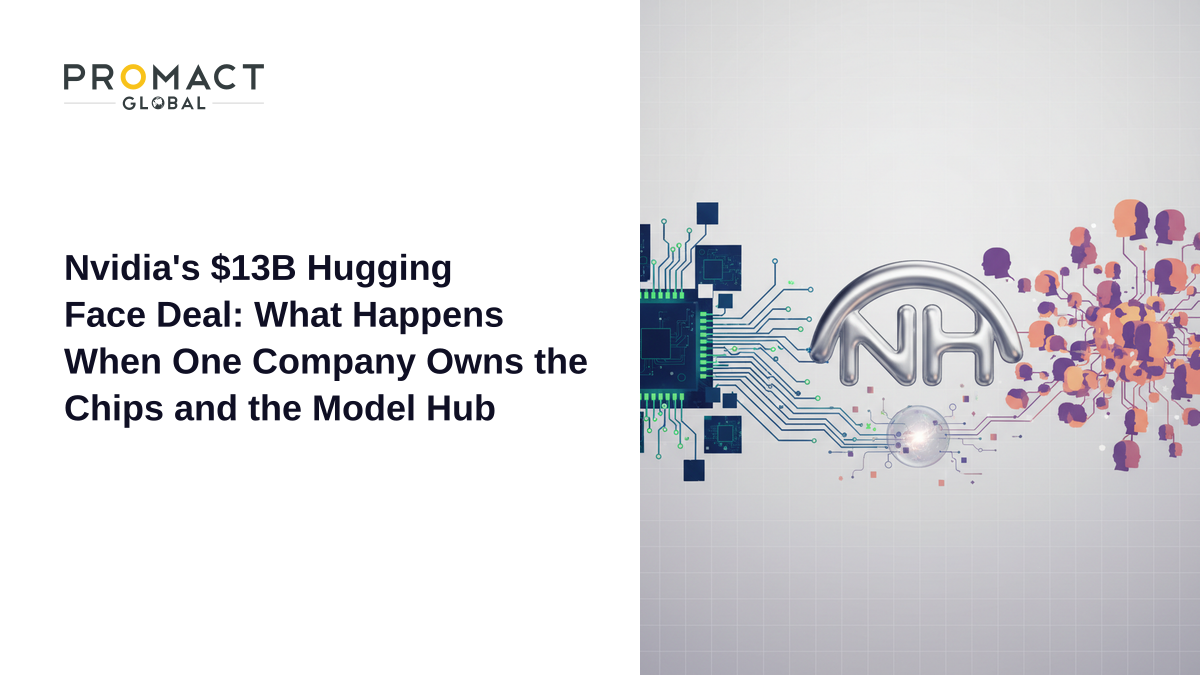
Nvidia's $13B Hugging Face Deal: What Happens When One Company Owns the Chips and the Model Hub
On September 3, 2026, Nvidia agreed to buy Hugging Face for roughly $12.93 billion — a figure that would have sounded absurd a few years ago for a company best known for hosting other people’s open-source models for free. Hugging Face isn’t a lab that trains frontier models; it’s the plumbing. More than 18 million developers rely on it to share over 3 million models, 500,000 datasets, and 1 million applications, and more than 200,000 companies use it to discover, evaluate, and deploy AI. If your engineering team has ever pulled a model checkpoint, fine-tuned an open-weight model, or run a demo through Hugging Face’s Inference Endpoints, you have already depended on infrastructure that a single chipmaker is about to own outright.
That’s the part worth sitting with. This isn’t a story about a hot AI startup getting acquired for a big number — those happen every month now. It’s a story about what happens when the company that already controls the GPUs, the CUDA software stack, the networking layer, and the inference runtime also comes to control the single most important distribution channel for the models built to run on all of it. For any business that has bet its AI roadmap on “we’ll just use open models and stay flexible,” this deal is worth understanding in detail, because the flexibility you thought you had may be quietly narrowing.
This post breaks down what the deal actually says, why regulators and developers are nervous about it, what the realistic risk to your business looks like, and what to actually do about it — regardless of whether the deal closes as announced.
What Nvidia Is Actually Buying
The mechanics of the deal are straightforward. Nvidia will pay roughly $11.9 billion to Hugging Face shareholders, plus up to $1 billion in retention equity for employees who join Nvidia as part of the transaction. The deal is expected to close in the first half of 2027, pending regulatory approval in the U.S., EU, and potentially the UK.
Nvidia CEO Jensen Huang has framed the acquisition as an investment in openness, not control, saying the two companies will “scale Hugging Face’s platform, strengthen its infrastructure, and expand access to AI for developers and institutions worldwide.” Nvidia’s official statement goes further, promising that Hugging Face will remain an open platform where developers can keep choosing their own models, frameworks, clouds, inference providers, and compute — explicitly stating that Nvidia compute won’t be required to build on or deploy through Hugging Face.
It’s worth noting this isn’t the first time Nvidia and Hugging Face have partnered — the two companies have worked together since at least 2023 to connect developers to Nvidia’s supercomputing infrastructure. What’s new is that a partnership is becoming ownership, and ownership changes who ultimately decides the platform’s priorities. This mirrors a pattern we’ve seen elsewhere this year, like Stripe’s $7 billion acquisition of OpenRouter, where a company that already sat one layer away from the AI stack moved to own a neutral routing layer outright.
Why Hugging Face, Why Now
Nvidia’s stated rationale is defensive as much as it is offensive. Major AI labs — including OpenAI and Google — have been developing their own custom silicon specifically to reduce their dependence on Nvidia’s GPUs and cut inference costs. Owning the platform where the broader developer ecosystem discovers, benchmarks, and deploys models gives Nvidia a foothold in the application and tooling layer that doesn’t depend on any single lab’s chip choices. If every open-weight model on Hugging Face is a little easier to run well on Nvidia hardware, Nvidia’s silicon stays relevant even as labs diversify their compute.
The Neutrality Problem
Hugging Face’s value has always come from being the neutral ground of the AI ecosystem — the one place a developer could go regardless of whether they were building on AMD, Intel, Nvidia, Google TPUs, or a cloud-neutral inference provider. That neutrality is exactly what’s now in question.
Hugging Face currently maintains libraries like Optimum AMD and Optimum Intel as first-class citizens alongside its Nvidia-focused tooling. Analysts covering the deal have pointed out that under Nvidia’s ownership, those libraries could see reduced maintenance investment, slower support for new model architectures, or lower visibility compared to Nvidia-first tooling — not necessarily through any deliberate sabotage, but simply because resourcing decisions inside a company tend to favor the parent’s own priorities. Rival chip vendors face a real risk that new quantization formats, serving optimizations, or library features ship Nvidia-first, with other backends catching up months later. Developers building on the fastest-supported path tend to stay on it, which is precisely how lock-in happens without anyone signing a contract that says so.
As one industry analysis put it plainly: open weights protect you from a model vendor, not from whoever owns the distribution layer. You can self-host a Llama or Mistral checkpoint forever, immune to that lab raising prices or shutting down access. But if the tooling, benchmarks, documentation, and “path of least resistance” for using that model increasingly assume Nvidia hardware underneath, your practical independence erodes even though the model file itself never changes. The risk isn’t a hard wall — it’s a slow drift where the Nvidia-optimized path quietly becomes the easy path, and everything else becomes the friction path.
The Regulatory Question
Unsurprisingly, this is drawing serious antitrust attention. Nvidia has a relevant scar here: its $40 billion bid for chip designer Arm collapsed in 2022 after regulators in the US, UK, EU, and China argued that a platform the entire industry depends on shouldn’t be owned by one of the companies that also depends on it competitively. Hugging Face is arguably an even more central dependency for the AI industry than Arm’s chip designs were for the semiconductor industry.
Nvidia’s own executives are aware of the comparison. Justin Boitano, an Nvidia vice president, has argued the deal should be viewed as a “deconcentration platform” rather than a consolidation play, expecting regulators to ultimately see it as positive for competition rather than against it. Whether the FTC, DOJ, and European regulators agree remains an open question, and the deal’s own first-half-2027 closing timeline signals that Nvidia expects a genuine review process, not a rubber stamp.
What This Means If You’ve Built on Open Models
If your organization’s AI strategy leans on open-weight models — for cost control, data residency, fine-tuning flexibility, or simply to avoid being tied to one API vendor — this deal doesn’t require you to panic, but it does require you to look honestly at where your dependencies actually sit. A few questions worth asking your engineering team this quarter:
Audit where “open” quietly became “Nvidia-shaped”
Look at your model-serving stack. If every fine-tuned checkpoint you run is quantized with Nvidia-specific tooling, served through an Nvidia-optimized runtime, and benchmarked using Hugging Face leaderboards that assume Nvidia hardware, your team’s practical flexibility is narrower than your architecture diagram suggests. This is the same lesson enterprises learned the hard way when AWS retired Bedrock Agents Classic and forced a migration few teams had planned for — convenience today can become a forced migration tomorrow.
Don’t treat “open weights” as a complete de-risking strategy
Open licensing protects you from one specific failure mode: a vendor revoking your access or discontinuing a model. It does not protect you from the distribution and tooling layer becoming harder to use with anything other than one company’s hardware. If vendor independence is a genuine priority — not just a talking point — it needs to be evaluated at the tooling and infrastructure layer, not just the model license.
Watch how this affects the broader AI supply chain
This acquisition follows a pattern of infrastructure consolidation across the AI stack this year. We’ve already seen IBM’s partnership with OpenAI signal the end of single-vendor AI bets for enterprises that want optionality, and Stripe’s move into model routing infrastructure. Each of these deals, on its own, looks like a rational business move. Together, they describe an AI industry where the “neutral” layers enterprises have relied on for flexibility are steadily being absorbed by the biggest players. That’s a structural shift worth tracking even if no single deal affects you directly today.
Reconsider your multi-cloud, multi-accelerator posture
If your procurement or platform team has been deprioritizing AMD, Intel, or alternative accelerators because “everything runs fine on Nvidia anyway,” this is a reasonable moment to revisit that assumption — not because Nvidia hardware is bad, but because a single point of dependency across chips, software stack, and now model distribution is a genuine concentration risk regardless of how good any individual piece is. Diversifying isn’t about distrust of Nvidia specifically; it’s about not letting your AI roadmap depend entirely on one company’s roadmap, pricing, and priorities.
The Bigger Pattern: Infrastructure Is Where the AI Money Is Moving
It’s tempting to read every AI acquisition as a story about models getting smarter. This one isn’t. Nvidia isn’t buying Hugging Face for a breakthrough model — it’s buying distribution, developer mindshare, and a front-row seat to which models and techniques gain traction next, months before that shows up in any benchmark. That’s a fundamentally different kind of bet, and it says something about where the real leverage in the AI industry currently sits: not necessarily with whoever has the best model this quarter, but with whoever controls the rails everyone else builds on.
Enterprises evaluating their AI strategy for 2027 should treat this as a data point in a broader trend, not an isolated event. The layers of the stack that used to be treated as neutral utilities — model hubs, routing infrastructure, agent orchestration frameworks — are consolidating into the hands of a small number of very large, very well-capitalized companies. That doesn’t mean those companies will behave badly. It does mean the assumption that “open” automatically equals “independent” deserves more scrutiny than it got a year ago.
Frequently Asked Questions
Is the Nvidia-Hugging Face acquisition final?
No. The deal was announced on September 3, 2026, and is expected to close in the first half of 2027, subject to regulatory approval in the U.S., EU, and potentially other jurisdictions. Given Nvidia’s collapsed Arm acquisition in 2022 over similar competitive concerns, regulatory review is expected to be substantial.
Will Hugging Face stop supporting non-Nvidia hardware?
Nvidia has publicly committed to keeping Hugging Face an open, multi-cloud, multi-accelerator platform, and says Nvidia compute won’t be required to use it. The more realistic risk analysts point to isn’t an outright removal of support for AMD, Intel, or other backends, but a gradual shift in investment and support priority toward Nvidia-optimized paths over time.
Does this affect companies that don’t use Nvidia GPUs directly?
Yes, potentially. If your organization relies on open-weight models, fine-tuning workflows, or benchmarks sourced from Hugging Face, the platform’s future priorities can shape which models and tools are best supported — regardless of what hardware you personally run.
What should my company do right now?
Nothing drastic is required immediately, since the deal hasn’t closed. The practical step is an audit: map which parts of your AI stack depend on Hugging Face’s tooling and infrastructure specifically, versus which depend on the underlying open model weights, which remain portable regardless of who owns the platform.
Is this similar to other recent AI infrastructure acquisitions?
Yes. It follows a broader 2026 pattern of major companies acquiring the “neutral” infrastructure layers of the AI stack, including Stripe’s acquisition of the model-routing platform OpenRouter. The common thread is large, capitalized players moving to own the rails that smaller AI companies and enterprises build on.
Why did Hugging Face agree to be acquired instead of staying independent?
Public reporting indicates Hugging Face’s leadership approached Nvidia about the deal weeks before it was announced, suggesting the company saw an opportunity to access Nvidia’s infrastructure investment and scale rather than being pursued as a reluctant target.
Sources
- NVIDIA to Acquire Hugging Face - Nvidia’s official announcement blog post with deal terms and executive statements.
- Nvidia agrees to buy Hugging Face for almost $13 billion, AI expansion - CNBC coverage including deal structure and Hugging Face’s outreach to Nvidia.
- Nvidia confirms $13 billion acquisition of open-weight AI platform Hugging Face - Deal financial breakdown, including shareholder payout and retention equity.
- Nvidia’s $13 Billion Hugging Face Deal Expands Open-Source AI - Yahoo Finance analysis of the deal’s open-source implications.
- Hugging Face is too important to fall into Nvidia’s hands - The Register’s analysis of neutrality concerns and the Arm acquisition precedent.
- Nvidia’s $12.9B Hugging Face Deal Must Pass Antitrust Review Its Quasi-Mergers Dodged - Tech Times on the FTC/DOJ inquiry into AI competitive collaborations.
- Nvidia-Hugging Face deal could require an enterprise AI rethink - Computerworld’s analysis of vendor lock-in risk for enterprises.
- Nvidia + Hugging Face Is a Lock-In Question - Analysis of Optimum AMD/Intel library risk under Nvidia ownership.
- NVIDIA Insists Its $12.93 Billion Acquisition Of Hugging Face Will Escape Antitrust Scrutiny, Calling It A “Deconcentration Platform” - Coverage of Nvidia’s regulatory defense strategy.
Have a project like this in mind?
Tell us what you're building — we'll help you scope it and ship it.
Talk to usKeep reading
October 21, 2026
82% Say They Can Govern AI Agents, 26% Can Resolve Their Conflicts: What OutSystems' New Survey Reveals
October 20, 2026
The Agentic Insider: What Microsoft's Guardian Agents Mean for Governing AI Agents Like Employees

October 19, 2026