May 18, 2026
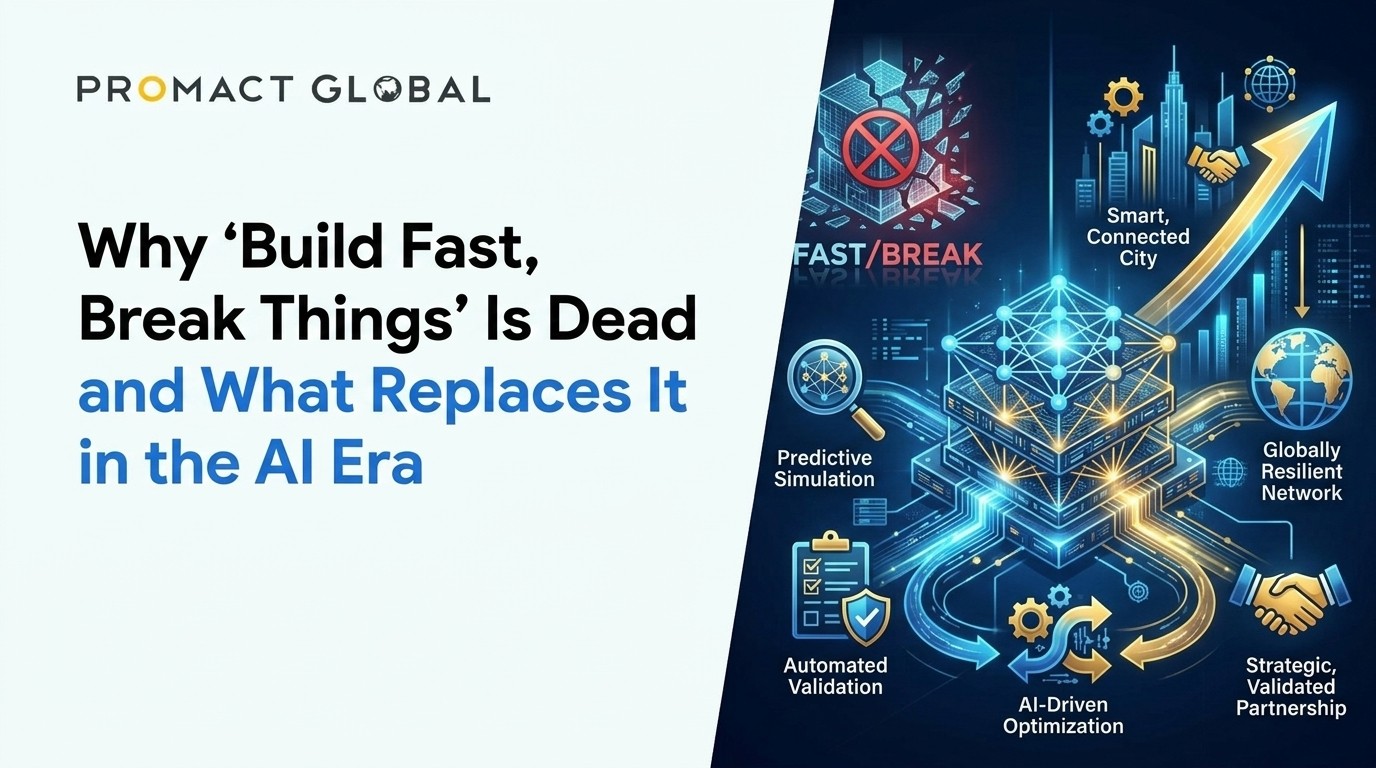
Why "Build Fast, Break Things" Is Dead and What Replaces It in the AI Era
Introduction: A Mantra That Broke Too Many Things
There is a good chance you have heard this phrase in a pitch deck, a co-working space, or a late-night startup war story: “Move fast and break things.” For a long time, it felt like the unofficial anthem of Silicon Valley. It had energy. It rewarded boldness. It gave founders permission to ship imperfect products and iterate later.
But here is the uncomfortable truth: that philosophy helped birth a generation of products that moved fast and broke trust.
Social media platforms optimized for engagement at the cost of mental health. Gig economy apps scaled without labour protections. Fintech products pushed into markets before understanding local regulations. The mess that followed was not just a PR problem. It was a structural failure in how companies thought about consequences.
And now, with agentic AI reshaping every layer of the startup stack, the “break things” mentality is not just dated — it is genuinely dangerous.
The new AI startup product strategy for 2026 looks very different. It is still fast. But it is also governed, trustworthy, and built with safety baked into the foundation — not bolted on as an afterthought.
Where Did “Move Fast and Break Things” Actually Come From?
Mark Zuckerberg is often credited with coining this phrase, and he did use it internally at Facebook during the company’s hypergrowth years. The logic was simple: speed of iteration was a competitive advantage. If you waited too long to ship, a competitor would eat your lunch. Imperfection was acceptable. Friction was the enemy.
This mindset made sense in a world where the worst-case outcome of shipping fast was a buggy app or a confusing UX. You pushed code, something broke, you fixed it. The blast radius was limited.
But that calculus has changed. Dramatically.
The Agentic AI Shift Changes Everything
Agentic AI refers to AI systems that can take actions autonomously — browsing the web, writing and executing code, making decisions, and interacting with external services without constant human input. Tools like autonomous research agents, AI-powered customer service bots with backend access, and multi-agent orchestration systems are not theoretical anymore. Startups are building with them right now.
This shift in AI startup product strategy for 2026 is not incremental. It is categorical.
When an agentic AI system makes a mistake, it does not just display a wrong answer. It can take a wrong action. It can send an email on your behalf, execute a financial transaction, or modify a document — and then do it again before you even notice. The blast radius of a poorly governed AI system is not a bug report. It can be a legal liability, a data breach, or a broken relationship with your users.
Think of it this way. In the old world, shipping a buggy feature was like throwing a paper airplane badly. It flopped. You picked it up and tried again. In the agentic AI world, shipping an ungoverned system is more like handing someone a powered drone without a controller. Things escalate quickly.
The New Startup Mantra: Build Fast, Stay Governed
The phrase that is quietly replacing “move fast and break things” across forward-thinking product teams is something closer to: build fast, stay governed.
This does not mean building slowly. Iteration speed still matters. Being first to find product-market fit still matters. But the definition of “good enough to ship” has expanded. Now it includes: Is this safe enough to ship? Is this transparent enough to ship? Is this private enough to ship?
This is the heart of the new AI startup product strategy for 2026. Speed and governance are no longer opposites. They are co-requirements.
Here is how this plays out in practice.
Trust Has to Be a Feature, Not a Promise
In the pre-AI era, trust was something companies earned over time. You shipped a product, the product worked reasonably well, and users gradually came to rely on it. Trust was a lagging indicator of quality.
With agentic AI, trust has to be designed in from the start. Users are increasingly aware that AI systems can behave unexpectedly. They want to know: What is this doing? Why did it do that? Can I reverse it?
Startups that treat explainability and user control as core product features — not as compliance checkboxes — are going to earn and keep user trust faster. Companies like Anthropic, with its Constitutional AI framework, and OpenAI, with its published model specifications, are setting a tone that the broader ecosystem is now responding to. But it is not just the big labs. Startups building on top of these models also carry a responsibility to think carefully about how they expose AI capabilities to end users.
Data Privacy Is Not a Legal Problem. It Is a Design Problem.
Here is something that used to be a legal team’s headache and is now a product team’s mandate: data privacy.
In a world where AI systems ingest user data to personalise outputs, remember context across sessions, and improve over time, the question of what data gets collected, stored, and used is fundamental. It is not something you figure out when a regulator asks. It is something you figure out in your first sprint.
The General Data Protection Regulation (GDPR) in Europe, India’s Digital Personal Data Protection Act (DPDP Act) of 2023, and California’s CCPA are all frameworks that reward companies who build privacy in early and penalise those who retrofit it later. Beyond regulatory compliance, users are simply more sophisticated now. They ask questions about their data. They read privacy policies (well, some of them do). They choose products that feel trustworthy.
A thoughtful AI startup product strategy for 2026 treats privacy as a competitive advantage. Not a checkbox.
Safety Is the New Scalability
In the early 2010s, every startup pitch deck had a slide about infrastructure: “We are built on AWS. We scale horizontally. We can handle 10 million users.” Scalability was the proof of technical seriousness.
In 2026, safety is playing that role.
When a founder can credibly explain how their AI system handles edge cases, what guardrails exist against misuse, how they monitor model drift, and how they respond when something goes wrong — that is a signal of product maturity. It is the kind of thing that enterprise clients, investors, and regulators are looking for.
This does not mean startups need to build the equivalent of a pharmaceutical clinical trial process. But it does mean thinking through failure modes before you hit them. Red-teaming your AI before launch. Defining what the system should refuse to do, not just what it can do.
MVPs in the AI Era Look Different
The Minimum Viable Product concept is not dead. But its definition has been updated.
In the old framework, an MVP was the smallest thing you could ship to test market demand. Features could be rough. The backend could be duct-taped together. You were testing a hypothesis, not shipping a finished product.
In an AI startup context, the MVP still tests a hypothesis. But the hypothesis now includes trust. Does this AI behaviour feel right to users? Do people feel safe using it? Are there unexpected outputs that would damage trust before you have had a chance to build it?
This means the minimum bar for an AI-powered MVP is slightly higher than it was for a traditional software MVP. Not dramatically higher. But higher. You are not just testing whether users want the feature. You are also testing whether users trust the feature to behave in expected ways.
Practically, this translates to things like: building a feedback loop where users can flag unexpected AI outputs, designing human-in-the-loop moments for high-stakes actions, and setting clear user expectations about what the AI can and cannot do.
The Governance Stack: What “Baked In” Actually Means
When people say governance should be “baked in from day one,” it can sound abstract. Here is what it actually looks like in a startup context.
At the model level, it means choosing foundation models that have strong alignment practices, clear usage policies, and active safety research behind them. At the application level, it means defining system prompts that constrain model behaviour, building output filters, and logging AI decisions for auditability. At the product level, it means giving users meaningful controls, clear disclosures that they are interacting with AI, and easy pathways to escalate to human support when needed.
None of this is impossibly hard. But none of it is optional either — not if you want to build something that lasts.
The Competitive Case for Governed AI
Here is the argument that tends to land with growth-focused founders who are not primarily motivated by ethics: governed AI products win in enterprise sales.
Selling an AI product to a hospital, a bank, a law firm, or a government agency in 2026 requires passing procurement reviews that ask hard questions about security, privacy, explainability, and incident response. Companies that have thought through these questions early move through enterprise sales cycles faster. Companies that have not spend months retrofitting governance documentation.
Beyond enterprise, consumer trust is also a real business metric. Churn driven by privacy concerns, public trust failures, and AI-related incidents is increasingly common. The companies building the fastest right now are the ones that are not having to pause to clean up AI incidents.
The new AI startup product strategy for 2026 is not slower. It is actually more durable.
Conclusion: Speed Is Still a Virtue. It Just Has a Co-Pilot Now.
The death of “move fast and break things” is not a call for caution over ambition. It is a recognition that in the age of agentic AI, the consequences of broken things are fundamentally different.
The startups that will define this decade are not the ones who move the slowest. They are the ones who move fast with a co-pilot in the seat: governance, trust, privacy, and safety built into the product from day one.
Build fast. Stay governed. That is the mantra for the AI era.
Have a project like this in mind?
Tell us what you're building — we'll help you scope it and ship it.
Talk to usKeep reading

August 25, 2026
The AI-SPM Gold Rush: What $210 Million in 24 Hours Says About Securing Your AI Agents
August 23, 2026
Agent Plugins 1.0: What Actually Ports Between Your AI Coding Tools — And What Doesn't
August 22, 2026