

May 13, 2026
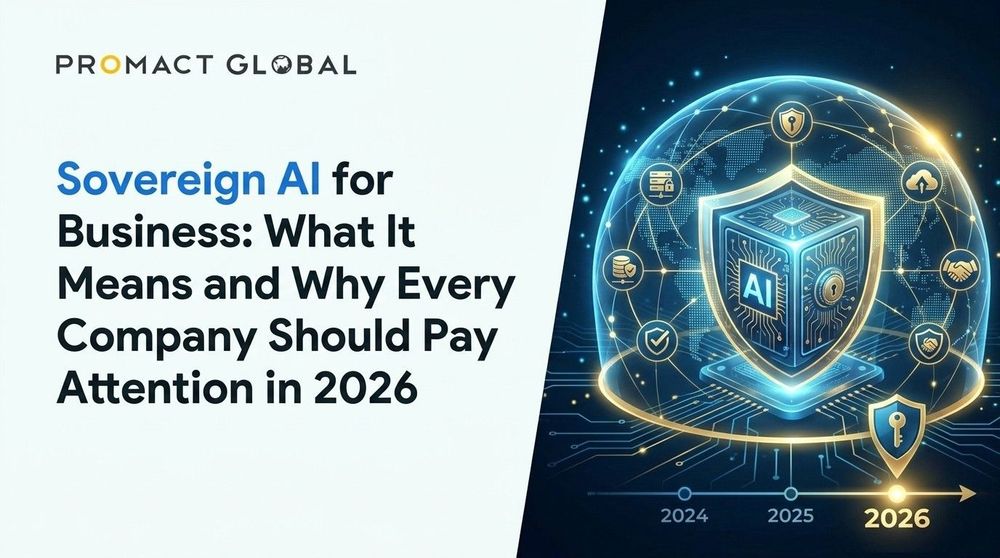
Sovereign AI for Business: What It Means and Why Every Company Should Pay Attention in 2026
Introduction: Who Actually Controls Your AI?
There is a question that most business leaders have not stopped to ask yet, even though the answer has serious consequences for their company: who controls the AI your business depends on?
Not who built it. Not who licensed it to you. Who actually controls it, the data it runs on, the infrastructure it sits on, and the laws that govern how it behaves?
If you are using a large AI platform hosted abroad, the answer might not be what you expect. Your customer data, transaction histories, business logic, and operational insights could all be passing through systems governed by foreign laws, foreign courts, and foreign corporate priorities. In most cases, you agreed to this in a terms-of-service document nobody read.
This is what the global conversation around sovereign AI for business is really about. And in 2026, it has moved well beyond theoretical discussion into boardrooms, government ministries, and product roadmaps around the world.
What Is Sovereign AI, Exactly?
The term “sovereign AI” sounds technical, but the core idea is actually straightforward. It refers to a country, and the businesses operating within it, having genuine control over the AI systems they use. That means control over the data those systems consume, the infrastructure they run on, and the regulatory framework that governs their behavior.
MIT Sloan Management Review has described sovereign AI as a country’s ability to produce AI using its own infrastructure, data, workforce, and business networks. But the concept extends to companies too. A business practicing AI data sovereignty ensures that its data stays within defined legal and geographic boundaries, is processed under local law, and is not subject to unilateral access or modification by a foreign government or corporation.
Think of it like this. In the early days of cloud computing, many companies rushed to move everything to US-based platforms because it was fast, cheap, and convenient. A decade later, several of those same companies found themselves navigating complex GDPR compliance questions, data residency issues, and uncomfortable dependencies on a handful of hyperscalers. Sovereign AI is the same conversation, just happening earlier and with higher stakes.
Why This Matters More in 2026 Than It Did Before
The urgency around sovereign AI for business has grown considerably over the past two years, for reasons that are both geopolitical and practical.
On the geopolitical side, AI has become a strategic asset in the same way that oil, semiconductors, and telecommunications infrastructure once were. Countries that control foundational AI models, the training data behind them, and the compute required to run them hold enormous leverage over countries that do not. This has driven governments from the European Union to India to Saudi Arabia to invest in national AI strategies that prioritize local infrastructure, local data, and locally trained models.
India is a particularly instructive case. With over 1.4 billion people generating enormous volumes of data every day, India has both an immense stake in AI and an immense vulnerability if that data flows exclusively through systems outside its jurisdiction. The Digital Personal Data Protection Act of 2023 signaled a clear policy direction: data about Indian citizens, generated on Indian soil, should be protected under Indian law. The IndiaAI Mission, with its focus on building domestic compute infrastructure and open datasets, is the operational expression of that same principle.
On the practical side, the risk profile for businesses has changed. Three years ago, the main concern was data privacy. Today, companies are grappling with questions like: What happens to our AI systems if a foreign vendor suddenly changes its pricing, gets acquired, or is subject to trade restrictions? What happens if a foreign government issues a subpoena for our data? What happens if the model we depend on gets updated in a way that changes our product behavior overnight?
These are not hypothetical scenarios. They are documented risks that several large enterprises have already encountered.
The Dependency Problem: Understanding Your Exposure
One of the clearest ways to understand sovereign AI for business is to think about dependency, specifically, how much of your AI capability rests on systems and decisions you cannot control.
At one end of the spectrum, a company might be fully dependent: all AI workloads run on a single foreign cloud, using a proprietary model, under terms that give the vendor considerable latitude. At the other end, a company might run everything on-premise or in a domestic private cloud, using open-source models fine-tuned on proprietary data, with full visibility into every layer of the stack.
Most businesses sit somewhere in the middle, but many do not know exactly where. A useful self-assessment involves asking a few honest questions.
First, where does your data actually go? When your AI tools process customer information, invoices, support tickets, or product data, what country does that data travel through? Which jurisdiction’s laws apply to it?
Second, what is your exit cost? If your primary AI vendor raised prices by 300% tomorrow, or was sanctioned, or simply discontinued the product you depend on, how long would it take you to migrate? What would you lose in the process?
Third, what visibility do you have into the model itself? Do you know how your AI vendor trained the model you are using? Do you know what data went into it, and whether that creates any intellectual property or compliance risks for you?
Fourth, who can access your data? Under what legal circumstances could a government, regulator, or court in another country compel your vendor to produce your data without your knowledge?
If you found any of these questions difficult to answer, that is useful information. It means you have dependency exposure that is worth understanding before it becomes a crisis.
What Sovereign AI Looks Like in Practice
Sovereign AI for business is not about building every AI capability from scratch. That would be neither practical nor advisable for most companies. It is about making deliberate choices at each layer of the technology stack to maintain meaningful control and reduce unacceptable risk.
In practical terms, this might mean using open-source foundation models that can be deployed on your own infrastructure rather than depending entirely on API calls to a foreign proprietary model. It might mean choosing a cloud provider that offers data residency guarantees in your country, or working with a domestic software partner who builds and maintains AI systems under your jurisdiction’s legal framework.
For Indian enterprises specifically, the IndiaAI Mission’s push to make compute capacity available through domestic data centers creates new options for companies that previously had no alternative to foreign infrastructure. Several Indian states have also moved to establish AI-specific data governance frameworks, creating a clearer regulatory environment for businesses that want to build responsibly.
At Promact Global, conversations with enterprise clients increasingly start with these questions. Companies that once thought of AI adoption purely in terms of feature sets and costs are now asking about data flows, vendor lock-in, and compliance frameworks. That shift in the conversation reflects a broader maturity in how businesses think about technology risk.
The Risks of Getting This Wrong
It is worth being concrete about what is actually at stake when companies ignore AI data sovereignty.
Regulatory risk is the most immediate. Jurisdictions that have passed or are passing data protection laws, including India’s DPDP Act, the EU’s AI Act, and similar legislation in Brazil, Canada, and several Southeast Asian countries, are beginning to enforce requirements around data residency and AI transparency. Companies that have built their AI stack without considering these requirements may face significant compliance costs, or worse, enforcement actions.
Competitive risk is subtler but equally real. If a foreign AI vendor trains its models on data from across its entire client base, your proprietary business data could theoretically inform improvements that benefit your competitors. Most vendor agreements address this in theory, but the practical reality of how large models are trained and updated is considerably harder to audit.
Operational risk is the most underappreciated. Businesses that build critical workflows on top of AI systems they do not control are creating single points of failure in their operations. Model updates, API deprecations, outages, and vendor policy changes have all caused significant disruption to businesses that discovered too late how deeply they had integrated a particular tool.
Strategic risk, finally, is about the long game. A company that builds its AI capabilities on a foundation it does not own is, in a meaningful sense, renting its own competitive advantage. That is a fragile position in a technology environment that is changing as quickly as AI is.
Building a Practical Path Forward
None of this means businesses should avoid AI or treat every vendor with suspicion. The benefits of modern AI are real, and the companies that use it well will have significant advantages over those that do not.
What it does mean is that building an AI strategy in 2026 requires thinking like a risk manager as much as like a technologist. It means understanding your dependencies before they become liabilities. It means choosing vendors and architecture patterns that preserve your options. And it means staying engaged with the regulatory environment in your jurisdiction so you can build proactively rather than scrambling to retrofit compliance later.
For companies building software products, this is particularly relevant. The architecture choices made today, about where data is stored, how models are trained, what APIs are called and under what terms, will shape both the capability and the risk profile of the product for years to come. Getting those choices right requires more than a technically competent engineering team. It requires a team that understands the broader context in which AI systems operate.
Final Thought: Sovereignty Is About Options
There is a tendency to hear “sovereign AI” and think it is primarily about nationalism or protectionism. That framing misses the point. What AI data sovereignty really provides is options.
When a business controls its own AI stack, or at least maintains genuine portability and transparency within it, it retains the ability to adapt. It can respond to regulatory changes without crisis. It can switch vendors without catastrophic data loss. It can audit its own systems when something goes wrong. It can negotiate from a position of strength rather than dependency.
In a technology environment where the rules, the vendors, and the capabilities are all changing rapidly, options are enormously valuable. Sovereign AI for business is ultimately a strategy for preserving those options, and for building AI capability on a foundation that is durable enough to be worth the investment.
Have a project like this in mind?
Tell us what you're building — we'll help you scope it and ship it.
Talk to usKeep reading
October 18, 2026
From Pilot to Production: What ServiceNow's AI Workflow Factory Means for Enterprise AI ROI
October 17, 2026
Did the Agent Do What You Asked? What Amex's Intent Intelligence Framework Means for AI Commerce
October 16, 2026