

May 14, 2026
Retention Over Acquisition: How AI Customer Churn Prediction Is Changing the Way Businesses Grow
Introduction: The Leaky Bucket Problem
Picture a bucket with a few small holes at the bottom. You can pour water in as fast as you like, but if you never patch those holes, you will always be running to refill it. That is exactly what happens when a business focuses almost entirely on acquisition while ignoring retention.
Every subscription cancelled, every client who quietly walks away, every user who stops logging in represents a real financial loss. And according to research by Frederick Reichheld of Bain and Company, the firm that popularised the Net Promoter Score, acquiring a new customer can cost five to seven times more than retaining an existing one. A separate study published in the Harvard Business Review found that increasing customer retention rates by just 5% can increase profits anywhere from 25% to 95%.
Those are not small numbers. They represent the difference between a business that grows sustainably and one that is forever sprinting just to stay in place.
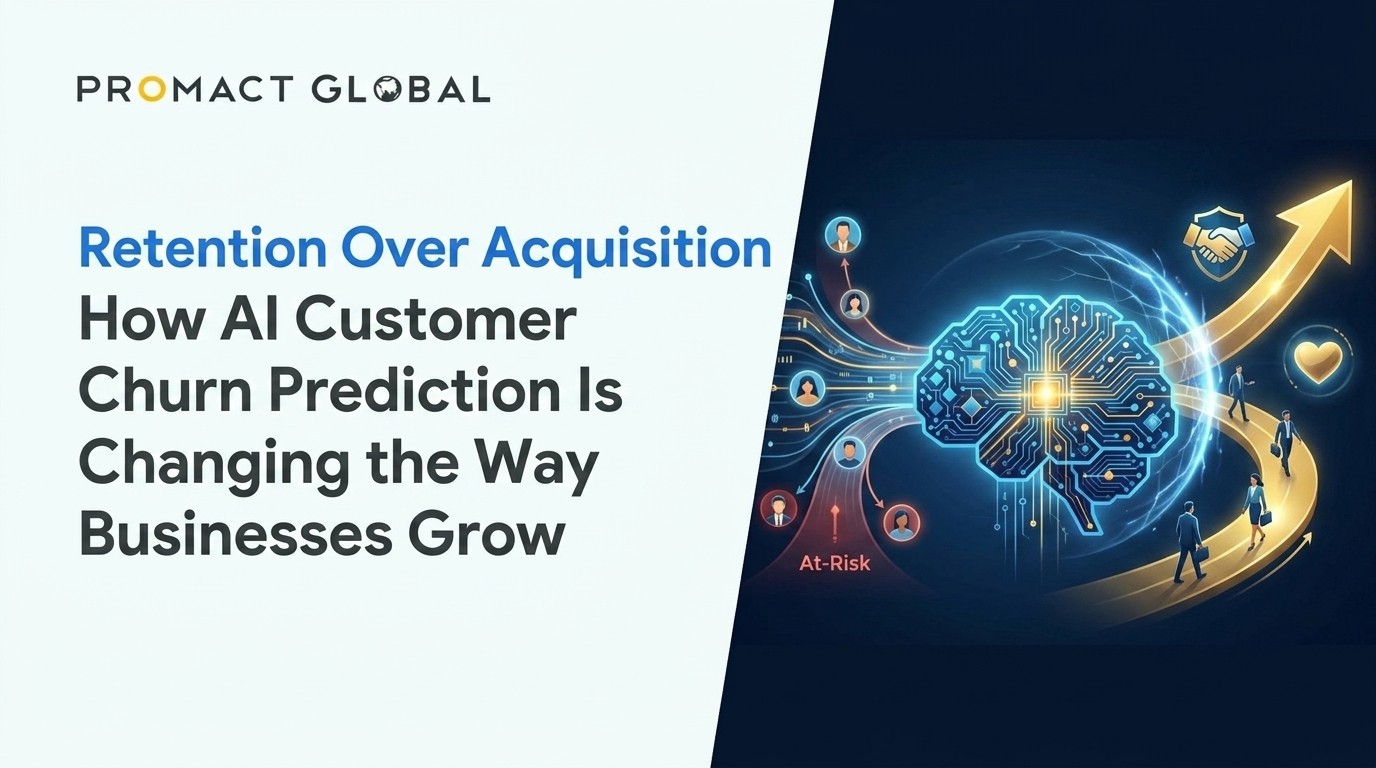
The good news is that a new generation of tools has arrived to help plug those holes before customers ever think about leaving. At the centre of this shift is AI customer churn prediction, a technology that uses machine learning to analyse behavioural signals and flag at-risk customers weeks or even months before they cancel.
This article explains how it works, why it matters, and what businesses need to understand before they consider putting it to use.
What Is Customer Churn, and Why Does It Matter So Much?
Churn is simply the rate at which customers stop doing business with you. For a SaaS company, churn might mean cancelled subscriptions. For an e-commerce brand, it might mean customers who made one purchase and never came back. For a telecom provider, it might mean users who switched to a competitor.
Churn is a lagging indicator, meaning by the time you see it in your monthly metrics, the decision to leave has usually already been made. A customer who cancels their subscription today probably stopped engaging meaningfully with your product two or three months ago. They just had not got around to clicking the cancel button yet.
That gap between disengagement and cancellation is where AI customer churn prediction becomes valuable. Rather than waiting for the cancellation event, it looks for the early signals that precede it.
Why Traditional Approaches Fall Short
Historically, businesses tried to manage churn reactively. A customer service team would follow up on cancellation requests, sometimes offering a discount or additional support in a last-ditch effort to retain the customer. Some companies still do this, and it works occasionally. But it is an exhausting and inefficient way to run a retention programme.
Other businesses used simpler rule-based systems. If a customer has not logged in for 30 days, send them a re-engagement email. If they have not used a core feature in 60 days, trigger a support call. These systems were a step in the right direction, but they had obvious limits. A customer might log in regularly but use only a fraction of the product, quietly growing frustrated without ever tripping any of the preset thresholds.
Rule-based systems also struggle to weigh multiple signals at once. A drop in login frequency on its own might mean nothing. But a drop in login frequency, combined with a reduction in feature usage, a recent support ticket about billing, and a low score on a satisfaction survey? That combination tells a very different story. No human analyst can monitor those patterns across thousands of customers simultaneously. That is exactly where machine learning changes the equation.
How AI Customer Churn Prediction Actually Works
At its core, AI customer churn prediction is a classification problem. A machine learning model is trained on historical data from customers who did churn and customers who did not. It learns which patterns and combinations of signals reliably predicted churners in the past, and then it applies that learning to your current customer base in real time.
The inputs vary by industry and product, but they typically include some combination of the following:
Usage and behavioural data is usually the richest source of signal. How frequently does the customer log in? Which features do they use and how deeply? Are they using fewer workflows compared to 60 days ago? A steady decline in active usage is often one of the strongest early indicators that a customer is quietly checking out.
Support ticket data adds context that pure usage metrics miss. A customer who submits multiple support tickets in a short window, especially tickets about billing, failed integrations, or missing features, is often expressing frustration that could eventually lead to cancellation. Natural language processing can even analyse the tone and content of those tickets to gauge sentiment.
NPS and satisfaction signals give direct voice-of-customer input. A customer who scores you a 6 out of 10 on a Net Promoter Score survey is considered a detractor. When that low score is combined with declining usage and a recent support issue, the risk profile of that customer climbs sharply.
Contract and billing signals matter in B2B contexts especially. Is the customer coming up for renewal? Did they recently downgrade their plan? Did a payment fail? These moments create friction that, if not handled well, can accelerate a decision to leave.
The model assigns each customer a churn probability score, often updated daily. Customer success teams can then prioritise outreach based on those scores, reaching out to high-risk accounts proactively rather than reactively.
A Real-World Example: How This Plays Out in Practice
Consider a mid-sized SaaS company offering project management software. They have 3,000 business customers across different plan tiers. Their customer success team of eight people cannot possibly stay in close contact with all 3,000.
Before implementing AI customer churn prediction, their process was largely intuitive. Account managers would flag customers they felt uneasy about based on gut feel and occasional check-in calls. Some churners slipped through unnoticed until the cancellation request landed in the inbox.
After deploying a churn prediction model trained on 18 months of historical data, the team started receiving a daily prioritised list. Customers with churn probability scores above a certain threshold were surfaced automatically. The team discovered that three specific patterns were most predictive for their product: a drop in team member invitations (suggesting the customer was not growing their usage), a reduction in project creation, and any support ticket tagged as a feature request that had gone unanswered for more than two weeks.
Armed with this intelligence, the team began proactive outreach to at-risk customers 45 days before renewal rather than two days before. They reported a measurable improvement in renewal rates within two quarters, and more importantly, they started having better conversations because they went into calls with specific context rather than vague concern.
The Role of Data Quality and the Importance of Getting That Right
No AI model performs better than the data it was trained on. This is a point that gets glossed over in a lot of conversations about AI, and it is worth being direct about.
If your customer data is fragmented across multiple systems, if your usage events are inconsistently tracked, or if your historical records of churned accounts are incomplete, your churn prediction model will reflect those gaps. Garbage in, garbage out, as the old computing expression goes.
Before investing in a sophisticated prediction system, businesses need to be honest about the state of their data infrastructure. That often means consolidating data from CRM systems, product analytics platforms, billing tools, and support desks into a unified data warehouse or customer data platform. It means establishing consistent event tracking within the product itself. And it means ensuring that historical churn data is labelled correctly so the model has clean examples to learn from.
This foundational work is unglamorous, but it is the difference between a churn model that genuinely guides decisions and one that produces scores nobody trusts.
What Happens After the Model Flags a Customer?
This is a question that does not get asked often enough. AI customer churn prediction tells you who is at risk. It does not automatically fix the problem. The human response to that intelligence is where the real value is either captured or lost.
The most effective retention programmes use churn scores as a trigger for personalised, contextual outreach rather than generic campaigns. If the model flags a customer because their feature usage dropped after a recent product update, the right response is a targeted call or email that acknowledges the specific change and offers help navigating it, not a generic “we noticed you haven’t logged in recently” message.
Some teams build playbooks for different churn risk profiles. A customer flagged primarily because of billing friction gets a different outreach than one who appears to have lost their internal champion after a team restructure. The segmentation that AI makes possible is only as valuable as the thoughtfulness of the human response behind it.
How AI Churn Prediction Fits Into a Broader Retention Strategy
It is worth being clear that AI customer churn prediction is a tool within a retention strategy, not a replacement for one. It accelerates and improves decision-making, but it works best when it sits inside a broader framework that includes solid onboarding, ongoing customer education, regular business reviews for higher-value accounts, and a genuine commitment to product improvement based on customer feedback.
Think of it the way a cardiologist might think of an early warning monitor. The monitor does not keep the patient healthy on its own. But it gives the doctor the information they need to intervene at the right moment, before a manageable problem becomes a crisis.
The companies that get the most from churn prediction are usually those that have already built strong foundations in customer success. The AI amplifies their capacity to act on what they already know matters.
Closing Thoughts: Retention Is a Growth Strategy
There is a tendency in business to treat retention as a defensive activity, something you do to stop losing ground while the real growth happens on the acquisition side. That framing is outdated.
When you retain customers longer, they spend more over their lifetime. They are more likely to expand into additional products or higher plan tiers. They refer new customers. They become the case studies and testimonials that make acquisition more efficient. Retention and acquisition are not in competition; they are reinforcing loops.
AI customer churn prediction is one of the more practical and immediately applicable ways businesses can start building that retention advantage today. It does not require a research team or a decade of machine learning expertise. It does require good data, a clear process for acting on the insights the model surfaces, and a genuine willingness to think about growth from the customer’s perspective rather than only from the pipeline.
The businesses that get this right will not just reduce their churn rate. They will build the kind of customer relationships that compound over time, and that is a competitive advantage that is very hard to replicate.
Have a project like this in mind?
Tell us what you're building — we'll help you scope it and ship it.
Talk to usKeep reading

August 23, 2026
Agent Plugins 1.0: What Actually Ports Between Your AI Coding Tools — And What Doesn't

August 22, 2026
OpenAI Paused Its Biggest Training Run Over Cyber Risk — What That Should Change About How You Vet AI Vendors
August 21, 2026