

May 28, 2026
Multimodal AI: When Your AI Can See, Hear, and Read at the Same Time
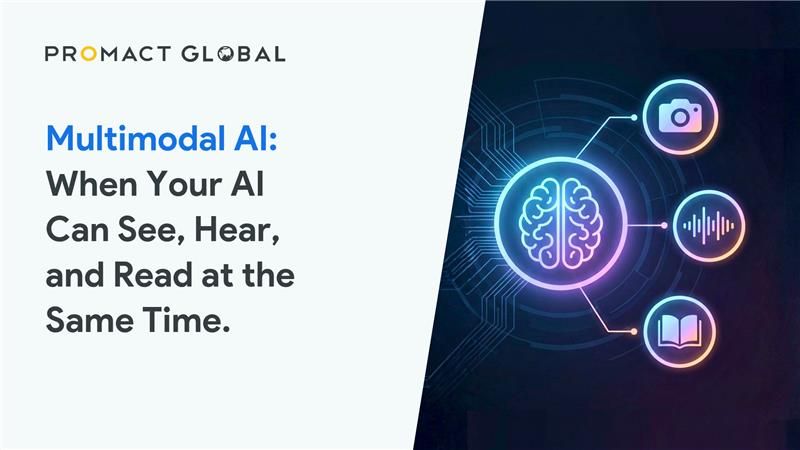
The next generation of AI doesn't just understand text — it perceives images, audio, documents, and more simultaneously, much like a human mind. Here's why that changes everything for business.
What Exactly Is Multimodal AI?
For years, AI models were specialists. A language model read text. A vision model analyzed images. An audio model transcribed speech. Each lived in its own lane, solving its own narrow slice of the problem.
Multimodal AI breaks those walls down. A multimodal model can receive inputs across multiple formats simultaneously — text, images, video, audio, PDFs, structured data — and reason across all of them at once to produce a coherent output.
Think of it as the difference between a team of isolated specialists and one expert who can watch a video, read the accompanying report, and listen to a briefing all at the same time — before giving you a single, unified answer.
"Multimodal AI models will be able to perceive and act in the world much more like a human — bridging language, vision, and action all together." — IBM Research
This isn't a distant future technology. Models like GPT-4o, Google Gemini, and Claude already demonstrate this capability in production environments today, and the business applications are maturing rapidly.
The Three Pillars: Language, Vision, and Action
To understand what makes multimodal AI so significant, it helps to look at the three core capabilities that converge in these models.
CapabilityWhat It ProcessesBusiness ExampleLanguageText, instructions, documents, emailsReading contracts, answering customer queriesVisionImages, video frames, diagrams, scanned docsInspecting product defects, reading invoicesAudioSpeech, tone, background contextTranscribing support calls with sentiment taggingActionTool use, form completion, system navigationAgentic workflows: read → decide → act
The breakthrough isn't in any single capability — it's in the fact that all four work together, in a single pass. When an AI can see a photo of a damaged product, read the warranty document, and simultaneously draft a resolution email, the productivity gain is exponential.
Why Multimodal AI Matters for Your Business
The business case for multimodal AI is rooted in a simple truth: the real world is multimodal. Your customers send photos. Your suppliers send scanned PDFs. Your products generate visual output. Your support calls are audio.
Single-modal AI forces you to build complex, fragile pipelines to handle each data type separately — multimodal AI handles it all natively.
Consider this: nearly 67% of enterprise data is unstructured — images, PDFs, video — formats that older AI simply couldn't process. Early multimodal AI business deployments have reported up to 3× faster task completion compared to single-modal pipelines.
Three High-Impact Business Applications
Based on enterprise deployments tracked by IBM and leading AI research groups, three use cases have emerged as the clearest early wins for multimodal AI adoption:
1. Product Inspection
AI vision language models analyze manufacturing images in real time, cross-referencing visual defects with specification documents to flag issues and suggest corrective action — without requiring human review in the loop.
Traditional computer vision could tell you that a defect exists. Multimodal AI tells you why, classifies the type of defect, and generates the appropriate response action — all in one step.
2. Document Processing
Invoices, contracts, forms, and scanned receipts are read both visually and semantically. The model extracts structured data, identifies anomalies, and routes documents automatically — cutting processing time from hours to seconds.
This is a major leap beyond OCR. Multimodal models understand the intent of a document, not just its text content.
3. Customer Support
Customers share screenshots, photos of broken products, or voice notes alongside text queries. Multimodal agents understand the full context and resolve issues faster — reducing escalation rates and significantly improving customer satisfaction scores.
AI Vision Language Models: A Deeper Look
At the core of most multimodal deployments are AI vision language models (VLMs) — architectures that fuse a large language model's reasoning capability with a computer vision encoder that understands spatial and visual context.
Models like LLaVA, PaliGemma, and GPT-4V belong to this family. They are trained on billions of image-text pairs so that when they "see" an image, they don't just detect objects — they understand context, relationships, and anomalies, and can answer nuanced natural language questions about what they observe.
What VLMs can do that older vision AI could not:
- Describe why a product image shows a defect, not just that a defect exists
- Read handwritten notes on a scanned form alongside printed text
- Compare a live image against a reference specification and report discrepancies in plain language
- Answer follow-up questions about an image ("Is the damage consistent with shipping or manufacturing?")
- Generate structured reports, tickets, or alerts from visual data — without developer-written templates
Implementation: What to Consider Before You Start
Multimodal AI adoption is accelerating, but successful implementation requires more than plugging in an API. Here are the considerations that matter most:
1. Data Readiness Do your internal assets — images, scanned documents, audio recordings — exist in digital, accessible formats? Multimodal AI magnifies the value of unstructured data, but that data must first be accessible to the model pipeline.
2. Model Selection Not all multimodal models perform equally across tasks. A model optimized for document parsing may underperform on complex product imagery. Benchmark the AI vision language models most relevant to your specific use case before committing to infrastructure.
3. Integration Architecture The most powerful multimodal applications pair perception with action — the model doesn't just analyze, it triggers next steps in your existing systems. Plan your integration layer with this agentic future in mind from day one.
4. Governance and Accuracy In regulated environments — manufacturing, finance, healthcare — multimodal AI outputs may require human-in-the-loop validation. Build audit trails and confidence thresholds into your design before you scale.
What's Next: The Multimodal Horizon
We're in the early innings. Current multimodal AI business applications are largely reactive — a human submits input, the model responds. The emerging frontier is proactive, agentic multimodal AI: models that monitor a live video feed of a production line, continuously read sensor data, and autonomously flag, escalate, or correct issues without prompting.
For businesses investing in AI infrastructure today, the strategic advantage lies in building towards this model now — rather than architecting for single-modal pipelines that will require costly rebuilds as the technology matures.
"The most future-proof AI investments today are those that treat multimodality as a first-class requirement, not a future upgrade."
Conclusion
Multimodal AI represents a fundamental shift in how machines understand the world. By bridging language, vision, and action into a unified model, it unlocks a class of business automation that simply wasn't possible with earlier single-modal systems.
The three most immediate opportunities — product inspection, document processing, and customer support — are proven, commercially viable, and deployable today. For businesses ready to move beyond experimental AI pilots into strategic transformation, multimodal AI is the architecture to build on.