

January 16, 2026
Integrating Generative AI Tools into Your Workflow: A Step-By-Step Guide
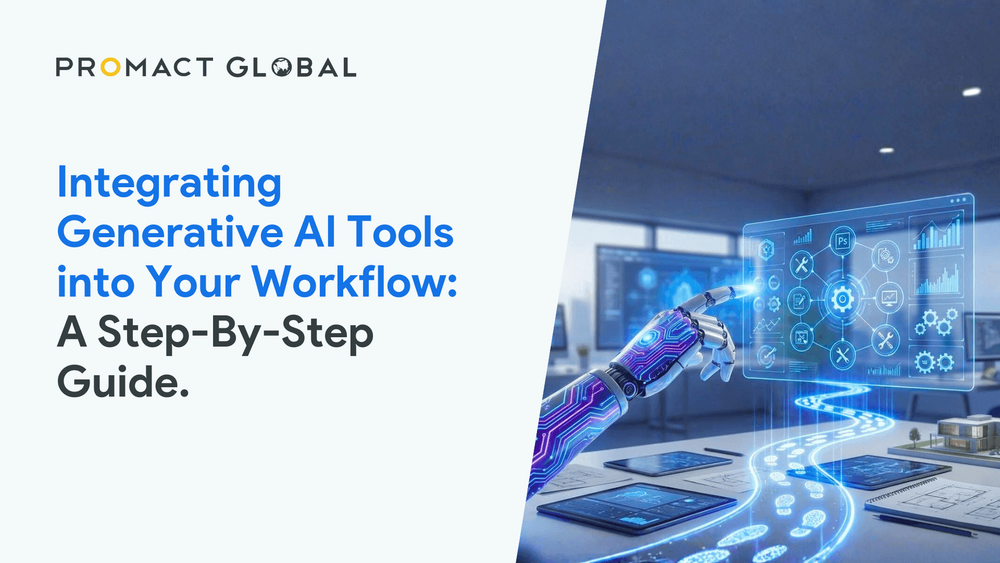
The integration of Generative Artificial Intelligence (GenAI) into enterprise workflows represents a technological inflection point that is comparable to the advent of the internet or the migration to cloud computing. It is not merely a tool upgrade but a fundamental restructuring of how knowledge work is performed, captured, and scaled. However, the path from an initial pilot to full-scale deployment is fraught with complexity. This often leads to a phenomenon known as “pilot purgatory,” where successful experiments fail to translate into sustained business value due to strategic misalignment, inadequate data infrastructure, or cultural resistance.
At Promact Global, we have seen firsthand that successful integration depends less on the model itself and more on the organizational “connective tissue.” This includes the data pipelines, API gateways, governance guardrails, and human workflows that surround the technology. This guide moves beyond the hype to provide a rigorous, step-by-step framework for operationalizing GenAI. By following a structured roadmap, enterprises can transition from experimentation to an “AI-native” operational model.
Step 1: Strategic Alignment and Use Case Definition
The most common failure mode when integrating generative AI tools is the “solution in search of a problem” phenomenon. Organizations frequently deploy tools like ChatGPT or Microsoft Copilot without a clear understanding of the specific operational friction they are attempting to resolve. This inevitably leads to low adoption and wasted resources.
Successful generative AI adoption workflow begins not with model selection but with a rigorous Business Function Analysis. This involves dissecting current workflows to identify bottlenecks where GenAI’s specific capabilities (summarization, generation, extraction, and transformation) can deliver measurable relief.
The Ideation Phase
The ideation phase must be expansive. You should encourage organization-wide submission of ideas to create a comprehensive “use case pipeline”. This democratization of innovation allows for the discovery of “embedded” use cases. These are often the unglamorous but high-value operational fixes that leadership might overlook.
When you are integrating generative AI tools, look for opportunities in these high-impact categories:
- Query Resolution: Automating responses for common customer inquiries to reduce Mean Time to Resolution (MTTR).
- Knowledge Management: Centralizing information access through semantic search, which allows employees to “chat” with their enterprise data.
- Service Scalability: Enabling support teams to handle multiple customer interactions simultaneously without linear headcount growth.
- Quality Assurance: Maintaining consistent service standards by using AI to audit communications and flag anomalies.
- Process Automation: Removing bottlenecks in complex workflows, such as summarizing deviation patterns in manufacturing or prefilling logbooks.
Prioritization Framework
Once a pipeline of use cases is established, the subsequent prioritization phase must be ruthless. A recommended framework for evaluation involves a scoring matrix that rates potential use cases on two primary axes: Impact Potential (financial, strategic, customer experience) and Implementation Complexity (technical feasibility, data readiness, risk).
Often, the prioritization process reveals that the “flashiest” use cases are not the most valuable. Instead, high-impact opportunities are frequently found in “boring” operational frictions. For instance, summarizing deviation patterns across product lines in manufacturing is less exciting than a creative writing bot, but it solves a critical and costly business problem. This pragmatic approach is essential for a successful generative AI adoption workflow.
Step 2: Technical Architecture and Tool Evaluation
A fundamental strategic decision in integrating generative AI tools is the choice between building a custom solution, buying a point solution, or leveraging a full-stack platform. This “Build vs. Buy” decision dictates the long-term cost structure, flexibility, and maintenance burden of the initiative.
The Build vs. Buy Decision
- Point Solutions (SaaS): These are best for specific departmental needs, like Jasper for Marketing or GitHub Copilot for developers. They offer rapid deployment and specialized features but come with high vendor lock-in risk and potential data silos.
- Full-Stack Platforms: Options like Azure AI Foundry or IBM watsonx are ideal for enterprise-wide adoption requiring governance. They provide centralized governance and shared infrastructure but are more complex than SaaS.
- Custom Build (Open Source): This path is suited for highly regulated industries or unique use cases requiring total control. It offers maximum control over data and security but requires significant upfront engineering cost and specialized talent.
Tool Evaluation Criteria
When selecting tools for your AI tools workflow integration, a rigorous evaluation framework is necessary to ensure enterprise readiness.
- Accuracy and Reliability: The tool must produce consistent, fact-based outputs. In critical domains like finance or healthcare, the tolerance for hallucination is near zero.
- Security and Compliance: The solution must adhere to strict data governance protocols. Key questions include data sovereignty and training policies.
- Integration Capabilities: The tool must integrate seamlessly with existing ERP, CRM, and document management systems. Lack of API compatibility can create operational bottlenecks.
- Cost vs. Value: Beyond licensing fees, organizations must evaluate the Total Cost of Ownership (TCO), including inference costs and token usage.
Deep Dive: Retrieval-Augmented Generation (RAG)
For most enterprises integrating generative AI tools, the standard “out-of-the-box” Large Language Model (LLM) is insufficient because it lacks knowledge of private enterprise data. The industry standard solution is Retrieval-Augmented Generation (RAG). This architecture combines the reasoning capabilities of an LLM with the retrieval of specific, proprietary information.
In a RAG system, enterprise data is ingested and split into manageable segments or “chunks”. A critical nuance is “privacy-aware chunking,” where documents are split along logical boundaries to preserve context and allow for granular access control. This prevents a “naive” RAG implementation from retrieving a sensitive document and summarizing it for an unauthorized user.
Step 3: Data Readiness and Governance
Data quality is the single most significant determinant of success in any generative AI adoption workflow. Poor data quality has derailed more initiatives than any other factor. Before a single model is trained or a prompt is engineered, the organization must undertake a comprehensive data audit.
The Foundation of Data Hygiene
This process involves rigorous data cleansing to remove duplicates, correct inconsistencies, and fill gaps in historical records. Data lineage must also be documented to understand the flow of data through the organization and its origin. This is essential for debugging model outputs and ensuring regulatory compliance during AI tools workflow integration.
Since GenAI excels at processing unstructured text like contracts and emails, organizations must digitize and index these assets. This often involves moving them from dark data silos into accessible data lakes or knowledge bases.
Governance and Compliance
As you proceed with integrating generative AI tools into production, you need a governance framework that addresses the unique risks of probabilistic systems. Unlike traditional software, which is deterministic, GenAI outputs can vary.
- Human Oversight: Are there “human-in-the-loop” mechanisms for high-stakes decisions? An automated code generator, for example, should not deploy to production without human review.
- Explainability: Can the system explain its reasoning? Techniques like “Chain of Thought” prompting and citation generation are critical for building trust.
- Privacy Preservation: Are Personally Identifiable Information (PII) redaction tools in place? Before a prompt is sent to an external LLM, it should pass through a “PII scrubber” to mask sensitive entities.
Managing Bias
Bias in AI is a documented operational failure mode. To prevent this during your generative AI adoption workflow, organizations must employ “Red Teaming.” This is where internal teams attempt to provoke the model into generating biased or harmful content before release.
Step 4: Pilot Execution and Iteration
A well-structured pilot is the crucible wherein strategy meets reality. When integrating generative AI tools, a typical pilot timeline spans 8 to 15 weeks. This balances the need for speed with the necessity of gathering statistically significant data. Shorter pilots often fail to capture edge cases, while longer ones risk losing stakeholder momentum.
The Pilot Timeline
- Preparation (Weeks 1-4): Establish baseline metrics like current MTTR and conduct user training. Define the “Golden Set” of evaluation data, which consists of verified input-output pairs.
- Initial Implementation (Weeks 5-6): Launch core functionality to “champion” users. The focus here is on technical stability and rapid bug fixing.
- Stability Period (Weeks 7-10): Users develop comfort with the system. Gather qualitative feedback via surveys and monitor for performance drift.
- Feature Expansion (Weeks 11-13): Introduce advanced features like multi-turn reasoning and test the limits of the system.
- Evaluation & Decision (Weeks 14-15): Conduct a comprehensive review against success criteria like ROI and adoption to make a final “Go/No-Go” decision for enterprise scaling.
Testing and Validation
Testing during AI tools workflow integration requires a shift from binary pass/fail tests to probabilistic evaluation.
- Technical Validation: Measure latency and error rates. For RAG systems, metrics like Retrieval Precision (did we get the right document?) and Generation Faithfulness (did the model stick to the facts?) are paramount.
- Business Validation: Assess whether the tool actually solves the business problem. This might involve A/B testing where one group uses the AI tool and another uses legacy processes to compare productivity.
- User Experience (UX) Validation: Use “thumbs up/down” feedback mechanisms embedded in the tool to gauge user satisfaction.
The pilot is not a linear process but a cycle of continuous improvement. If users consistently rate a specific type of answer as unhelpful, that data must flow back to the engineering team to refine the retrieval logic.
Step 5: Scaling and Stakeholder Management
Engineering teams frequently underestimate the cultural resistance to integrating generative AI tools. An estimated 85% of AI adoption failures are attributed to change management challenges rather than technical limitations. Employees often fear displacement or view the new tools as an imposition.
To address this aspect of the generative AI adoption workflow, organizations should adopt structured change management frameworks like ADKAR (Awareness, Desire, Knowledge, Ability, Reinforcement), specifically adapted for AI adoption.
- Awareness: Clearly communicate why the change is happening and the business necessity.
- Desire: Highlight “What’s in it for me?” by showing how the tool acts as a force multiplier rather than a replacement.
- Knowledge: Provide the necessary training and conceptual understanding.
- Ability: Ensure employees have the hands-on skills to use the tools effectively.
- Reinforcement: Celebrate wins and recognize “AI Champions” to embed the change into the culture.
Upskilling the Workforce
Upskilling must be segmented by role because a “one-size-fits-all” training program is ineffective.
- General Employees: Focus on foundation and ethics, including basic prompt engineering and data privacy.
- HR Professionals: Train on functional applications like job description generation and candidate screening with bias awareness.
- Technical Teams: Focus on advanced engineering, including RAG architecture and secure coding with AI assistants.
Combating “Shadow AI”
A significant risk during scaling AI tools workflow integration is “Shadow AI.” This is the unauthorized use of consumer-grade tools for enterprise work. The most effective strategy to combat Shadow AI is not draconian blocking but provisioning approved alternatives. By providing a secure, enterprise-grade sandbox that matches the utility of consumer tools, organizations can bring this activity into the light.
Step 6: Monitoring, Optimization, and ROI
Measuring the success of integrating generative AI tools requires a blend of “Hard” and “Soft” metrics. Traditional ROI metrics often fail to capture the broader value of innovation and risk reduction.
Hard Metrics
- Cost Savings: Reduction in labor hours per task or lower outsourcing costs.
- Revenue Uplift: Attributed revenue from faster time-to-market or AI-driven cross-selling.
- Productivity Gains: Measurable increases in output, such as lines of code per developer or support tickets resolved per hour.
Soft Metrics
- Customer Experience (CX): Improvements in Net Promoter Score (NPS) due to faster responses.
- Employee Satisfaction: Reduction in burnout or “toil” (repetitive, low-value work).
- Innovation Velocity: The increased rate of prototyping and experimentation enabled by AI tools.
ROI Calculation
The ROI formula for generative AI adoption workflow must account for the substantial ongoing costs of operation. The formula is (Net Gain from AI - Cost of Investment) / Cost of Investment. The Cost of Investment includes development costs, infrastructure (Cloud/GPU/Vector DB), personnel, maintenance, change management, and license fees.
Post-deployment, monitoring must track Model Drift and Hallucination Rates. Tools like Langfuse or Arize AI can provide observability to detect anomalies before they impact users.
Future Outlook: From Chatbots to Agentic AI
The current wave of integrating generative AI tools is dominated by “Copilots.” These are passive assistants that wait for human input to generate text or code. However, the next frontier is Agentic AI. These are autonomous agents capable of planning, reasoning, and executing multi-step workflows with minimal human intervention.
These agents will move beyond simple generation to performing actions like querying a database, analyzing the results, formatting a report, and emailing it to a stakeholder. This requires a shift in architecture from simple RAG to ReAct (Reason + Act) frameworks. To prepare for this future, enterprises must build a robust “AI Foundation” today by standardizing data and governance protocols.
Conclusion
Integrating generative AI tools is a multi-dimensional challenge that spans strategy, engineering, data science, and organizational psychology. It requires a shift from viewing AI as a novelty to treating it as a core enterprise capability.
By following the structured roadmap outlined in this guide, starting with strategic clarity and building on a secure technical foundation, organizations can navigate the complexities of this transformation. The window for early adopter advantage is narrowing. The imperative now is to move from “pilot” to “production” with discipline, rigor, and a relentless focus on value.
At Promact Global, we believe that the successful generative AI adoption workflow is not just about the technology you choose but the strategy you employ to weave it into the fabric of your business. Whether you are improving AI tools workflow integration for efficiency or innovation, the journey begins with a single, well-planned step.
Have a project like this in mind?
Tell us what you're building — we'll help you scope it and ship it.
Talk to usKeep reading
September 20, 2026
The Control Plane Era: What WSO2's Open-Source Agent Governance Bet Means for Enterprise AI Buyers
September 19, 2026
The Six-Week Silence: What OpenAI's DSEwiki Agent Swarm Means for Enterprise AI Oversight

September 17, 2026