

May 13, 2026
How Intelligent Document Processing AI Is Turning Your Messy Data Into a Business Asset
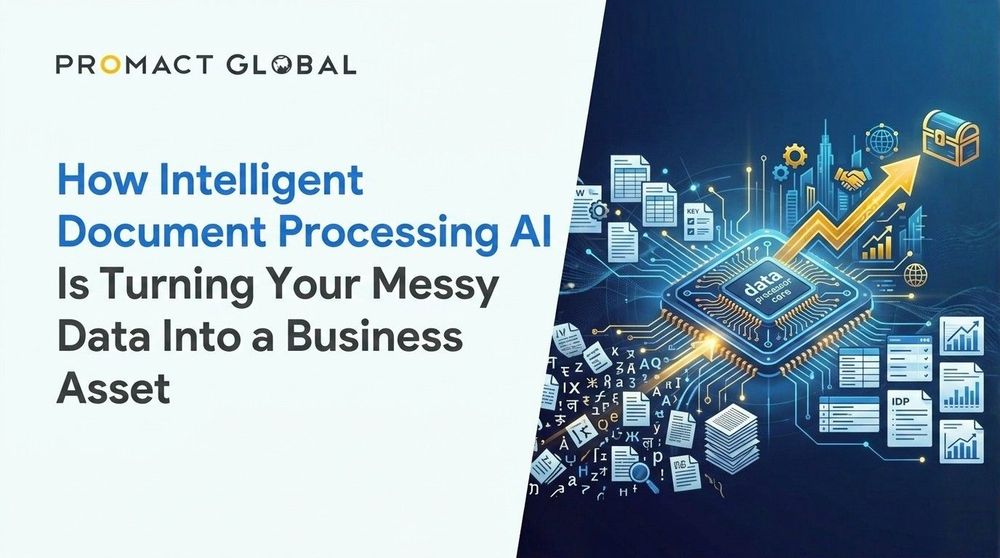
There is a good chance your company is generating more data than it knows what to do with. Emails, contracts, invoices, shipping records, case files, and scanned forms pile up every single day. And despite all the investment in dashboards, CRMs, and AI tools, most of that data just sits there. Unused. Invisible to the systems that are supposed to use it.
This is not a niche problem. Industry experts estimate that somewhere between 80 and 90 percent of all business data is unstructured. That means it does not live in neat rows and columns. It is buried in PDFs, buried in email threads, buried in handwritten notes that someone scanned three years ago and never touched again. The result? Most companies are making decisions with a fraction of the information they actually have.
Intelligent document processing AI is the technology that closes this gap. It is not flashy in the way that generative AI chatbots are. It does not write poems or answer trivia questions. But it does something arguably more valuable: it takes the document chaos that exists inside most organizations and converts it into clean, structured, and actionable data that your business systems can actually read, route, and act on.
This article breaks down how intelligent document processing AI works, which industries are seeing the biggest returns from it, and how to think about connecting it with the broader AI stack you are building.
What Intelligent Document Processing Actually Means
If you have heard of OCR, or optical character recognition, you already have some context. OCR has been around for decades. It takes a scanned image of a page and converts the visual characters into machine-readable text. That is useful, but it has a hard ceiling. OCR can tell you that a page has text. It cannot tell you what that text means.
Intelligent document processing AI goes several layers deeper. It combines OCR with machine learning, natural language processing (NLP), and AI-based classification to not just read documents but understand them. The system can look at a page and determine: this is an invoice, the vendor is X, the amount due is Y, the payment terms are Z, and there is a line item that does not match the corresponding purchase order.
The way it works in practice follows a fairly consistent pipeline. First, documents are ingested from wherever they live: email inboxes, cloud storage, scanners, ERP systems, or even WhatsApp uploads. The system then classifies each document by type. A loan application looks different from a shipping manifest, and the AI learns to tell them apart. After classification comes extraction, where relevant data fields are pulled out. Then comes validation, where the extracted data is cross-checked against existing records or business rules. Finally, the clean, structured data is routed into whatever downstream system needs it, whether that is an ERP, a CRM, a payment platform, or a legal case management tool.
One key feature that distinguishes modern intelligent document processing AI from older rule-based approaches is its ability to learn and adapt. If the system encounters an invoice from a new vendor with an unusual layout, it does not fail. It adjusts, asks a human to confirm if it needs to, and uses that confirmation to do better the next time. This is what makes it genuinely scalable, not just a faster version of what people were already doing manually.
Why Unstructured Data AI Is a Problem Worth Solving Now
The volume of business documents is not shrinking. Global data generation is accelerating, and most of that data is in formats that traditional software cannot touch. Emails, contracts, reports, regulatory submissions, scanned legacy records, and customer correspondence are all growing faster than the teams that are supposed to process them.
The cost of ignoring this is measurable. Manual document processing accounts for 20 to 30 percent of total operational costs in finance-heavy industries like banking and insurance. Companies that invest in intelligent document processing AI report an average of four times faster document processing speed compared to teams working manually. In invoice processing specifically, efficiency gains of up to 80 percent have been reported by firms that replaced manual workflows with AI-powered document automation.
There is also the question of error rates. Human data entry is accurate most of the time, but most of the time is not good enough when you are processing thousands of documents and a single misread field can trigger a compliance violation or a missed payment. Automated systems with proper validation layers are not just faster; they are more consistent.
The market is responding accordingly. Intelligent document processing is one of the fastest-growing segments in enterprise software. Multiple market research reports place the global IDP market on a trajectory toward tens of billions of dollars in the coming decade, with compound annual growth rates consistently above 25 percent.
How Legal Teams Use Intelligent Document Processing AI
Legal work is, at its core, document work. Contracts, case files, court records, NDAs, regulatory submissions, discovery documents: the list is long and the stakes for misreading any of them can be serious.
Historically, junior associates and paralegals would spend enormous amounts of time doing the initial review pass on documents: finding the relevant clauses, flagging deadlines, identifying unusual terms. Intelligent document processing AI takes that first pass at scale and speed that no human team can match.
Contract management is one of the clearest applications. An IDP system can read through hundreds of contracts, extract key terms like renewal dates, liability caps, payment conditions, and jurisdiction clauses, and feed them into a searchable database. What might take a team of lawyers weeks can happen overnight. The system can also compare contracts against standard templates and flag deviations that need a human’s attention, rather than requiring a lawyer to read every line of every document looking for them.
In litigation, IDP is being used to manage discovery, which is the process of gathering and reviewing documents relevant to a case. Discovery can generate hundreds of thousands of documents. Manually reviewing all of them is expensive and slow. Intelligent document processing AI can classify them, pull relevant sections, and help legal teams build a much faster picture of what matters.
One real case worth noting: a litigation finance firm called LitFin needed to extract data from hundreds of thousands of old agricultural invoices written in German, many of them with poor image quality, for use in a group litigation case. An IDP system processed them in weeks, something that would have taken a large team months to do manually. This kind of result is increasingly typical.
How Finance Teams Benefit from Intelligent Document Processing AI
Finance departments have always been document-heavy. Purchase orders, invoices, bank statements, loan applications, tax forms, KYC documentation, compliance reports: financial processes are defined by paperwork. And the consequences of errors in financial documents are direct: delayed payments, compliance fines, audit findings, and customer dissatisfaction.
Intelligent document processing AI is particularly well-suited to the finance function because financial documents, while varied in format, tend to contain predictable data fields. An invoice always has a vendor, an amount, a date, and a reference number. A loan application always asks for income, assets, liabilities, and identity verification. IDP systems trained on financial documents can extract these fields with high accuracy and feed them directly into accounting or lending platforms.
Accounts payable is one of the most common starting points. Companies receive invoices from dozens or hundreds of vendors, each with their own format and layout. Manually keying in the details from each one is tedious, slow, and error-prone. With intelligent document processing AI, invoices are automatically ingested, the key fields are extracted and validated against the corresponding purchase order, and any discrepancies are flagged before the payment runs. Matching errors that once took days to resolve can be caught in seconds.
Deutsche Post DHL Group, one of the world’s largest logistics and financial services companies, deployed an IDP solution to handle hundreds of thousands of invoices annually in multiple languages from over a hundred vendors. The result was a 70 percent improvement in efficiency across their finance document processing operation.
Loan processing is another major use case. Banks that have introduced intelligent document processing into their underwriting workflows have been able to reduce loan approval timelines significantly. Applicants submit documents like pay stubs, bank statements, and identity proofs, and the IDP system extracts and verifies the relevant details automatically rather than waiting for a manual reviewer to work through a stack of files.
Regulatory compliance is also a growing driver. Financial institutions are under constant pressure from regulators to document their processes, verify customer identities, and maintain audit trails. Intelligent document processing AI provides structure, consistency, and traceability across large volumes of compliance-related documents.
How Logistics Companies Use Intelligent Document Processing AI
Logistics is perhaps the most document-intensive industry that most people do not immediately think of when they picture document automation. Every shipment generates a cascade of paperwork: bills of lading, customs declarations, delivery receipts, shipping labels, freight invoices, insurance documents, and more. When that paperwork is wrong or delayed, the consequences hit the physical movement of goods.
Intelligent document processing AI addresses logistics document challenges in a few important ways. First, it automates the extraction of data from shipping documents so that the relevant information flows instantly into warehouse management systems, ERP platforms, and customs processing tools. A customs declaration that once required manual data entry can be processed automatically, reducing the chance of delays at the border due to data errors.
Second, IDP handles the matching problem that plagues logistics finance teams. A shipment typically generates at least three documents: a purchase order, a delivery receipt, and an invoice. All three need to match before payment can be released. Doing this manually across thousands of shipments per month is a significant overhead. An intelligent document processing AI system can match these automatically, flag exceptions, and route only the problem cases to human reviewers.
Third, IDP brings consistency to multi-vendor, multi-language, multi-format document environments. A global logistics company might receive documents from suppliers across dozens of countries, in multiple languages, in wildly different formats. Rule-based automation systems struggle with this variability. AI-powered document processing adapts to it.
The DHL example mentioned earlier is also relevant here. The same technology that handled their financial invoices also touched their logistics operations, given how tightly document processing runs across both functions in a company of that size.
Connecting Intelligent Document Processing to Your Existing AI Stack
One question that comes up frequently in conversations about intelligent document processing AI is: how does this fit with everything else we are already building?
The short answer is that IDP is not a standalone product. It is infrastructure for everything else. Before a language model can generate insights from a contract, before an AI agent can approve an invoice, before a machine learning model can flag fraud in a claim, the data from those documents needs to be clean and structured. That is what intelligent document processing AI produces.
Most modern IDP platforms are built to integrate with the systems businesses already use. APIs connect IDP outputs to ERP systems like SAP or Oracle, CRM platforms like Salesforce, and workflow tools like ServiceNow. Over 70 percent of IDP solutions available today offer API-based connectivity as a standard feature.
There are a few practical considerations worth keeping in mind when planning an integration. The first is data quality. IDP improves data quality, but it is not magic. If the source documents are very low quality, such as extremely blurry scans or documents in unusual formats, there will be edge cases that require human review. Building a human-in-the-loop review layer for exception handling is standard practice in well-designed implementations.
The second consideration is training data. Modern IDP systems come with pre-trained models for common document types like invoices and contracts. For specialized or industry-specific documents, some degree of fine-tuning with your own sample data will improve accuracy significantly. This is a one-time investment that pays dividends quickly.
The third consideration is governance. When documents contain sensitive information such as personal financial data or health records, the IDP system needs to handle that data in compliance with relevant regulations. Cloud-based deployment options now make it easier to configure data handling rules that align with GDPR, HIPAA, and similar frameworks.
Where This Is All Heading
The next generation of intelligent document processing AI is not just extracting data from documents. It is starting to reason about it. Generative AI capabilities are being integrated into IDP platforms, enabling systems to not just pull a figure from a contract but summarize what the contract means, flag risks that are unusual compared to market norms, and suggest responses. The line between document processing and document intelligence is blurring.
What this means for businesses is that the entry point is getting lower. IDP is no longer exclusively a large-enterprise technology requiring a multi-month implementation and a dedicated data science team. Cloud-native platforms with pre-trained models and no-code configuration options are bringing this capability within reach of mid-sized companies as well.
The 80 to 90 percent of unstructured business data that most organizations currently cannot use is not a permanent condition. It is a solvable problem. The tools exist. The integration patterns are proven. The business cases across legal, finance, and logistics are clear. What separates the organizations that will extract real value from their data in the next five years from those that will not is largely a question of how soon they decide to take the first step.
Promact Global partners with product and technology teams to design, build, and integrate software systems that solve real operational problems. If your team is exploring intelligent document processing AI or looking to connect document workflows into your existing AI stack, we work with you from architecture through deployment.
Have a project like this in mind?
Tell us what you're building — we'll help you scope it and ship it.
Talk to usKeep reading

October 23, 2026
Meet Harvey: The Open-Source AI Sales Agent That Runs on Your Own Subscription

October 23, 2026
The Agentic Cloud: What Daytona's $1 Billion Valuation Says About Where AI Agents Actually Work

October 22, 2026