April 16, 2026
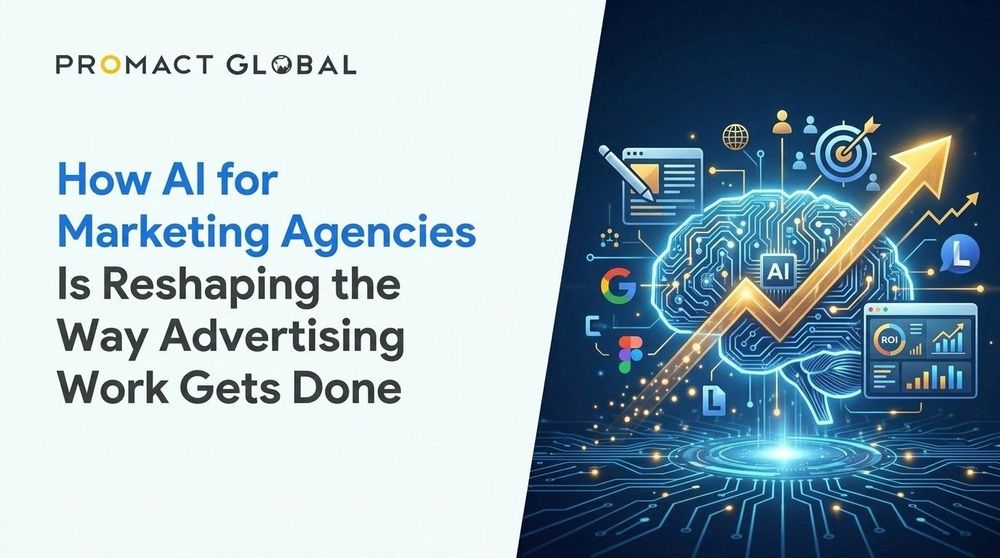
How AI for Marketing Agencies Is Reshaping the Way Advertising Work Gets Done
There is a running joke inside advertising agencies: the brief was due yesterday, the client changed direction this morning, and the deck needs to look like it took three weeks to build, even though you have three days. Sound familiar?
That pressure has not gone away. But the tools available to handle it have changed dramatically. Over the last two years, artificial intelligence has moved from being a curiosity people experimented with after hours into something agencies are weaving directly into how they plan campaigns, build content, run audits, and pitch clients.
This is not about replacing account managers or creative directors. It is about giving talented teams a serious upgrade in how fast and how well they can work. If you run a marketing or advertising agency, or if you are on the client side trying to understand what your agency partner means when they say they are “using AI,” this article is your practical guide.
What Has Actually Changed for Advertising Agencies
For a long time, AI in marketing meant recommendation engines, programmatic ad buying, or basic chatbots. These were real tools, but they sat in the background. Most agency teams never touched them directly.
What has shifted now is that AI has become conversational and accessible. Tools built on large language models can read a 40-page brand document and summarize the three things that matter most for a campaign brief. They can run a technical SEO audit and produce a clear, prioritized list of fixes. They can draft multiple creative directions from a single prompt, letting the creative team react and refine rather than start from zero.
The result is that the time between receiving a brief and producing something genuinely useful has gotten dramatically shorter. For an industry where time is money and client patience has a short shelf life, that is significant.
How AI for Marketing Agencies Is Changing Day-to-Day Work
The most useful way to understand what AI is actually doing inside agencies right now is to look at specific tasks rather than broad categories.
SEO Audits and Content Research
SEO work has always been time-intensive. Crawling a site, pulling data, identifying gaps, comparing against competitors, and writing up recommendations used to take a strategist several days of focused work. AI tools can now assist with a large portion of that process. Feed an AI the right inputs and it can identify patterns across thousands of pages of content, flag technical issues, and surface keyword opportunities in a fraction of the time.
The strategist still needs to interpret the output, apply judgment, and understand the client’s business context. But the grunt work shrinks considerably. What took three days can, in the right setup, be delivered in one.
Writing Creative Briefs
Creative briefs are one of those documents that everyone agrees are important and almost no one agrees on how to write well. They need to capture the brand’s voice, the audience insight, the campaign objective, and the creative territory, all without being so long that the creative team ignores them.
AI is proving particularly useful here because this kind of structured writing task responds well to well-designed prompts. Enterprise AI tools like Claude, developed by Anthropic, are being used by agencies to generate first-draft briefs that account teams then refine. The AI handles the structure and the synthesis of information. The human brings the relationship knowledge and the instinct for what will land creatively.
This is a good example of where the combination of AI and human judgment produces something better than either would alone.
Campaign Research and Audience Analysis
Understanding an audience used to involve commissioning research, waiting for results, and then interpreting findings. AI does not replace real consumer research, but it significantly accelerates the desk research phase. Analysts can process large volumes of publicly available information, study competitor campaigns, and generate audience hypotheses faster than before.
Some agencies are also using AI advertising automation tools to help test and optimize ad copy at scale, running variations across platforms and learning what works faster than a human team could manage manually.
What Enterprise AI Tools Actually Offer Agencies
There is a difference between using a free AI tool for a quick task and deploying enterprise AI thoughtfully across an agency’s workflow. Enterprise platforms built for professional use offer a few things that matter a great deal in an agency context.
The first is structured analysis. Tasks that require pulling apart a complex document, finding patterns, or synthesizing information from multiple sources are where enterprise AI tools genuinely shine. Claude’s enterprise features, for instance, have been recognized as particularly effective for structured tasks requiring analysis. For an agency, this shows up in everything from media planning to campaign post-mortems to competitive intelligence.
The second is consistency. When an agency is producing work across multiple clients and multiple teams, having AI tools that can be configured with specific guidelines and brand voices helps maintain quality standards without requiring every junior team member to reinvent the wheel.
The third is speed without sacrificing depth. One of the consistent findings from agencies that have adopted AI seriously is that the quality of thinking in their deliverables has not dropped. In many cases, it has improved, because teams have more time to focus on the judgment-heavy parts of the work rather than the mechanical parts.
A Practical Playbook for Agencies Getting Started
If your agency has not yet developed a real approach to AI, you are not alone. A lot of teams have experimented informally but have not built systematic workflows. Here is a starting point based on what is working for agencies that have done this thoughtfully.
Start with one workflow, not the whole agency. Pick a specific, repeatable task. SEO reporting, brief writing, or competitive research are good starting points because they have clear inputs and outputs. Run the AI-assisted version alongside your existing process for a month. Compare quality, time, and cost. Then decide whether to expand.
Build prompts deliberately. The quality of what you get from AI for marketing agencies depends heavily on the quality of what you put in. A vague prompt produces vague output. Invest time in building a library of prompts for your most common tasks. Treat these like templates: well-designed once, used repeatedly.
Keep humans in every loop that matters. AI output should always be reviewed before it goes to a client. This is not just about catching errors, though that matters too. It is about ensuring the work reflects your agency’s judgment and your understanding of the client relationship. AI can produce a brief that is structurally sound but misses something important about the client’s culture or their audience’s current mood. A human catches that.
Document what you learn. As teams start using AI tools regularly, they will discover what works and what does not. Capture those learnings. Which prompts produce the most useful first drafts? Which tasks still require so much human editing that the AI step is not saving time? Building this institutional knowledge is what separates agencies that use AI well from those that are just experimenting.
Be transparent with clients. There is a growing expectation from sophisticated clients that their agencies will be thoughtful about AI use. That does not mean disclosing every tool in your stack, but it does mean being honest about your approach if asked, and being confident that the work reflects your agency’s thinking and expertise.
The Concerns Worth Taking Seriously
No technology transforms an industry without some legitimate complications, and AI for marketing agencies is no exception.
The risk of generic output is real. If every agency in your competitive set is using the same AI tools with similar prompts, there is a risk that campaigns start to feel interchangeable. The answer is not to avoid AI but to use it in ways that amplify what is genuinely distinctive about your agency’s thinking rather than replacing that thinking.
Accuracy requires vigilance. AI tools can produce confident-sounding content that contains factual errors or outdated information. For agencies producing client-facing work, a fact-checking habit is non-negotiable.
There are also questions around intellectual property and data privacy that agencies need to think through carefully, especially when working with sensitive client information. Enterprise tools typically offer stronger data protection commitments than consumer products, which is one reason many agencies that have deployed AI seriously have moved toward enterprise-grade platforms.
Where This Is All Heading
It is worth being honest about the fact that AI capabilities are still developing quickly. What agencies can do with AI today is genuinely impressive. What they will be able to do in two years is likely to be more impressive still.
The agencies that will be best positioned are not necessarily those that adopt the most tools the fastest. They are the ones building the muscle now: developing real workflows, building genuine prompting expertise, and thinking carefully about where human judgment is irreplaceable versus where AI can carry more of the load.
AI advertising automation will continue to improve the speed and efficiency of campaign production. But the insight that makes a campaign resonate, the understanding of what a brand means to the people who love it, and the courage to take a creative risk that might not have been done before: those remain human contributions.
Final Thoughts
The advertising business has always been about doing more with less, faster than seems reasonable, at a standard that holds up to scrutiny. AI for marketing agencies does not change that fundamental challenge. It just gives you better tools to meet it.
The agencies making the most of this moment are not the ones replacing their people with AI. They are the ones figuring out how to give their people the leverage they need to do the best work of their careers. That is a goal worth working toward, and the tools to pursue it are more accessible now than they have ever been.
Have a project like this in mind?
Tell us what you're building — we'll help you scope it and ship it.
Talk to usKeep reading
September 20, 2026
The Control Plane Era: What WSO2's Open-Source Agent Governance Bet Means for Enterprise AI Buyers
September 19, 2026
The Six-Week Silence: What OpenAI's DSEwiki Agent Swarm Means for Enterprise AI Oversight
September 17, 2026