May 28, 2026
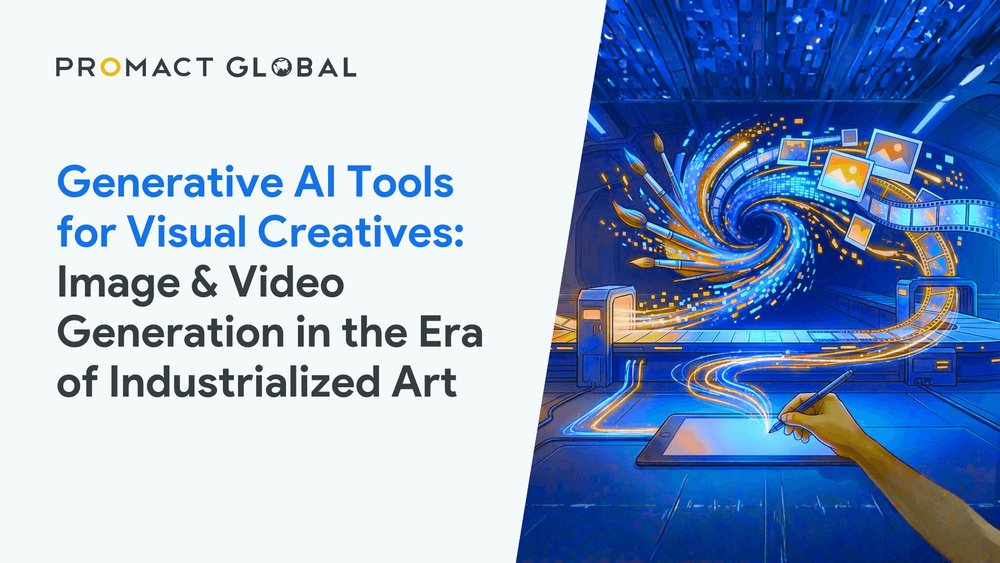
Generative AI Tools for Visual Creatives: Image & Video Generation in the Era of Industrialized Art
Introduction: The Future Arrived Yesterday
Remember when we all thought 2023 was the peak of AI? We looked at those slightly warped hands in Midjourney v5 and thought Wow, this is it. Fast-forward to late 2025, and the landscape seems almost unrecognisable. It feels a bit like that scene in Ferris Bueller’s Day Off life moves pretty fast. If you don't stop and look around once in a while, you could miss the shift from "cool toy" to "industry standard."
Our team was sitting the other day, looking at a receipt, one of the teammates had just expensed. It looked crinkled, faded, and had that specific coffee stain we all know. We asked him where he went for lunch. He laughed and told us he didn't go anywhere. He had generated the receipt image in ten seconds using Google’s latest model. That was our Black Mirror moment.
We are no longer just playing around. According to data from the Federal Reserve Bank, over 54% of adults are now using these tools. Productivity is up, workflows are changing and the "magic" of AI has become the mechanics of our daily jobs.
In this article, we are going to break down the massive ecosystem of generative AI tools image video creators need to know about right now. We will look at the new tech that powers them, the specific AI image generation tools dominating the market, the explosion of AI video generation tools, and the real-world constraints you need to watch out for.
The Engine Under the Hood: Goodbye GANs, Hello Diffusion
Before we dive into the specific tools, we need to understand the engine running them. For a long time, the industry relied on something called GANs (Generative Adversarial Networks). Think of a GAN as a forger and a detective working in the same room. The forger tries to make a fake painting and the detective screams "FAKE!" until the forger gets it right.
It worked okay for faces but it was brittle. It struggled to understand complex instructions.
By 2025, we have moved firmly into the era of Diffusion Models and Transformers. Diffusion is less like a forger and more like a sculptor. It starts with a block of static (noise) and slowly carves away the chaos until a clear image emerges. This is why modern generative AI tools image video platforms can handle such complex prompts.
The newest breakthrough is something called "Mixture-of-Experts" (MoE). Instead of one giant brain trying to do everything, MoE is like having a team of specialists. One part of the AI handles lighting while another handles motion. This makes the new AI video generation tools incredibly fast and efficient.
The Static Canvas: Top AI Image Generation Tools of 2025
When we look at the current market for generative AI tools image video production, static images are still the bread and butter of the creative workflow. The market has split into two camps: the "safe" corporate tools and the "wild west" open-source tools.
1. Google Gemini 3 (The "Nano Banana" Phenomenon)
If you have been on social media lately, you have seen the "Nano Banana" trend. This is the community nickname for Google’s Gemini 3 Pro image model.
It is currently the king of text rendering. Remember when AI used to write gibberish? Those days are gone. This tool can create perfect infographics, store signage and UI mockups directly from a prompt. It is so good that it caused a bit of a panic with people generating fake evidence photos, which is why Google had to implement SynthID watermarking to help us spot the fakes.
2. Adobe Firefly
For enterprise usage, Adobe Firefly remains the safest bet among AI image generation tools. It isn't always the most "artistic" compared to others but it is legally safe. It is trained on Adobe Stock, so you don't have to worry about a lawsuit from a random artist.
The killer feature here is integration. You don't have to leave Photoshop. You just use "Generative Fill" to expand an image or add an object. It is boring in the best possible way because it just works.
3. Flux and the Open Source Vanguard
For the power users who want total control, Flux has taken over the mantle from Stable Diffusion. This is for the tech-savvy designers.
The image fidelity is insane, especially for skin textures and lighting. But there is a catch. To run these generative AI tools image video models locally, you need a beast of a computer. We are talking about graphics cards with 24GB of VRAM, like the RTX 4090.
Why go through the trouble? One word: ControlNet. This allows you to upload a sketch or a stick figure and tell the AI "Use this exact pose." It turns the AI from a slot machine into a precision instrument.
The Motion Revolution: Leading AI Video Generation Tools
If 2023 was the year of images, 2025 is the year of video. The shift in generative AI tools image video capabilities has been nothing short of cinematic. We aren't just making 2-second GIFs anymore. We are making movies.
1. Google Veo 3
Google Veo 3 is currently a powerhouse in the commercial space. The biggest upgrade? Sound. Previous AI video generation tools were silent. You had to go find sound effects later. Veo 3 generates the video and the synchronized audio at the same time. It also understands physics much better than older models, so you get fewer of those weird "dream-like" morphing effects where a coffee cup turns into a cat.
2. Runway Gen-3 Alpha
Runway has always been the tool for the "cool kids" and filmmakers. Their new feature "Act-One" is a game changer. You can record a video of yourself acting out a scene in your webcam and the AI will map your performance onto a generated character. It is basically poor-man’s motion capture. You can be an alien or a goblin but the facial expressions are 100% yours.
3. Wan-AI (The Open Source Disruptor)
Just like Flux did for images, Wan-AI is disrupting AI video generation tools by being open-source. It uses that "Mixture-of-Experts" tech we mentioned earlier to run efficiently on local hardware. For studios that are paranoid about uploading their data to the cloud, this is the solution.
How Marketers and Designers Can Leverage These Tools
Okay, so we have these amazing generative AI tools image video platforms. How do we actually use them without getting into legal trouble or making garbage content?
The answer is the "Sandwich Workflow."
In the past, we tried to just prompt and pray. That doesn't work for professional output. Today, the industry standard for using generative AI tools image video effectively involves three steps:
- The Bread (Human Concept): You start with a human idea. A sketch, a script, a storyboard. This is your "source of truth".
- The Meat (AI Generation): You use the AI to flesh out that idea. You use AI image generation tools with ControlNet to adhere to your sketch. You use AI video generation tools to animate those images.
- The Bread (Human Refinement): You bring it back into Premiere Pro or After Effects. You color grade, you fix the glitches, you add the final polish.
Why do we do this? It is not just for quality. It is for copyright. The US Copyright Office has made it clear: you cannot copyright raw AI output. But if there is enough "human authorship" in the arrangement and editing, you can protect the final work. So, the Sandwich Workflow isn't just a creative choice; it is a business necessity when working with generative AI tools image video products.
Marketing Automation: The "Digital Twin"
Another massive area for generative AI tools image video adoption is hyper-personalization. Imagine receiving a video from the CEO of a company addressing you by name and speaking your local language. They didn't record that a thousand times. They recorded it once. Tools like Tavus and HeyGen create "digital twins" that can send thousands of unique videos. Virgin Voyages used this with Jennifer Lopez (calling her "Jen AI") to send personalized cruise invites. It worked because it feels personal even though it is automated.
The Constraints: It’s Not All Sunshine and Rainbows
We need to be real. Using generative AI tools image video software isn't magic. There are serious constraints you need to be aware of.
1. The Hardware Wall
There is a digital divide forming. The best open-source AI image generation tools and AI video generation tools require heavy hardware. VRAM (Video RAM) is the new gold. If you don't have at least 24GB of VRAM, you are stuck using the cloud or lower-quality "quantized" models.
2. The Physics Problem
Even with Veo 3, the physics can still get wonky. We call these "hallucinations." Sometimes a hand will pass through a table. Sometimes water will flow upwards. Because the output is "stochastic" (a fancy word for random), you might have to generate a clip 20 times to get one that follows the laws of physics. This impacts your budget.
3. The Legal Moat
This is the big one. While Adobe Firefly indemnifies you, other models are currently being sued by everyone from Disney to Getty Images. If you are a big brand, you have to be very careful about which generative AI tools image video platforms you let your team use. You don't want to accidentally generate Mickey Mouse in your ad campaign.
Conclusion
As we close out 2025, the role of the creative has fundamentally changed. We aren't just pixel pushers anymore. The "productivity paradox" is broken. We are seeing real gains.
But the challenge for 2026 isn't learning how to prompt. It is learning how to direct. The successful creative uses generative AI tools image video suites like a film director uses a crew. You have a lighting expert (Flux), a camera operator (Runway), and a set designer (Gemini). Your job is to make them work together to produce something human.
So, don't be afraid of the AI image generation tools or the AI video generation tools flooding the market. Pick up the director's megaphone. The studio is open and the equipment has never been better.