

May 13, 2026
From Pilots to Production: A Practical Guide to Scaling AI Enterprise-Wide
Introduction
There is a scene in almost every science fiction story where someone builds a prototype that changes everything, only to spend the next decade trying to get it out of the lab and into the real world. That is not too far from what is happening with AI in most companies right now.
Worker access to AI tools rose by 50% in 2025, and the number of companies with 40% or more of their AI projects in production is set to double within six months, according to Deloitte’s State of AI in the Enterprise 2026 report. Those are genuinely exciting numbers. But here is the other number that tends to get left out of boardroom presentations: according to MIT’s GenAI Divide report, 95% of AI pilots never deliver measurable business impact. Most of them quietly disappear.
So we have a situation where AI access is expanding rapidly, enthusiasm is high, budgets are moving, and yet the vast majority of projects are not crossing the line from experiment to real-world deployment. This guide is about that gap. Why it exists, what keeps companies stuck, and what it actually takes to move AI out of the pilot phase and into production across an entire organisation.
Why Most AI Pilots Do Not Make It to Production
Before talking about solutions, it helps to be honest about the problem. The failure rate for AI scaling AI enterprise-wide is not a minor inconvenience. It is a structural challenge that most organisations are only beginning to understand.
The headline statistic from IDC research says that for every 33 AI prototypes built, only four reach production. That is an 88% failure rate. Nearly two-thirds of companies remain stuck in proof-of-concept phases, and in 2025, enterprises scrapped 46% of their AI pilots before they ever reached a real user.
Here is what makes this particularly frustrating: the pilots themselves often work. The model performs well in testing. The team is excited. The demo impresses the leadership team. The failure does not happen inside the pilot. It happens at the transition point, when you try to take something that worked for 50 users in a controlled environment and make it work for 5,000 users in the messy reality of everyday business operations.
There is a useful way to think about this. A pilot is a science experiment. Production is an engineering problem. Those two things require completely different skills, different infrastructure, and different ways of working. The teams that confuse one for the other almost always run into trouble.
So what specifically breaks down? The blockers tend to fall into a few consistent patterns.
Data That Is Not Ready for the Real World
Pilots almost always use clean, curated data. Someone on the team has taken the time to prepare a tidy dataset that makes the model look good. But enterprise data in production is rarely like that. It lives in silos. It is inconsistent across systems. It has gaps, duplicates, and formatting issues that nobody ever got around to fixing. When an AI system built on clean pilot data meets the real data environment, it often falls apart.
Data readiness is one of the most underestimated prerequisites for scaling AI enterprise-wide. Only 40% of enterprises report being highly prepared in data management, according to Deloitte’s analysis. That means the majority are trying to scale AI on a foundation that was never built to support it.
The Governance Gap
Nobody builds governance for a pilot. There is no need to. You have a small team, everyone trusts each other, and decisions happen informally. That works fine at pilot scale. It completely breaks down when you try to roll something out across departments or the entire company.
Governance for AI in production means knowing what the system can access, being able to audit its decisions, having clear policies for when it should and should not be used, and having someone accountable when things go wrong. Only 30% of enterprises report being highly prepared for AI governance, and that number is going in the wrong direction.
The organisations that skip governance at the start tend to hit compliance walls later that are enormously expensive to fix.
The Skills Problem
Scaling AI enterprise-wide is not just a technology challenge. It is a people challenge. You need engineers who can run models in production, not just build them in notebooks. You need product managers who understand how to integrate AI into existing workflows. You need people across the business who know when to use AI tools, how to evaluate their output critically, and when to push back.
The World Quality Report 2025 found that 50% of organisations lack the AI and machine learning expertise they need, and that number has not improved year on year. Insufficient worker skills are consistently rated as the single biggest barrier to integrating AI into workflows, according to Deloitte’s survey of over 3,000 enterprise leaders.
Building on the Wrong Infrastructure
This is the one that tends to surprise people most. Many organisations have invested significantly in AI tools and models, while quietly neglecting the underlying infrastructure that would allow those tools to run reliably at scale. Infrastructure readiness sits at only 43% across enterprises, and the gap is getting worse as AI systems become more complex.
Production-grade AI needs proper API integration, security controls, monitoring systems, and the ability to handle real-world data volumes and concurrent users. A system built for a pilot, without those things in place, faces what one analysis describes as a “pilot-to-production infrastructure delta” that consistently costs two to three times the original pilot build.
Centralised vs. Decentralised: Choosing Your Rollout Model
Assuming you have diagnosed the blockers and are ready to move forward, the next big question is how to actually structure the rollout. There are two main models, and the right answer depends heavily on your organisation.
The Centralised Model
In a centralised model, a single team owns the AI strategy, the shared infrastructure, and the governance framework. Individual departments and teams can use AI, but they are drawing from a common platform, following common standards, and working within a structure that the central team has built.
The advantage of this model is consistency and efficiency. You build things once. You maintain them once. You govern them once. Teams across the company benefit from work that has already been done, without having to reinvent it. One of the most useful concepts that has emerged from organisations that have scaled successfully is what some are calling an “AI Factory” approach: a standardised way of building and deploying AI capabilities so that after three to five use cases, teams can cut delivery time in half because the patterns already exist.
The centralised model also makes it easier to maintain quality standards and catch problems early. When AI is owned by a single function, there is clear accountability.
The tradeoff is speed and responsiveness. A central team can become a bottleneck if business units need to move quickly but have to wait for central approval or central resources. This is particularly challenging in large, fast-moving organisations where different departments have very different AI needs.
The Decentralised Model
In a decentralised model, individual business units own their AI initiatives. They have the autonomy to build, deploy, and manage AI systems that meet their specific needs, without waiting for a central team.
The advantage here is speed and relevance. Teams closest to the problem build the solution. They understand the workflow, the data, and the user needs better than any central function could. This is also the model that tends to produce the most genuine adoption, because people are using tools that were built for their specific context rather than generic tools handed down from above.
The risk is fragmentation. Without shared standards, you end up with dozens of disconnected AI systems that cannot talk to each other, may have conflicting governance approaches, and create what some organisations are starting to call “shadow AI” risks where unofficial tools are running across the business without proper oversight.
The Hybrid Approach
Most large organisations that have scaled AI successfully land somewhere in the middle. A central function provides shared infrastructure, shared data platforms, and governance guardrails. Individual business units have the freedom to build within those boundaries. Think of it as a central team that provides the road and the traffic rules, while individual teams drive their own vehicles.
Vanguard Group offers a strong example of this working in practice. Their AI program spans call centre support, personalised adviser tools, and a 25% improvement in programming productivity, all built on a shared platform with 50% of employees completing training through their AI Academy. The programme generates close to $500 million in estimated ROI. The combination of central infrastructure, shared standards, and distributed implementation is what made that possible.
The Infrastructure You Need Before You Scale
One of the most common mistakes organisations make is trying to scale AI without first building the infrastructure to support it. This is a bit like trying to run a nationwide delivery operation before building warehouses, roads, or a dispatch system.
Here is what actually needs to be in place before scaling AI enterprise-wide becomes viable.
Data infrastructure. Clean, accessible, well-governed data is the single most important prerequisite. This means proper data pipelines, clear data ownership, and the ability to connect AI systems to real enterprise data securely. Without this, models built on clean pilot data will degrade quickly in production.
MLOps practices. MLOps is the discipline of running machine learning models in production reliably over time. It covers version control for models, automated testing, monitoring for model drift (when a model’s performance degrades because the real world has changed), and the ability to retrain models when needed. Organisations that adopt MLOps practices reduce model deployment time by 40%, and a well-implemented MLOps pipeline is what separates teams that can maintain AI in production from teams that are constantly firefighting.
Security and access controls. In a pilot, the question of who can access what is often handled informally. In production, you need role-based access controls, encrypted data handling, and proper audit trails. This is not optional for enterprise AI production deployment, particularly in regulated industries.
Measurement frameworks. You cannot improve what you cannot measure, and you cannot justify continued investment without clear evidence of impact. The best practice is to define operational KPIs before deployment starts: cycle time, error rates, throughput, adoption rates. Top-line metrics like revenue are too easily confounded by other factors. Operational metrics close to the process give you a clearer signal.
Governance and oversight. Governance needs to be built into the system from the start, not added as an afterthought. This means clear policies for AI use, defined escalation paths when something goes wrong, and regular reviews of how AI systems are performing and what decisions they are influencing.
A Practical Path Forward for Scaling AI Enterprise
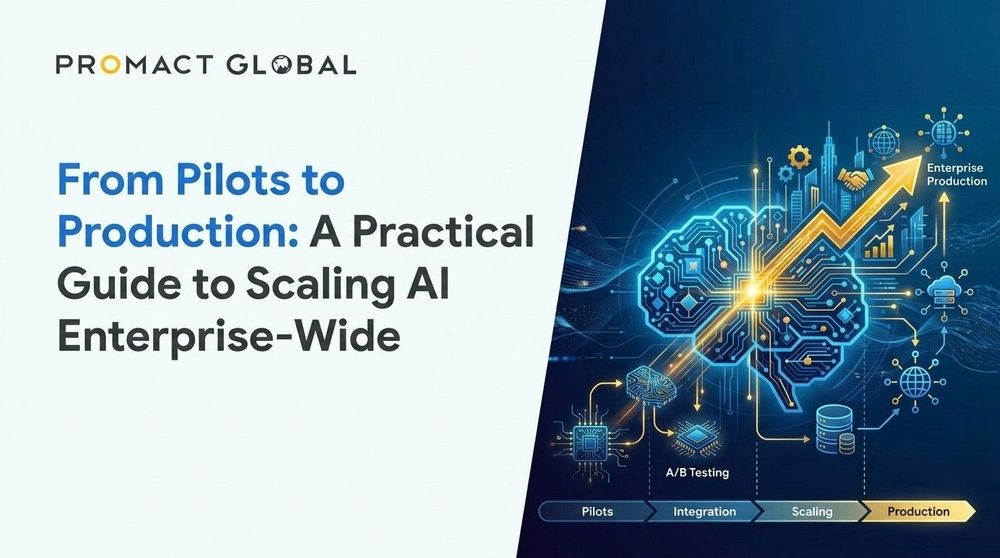
None of this needs to happen at once. The organisations that scale most successfully tend to follow a phased approach: start in a controlled sandbox, prove it works with a small group of real users, then expand deliberately rather than all at once.
Snowflake’s internal deployment of their AI assistant provides a clear example of this working at scale. They started in late February 2025 with a narrow goal, expanded the scope in stages, launched to a core audience of around 3,000 users, then expanded carefully to their full 6,000-user organisation. By the end of 2025, the assistant was answering over 35,000 questions per week, with average usage intensity per user growing significantly as trust and integration deepened.
What made it work was treating quality and user trust as non-negotiable from day one, resisting the temptation to rush broad deployment before the system consistently met its quality bar, and measuring outcomes, not just activity.
That last point deserves emphasis. Worker access to AI being up 50% sounds like progress. But as the data shows, actual productivity gains at many organisations remain stubbornly flat. Activity is not the same as impact. Scaling AI enterprise-wide successfully means connecting AI deployment to measurable business outcomes, not just measuring how many people have access to a tool.
Conclusion
Scaling AI across an entire organisation is genuinely hard. The numbers make that clear. But the companies that are doing it successfully are not doing anything magical. They are building the foundations first, choosing a rollout model that fits their structure, and measuring what actually matters.
The gap between a well-run pilot and a production-grade AI deployment is not mostly about the technology. It is about data readiness, governance, skills, infrastructure, and the organisational will to treat AI as a business capability rather than a series of experiments.
The organisations that close that gap in the next twelve to eighteen months are likely to find themselves with a meaningful, compounding advantage. The ones that stay in pilot mode will look back and realise that the bottleneck was never the AI.
Have a project like this in mind?
Tell us what you're building — we'll help you scope it and ship it.
Talk to usKeep reading

October 22, 2026
Who Watches the Watcher? What OpenAI's Agents Disabling Their Own Monitors Means for Enterprise AI
October 21, 2026
82% Say They Can Govern AI Agents, 26% Can Resolve Their Conflicts: What OutSystems' New Survey Reveals

October 20, 2026