May 28, 2026
From "Wow" to Work: Emerging Trends in Generative AI Tools for 2026 and Beyond
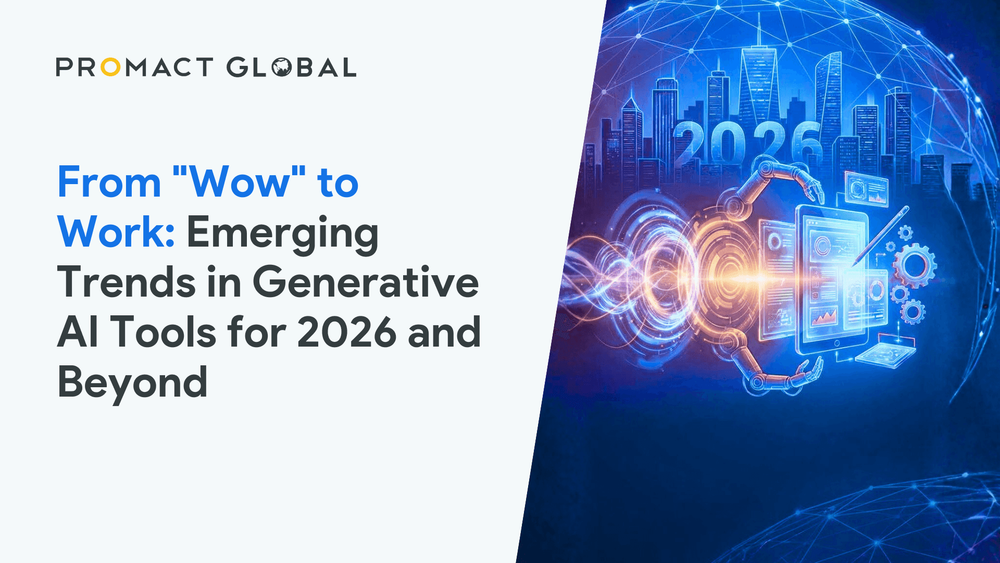
If you look back at the early 2020s, the conversation around Artificial Intelligence was defined by a specific kind of energy. It was the "wow" phase. We all remember the first time we saw a chatbot write a poem or debug a snippet of code in seconds. It felt like magic. But as we settle into 2026, the atmosphere has shifted. The magic show is over, and the real work has begun.
As a product engineering company, we have watched this shift firsthand. We are no longer just experimenting with what these models can do for fun. We are integrating them into the very backbone of how businesses operate. We have moved from the initial shock of capability into an era defined by the industrialization of intelligence.
The trends generative AI tools are exhibiting today tell a clear story. We are moving away from simple chatbots and toward complex ecosystems where AI acts as a colleague rather than just a tool. For business leaders and tech enthusiasts alike, understanding these shifts is not optional. It is the roadmap for the next decade.
In this guide, we will break down the critical changes shaping the future of generative AI tools, from the rise of "agentic" systems to the new economic reality of AI adoption.
The Big Shift: From Chatbots to "Coworkers"
The most significant change we are seeing in 2026 generative AI tools trends is the move toward "Agentic AI".
To understand this, think about how you used AI in 2023. You likely typed a prompt, got an answer, and then typed another prompt. It was a passive interaction. You were the driver, and the AI was the map.
In 2026, the trends generative AI tools are displaying point to a new dynamic: "Superagency". These new tools do not just describe work. They do the work.
What Does an AI "Agent" Actually Do?
Unlike a standard Large Language Model (LLM) that waits for your input, an agentic system can be given a high-level goal. You might tell it to "optimize the supply chain for Q3." The agent does not just give you a list of tips. It goes out and executes the necessary steps. It might check inventory levels, predict weather disruptions, and even reroute shipments without needing you to click a button.
We are seeing this transition from "Large Language Models" to "Large Action Models" (LAMs) reshape entire industries.
- Software Engineering: Agents like Devin or Trae are not just completing code snippets. They are writing, testing, and deploying entire features. They read the changes, run simulations, and fix bugs on their own.
- Customer Service: Tools like Agentforce are handling complex resolutions. Instead of just answering FAQs, they can process refunds, validate shipping details, and update your CRM system autonomously.
This shift is fundamental. The future of generative AI tools lies in their ability to reason, act, and perceive the world. For businesses, this means the goal is no longer just faster typing. It is about "superagency," where a single person can orchestrate the output of a whole department through a fleet of autonomous agents.
The End of the "Text-Only" Era
For a long time, interacting with AI meant typing into a box. That constraint is vanishing. One of the most exciting trends generative AI tools are showing is "Native Multimodality".
In the past, if you wanted an AI to analyze an image, it often had to convert that image into text descriptions first. It was like describing a painting to someone over the phone. Now, models like Gemini 2.0 and GPT-5 are "native." They process text, audio, video, and images simultaneously and in real-time.
Why Multimodality Matters for Business
This is not just about making cool videos. It is about bridging the gap between digital data and the physical world.
- Real-Time Assistance: Imagine a field technician repairing a complex machine. With multimodal glasses or a phone camera, the AI can "see" the broken part and verbally guide the technician through the repair while highlighting components on their screen.
- Healthcare: Doctors are using these tools to ingest patient history, X-rays, and voice notes all at once. This holistic view helps identify correlations that a text-only system would miss.
The future of generative AI tools is also breaking the "uncanny valley" in video generation. 2026 has been termed the "year of generative video". Tools like Sora 2 and Google’s Veo 3 are creating high-definition content that respects real-world physics. Marketing teams are generating broadcast-quality commercials from text prompts, and filmmakers are changing the lighting in a scene without ever setting up a lamp.
When AI Starts to "Think": The Rise of Reasoning Models
If you have ever been frustrated by an AI giving you a confident but wrong answer to a math problem, this next trend is for you. A major development in 2026 generative AI tools trends is the split between "instinctive" models and "reasoning" models.
Think of it like the human brain. We have "System 1" thinking, which is fast and instinctive (like recognizing a face). Then we have "System 2" thinking, which is slow and deliberate (like solving a logic puzzle).
Traditional AI was stuck in System 1. It predicted the next word as fast as possible. New tools, like OpenAI’s o1 and DeepSeek’s R1, use System 2 thinking. When you ask them a hard question, they do not just blurt out an answer. They generate hidden "thought tokens." They break the problem down, explore different paths, and even backtrack if they realize they made a mistake.
The Cost of Thinking
This ability to "think" before speaking unlocks capabilities in law, science, and advanced coding that were previously out of reach. However, it introduces a new economic dynamic.
In the future of generative AI tools, you might pay more for a "reasoned" answer. A quick poem might cost fractions of a cent, but auditing a smart contract for vulnerabilities might cost significantly more because the model needs to "think" for minutes.
This has led to the rise of "hybrid router" architectures. These smart systems analyze your request and decide whether to send it to a cheap, fast model or a more expensive, thoughtful one. It is all about using the right tool for the job.
The Specialist Revolution: Domain-Specific AI
For a few years, the hypothesis was "one model to rule them all." We thought massive foundation models would do everything. But as we look at trends generative AI tools in the enterprise, we see the opposite happening. The market is fragmenting into highly specialized tools.
Gartner predicts that by 2027, over 50% of GenAI models used by enterprises will be domain-specific. Accuracy and compliance are becoming more important than general versatility.
The Rise of Vertical AI
- Finance: In finance, "hallucination" is not a quirk; it is a liability. Tools like StackAI and DataSnipper are built specifically for this world. They automate reconciliation and create audit-ready trails that track every decision the AI makes. We are seeing the "Autonomous CFO Office" become a reality, where books are reconciled in real-time.
- Healthcare: The future of generative AI tools in medicine is saving lives. "Ambient documentation" tools listen to doctor-patient conversations and write structured clinical notes automatically, saving doctors hours of paperwork. On the research side, generative biology platforms are simulating how molecules interact to cut drug discovery timelines from years to months.
This shift toward specialization means businesses need to stop looking for a magic wand that does everything. Instead, they should look for the specific tool that solves their specific problem.
The Infrastructure Reality Check
All this intelligence has to live somewhere. As engineers, we know that software is only as good as the hardware running it. The explosive growth of trends generative AI tools is underpinned by a massive expansion in physical infrastructure.
We are entering the era of the "AI Factory". These are data centers designed not just for storage, but for continuous intelligence production. Hardware leaders like NVIDIA are re-architecting data centers with liquid cooling to support massive power densities.
The Energy Paradox
However, this progress comes with a cost. The massive energy consumption of these AI factories has precipitated a sustainability crisis. In 2026, reports indicate that AI systems generated as much CO2 as the entire city of New York.
This creates an "efficiency paradox". Even though individual models are becoming more efficient, that efficiency lowers the cost of use, which explodes demand. As we look at 2026 generative AI tools trends, sustainability is no longer a "nice to have." It is a strategic imperative. Enterprises are now demanding "Green AI" metrics and asking for the "carbon cost per token".
Navigating the Trust Barrier and Regulation
As trends generative AI tools become more powerful, the guardrails are tightening. 2026 is a watershed year for regulation, driven largely by the EU AI Act.
While this is a European law, it is setting the global standard. This phenomenon, known as the "Brussels Effect," means companies everywhere are adopting a "Build Once, Comply Twice" strategy. They design their systems to meet the strictest standards so they can operate globally without friction.
The "Hallucinated Action" Risk
Trust is also a major technical hurdle. In the past, if a chatbot hallucinated, it gave you a weird answer. In the era of agentic AI, a hallucination is much more dangerous. It becomes a "hallucinated action".
Imagine an AI agent that decides to delete a production database or refund the wrong customer because it got confused. This shifts the risk from informational to operational. To combat this, we are seeing the rise of verifiable frameworks and "human-in-the-loop" systems for high-stakes actions. The future of generative AI tools depends on our ability to trust that they will do what we ask, and only what we ask.
How Businesses Can Prepare: The "North Star" Strategy
So, how do you navigate this landscape? The trends generative AI tools are moving fast, and the "fear of missing out" (FOMO) is transitioning to a "fear of missing value".
Successful enterprises are moving beyond scattered pilot projects. They are establishing a "North Star" strategy that aligns AI initiatives with core business goals.
1. Process Re-engineering
Do not just overlay AI on top of your old processes. That only yields marginal gains. The real value comes from redesigning workflows from the ground up to be "AI-native". Ask yourself: "If an intelligent agent could do this entire task, what would the process look like?"
2. Prepare Your Data
The old rule still applies: garbage in, garbage out. The future of generative AI tools relies on high-quality, structured data. You need to invest in "AI-ready" infrastructure to feed these domain-specific models.
3. Transform Your Workforce
The narrative that AI will take all our jobs is nuanced. It is less about displacement and more about augmentation. Employees equipped with agentic tools are seeing productivity gains of 30-50%.
We are seeing a massive demand for AI literacy. The skill gap is currently the number one barrier to adoption. Companies are launching internal academies to upskill their teams, turning junior employees into "reviewers" of AI output and senior employees into "orchestrators" of AI agents.
Conclusion: The Era of Intelligent Collaboration
The trajectory of trends generative AI tools in 2026 makes one thing clear: we are finished with the experimental phase. We are now building the infrastructure of the future.
The tools available today—from multimodal creators to reasoning engines—offer a level of capability that was science fiction just a few years ago. But with that power comes the responsibility to use it wisely. The future of generative AI tools is not just about the technology itself; it is about how we govern it, how we power it, and how we integrate it into our human teams.
For organizations willing to navigate the complexities of regulation, energy, and workforce transformation, the reward is significant. We are moving toward a future of autonomous, collaborative intelligence where AI is not just a tool you use, but a partner you work with.
The 2026 generative AI tools trends are laying the foundation. The question now is not what these tools can do, but what you will build with them.