

April 16, 2026
Edge AI for Business: Why On-Device AI Processing Is the Next Big Thing
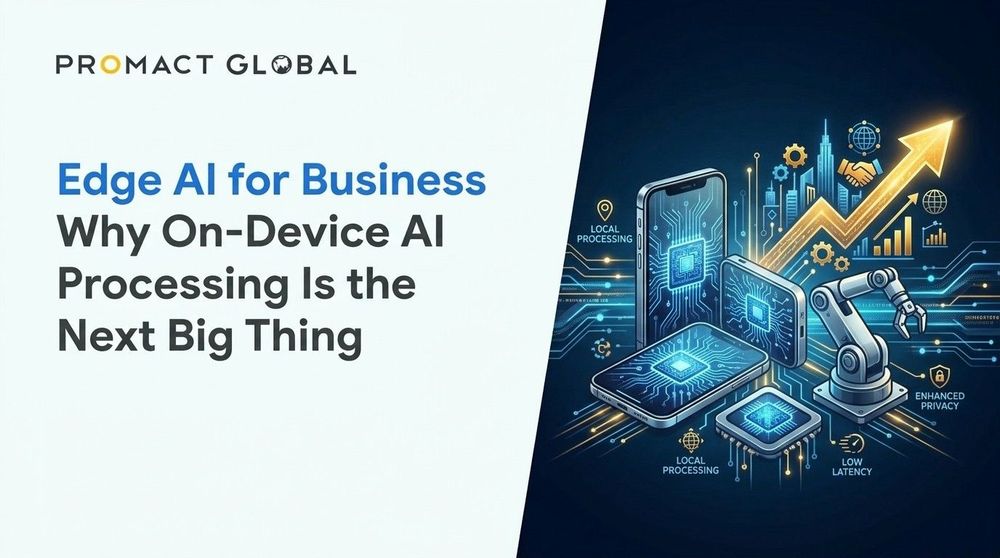
Let’s say a quality control camera on a factory floor that can spot a defective product in milliseconds — without ever sending an image to a server, without waiting for a cloud response, and without needing an internet connection at all. That is edge AI for business in action. And it is happening right now, across industries you might not expect.
For most of the last decade, artificial intelligence lived in the cloud. You sent data up, the cloud thought, and you got an answer back. It worked well enough when speed was not critical and privacy was not a dealbreaker. But as AI moves deeper into the physical world onto factory floors, retail shelves, delivery trucks, and medical devices, the round-trip to the cloud has started to feel like a problem.
Edge AI solves that problem by bringing the intelligence to the device itself. Instead of sending raw data to a remote server for processing, the device handles it locally. The result is faster decisions, less dependence on connectivity, stronger data privacy, and lower bandwidth costs. For businesses operating at scale, these are not minor conveniences. They are competitive advantages.
This article breaks down what edge AI for business actually means, how on-device AI processing works, and why companies in manufacturing, retail, and logistics are already making it a core part of their technology strategy.
What Is Edge AI, Really?
The term can sound abstract, so let us ground it in something familiar. Think of the Face ID feature on an iPhone. When you unlock your phone with your face, that recognition does not happen in Apple’s data centre. It happens on a specialized chip inside your phone itself. That is on-device AI processing in its most consumer-friendly form.
Now scale that idea up to an industrial setting. A conveyor belt fitted with AI-powered vision sensors can inspect thousands of items per minute and flag defects instantly. A smart retail shelf can detect when stock is running low and trigger a restocking alert without human intervention. A GPS-enabled delivery vehicle can reroute itself in real time based on traffic patterns, even if cellular connectivity is spotty.
In each of these cases, the intelligence lives at the “edge” of the network, meaning close to where the data is generated, rather than at a centralized cloud server. That is the essence of edge AI.
It is worth distinguishing edge AI from edge computing more broadly. Edge computing refers to processing data locally rather than in the cloud. Edge AI is a subset of that: it is specifically about running AI models, machine learning, computer vision, and natural language processing at the edge. Not every edge computing setup involves AI, but every edge AI setup involves local, on-device computation.
Why the Cloud Is No Longer Always the Right Answer
Cloud AI is powerful. It gives companies access to massive computing resources without building their own infrastructure. For tasks like training large AI models, analyzing historical data, or generating reports, it is still the right choice.
But cloud AI has a fundamental limitation: latency. Every time a device sends data to the cloud and waits for a response, there is a delay. In most consumer applications, that delay is barely noticeable. In industrial or safety-critical applications, it can be catastrophic.
Consider an autonomous vehicle. If the car’s collision-avoidance system had to send data to a server, wait for a processing response, and then act, it would be far too slow to prevent an accident. The entire decision cycle needs to happen in milliseconds, on the vehicle itself. Cloud AI cannot meet that requirement. On-device AI processing can.
Beyond latency, there are three other major drivers pushing businesses toward edge AI:
Privacy and data sovereignty. Many businesses operate in environments where sending raw data to the cloud creates compliance risks. A hospital using AI to analyze patient vitals cannot always stream that data off-site. A manufacturer working with proprietary designs does not want unencrypted production data travelling over public networks. Edge AI keeps sensitive data local.
Connectivity constraints. Cloud AI assumes reliable internet access. But factories, warehouses, remote agricultural sites, and offshore facilities often have patchy or expensive connectivity. Edge AI allows critical operations to continue even when the network is unavailable.
Bandwidth and cost. Sending continuous video feeds, sensor streams, or high-resolution imagery to the cloud is expensive. Edge AI processes data locally and only sends summaries or alerts, dramatically reducing bandwidth consumption and cloud costs.
Edge AI for Business: Three Industries Leading the Way
Manufacturing: Smarter Factories, Fewer Defects
Manufacturing may be the single most mature use case for edge AI for business. Quality inspection, predictive maintenance, and safety monitoring are all areas where on-device AI processing has delivered measurable results.
Traditional quality control relied on human inspectors or basic machine vision systems that followed rigid rules. Edge AI-powered vision systems can learn what a good product looks like, adapt to new product types, and flag anomalies that a rule-based system would miss. Because the processing happens on the device, inspection can happen at full production speed with zero lag.
Predictive maintenance is another area where the results are striking. Vibration sensors, thermal cameras, and acoustic monitors attached to machinery can detect the early warning signs of equipment failure. An edge AI model running on that sensor can analyze patterns in real time and send a maintenance alert before a breakdown occurs rather than after it has shut down a production line.
According to McKinsey, manufacturers that adopt AI-enabled predictive maintenance can reduce machine downtime by 30 to 50 percent and cut maintenance costs by up to 25 percent. Those numbers become achievable specifically because edge AI allows monitoring to happen continuously and locally, without relying on data centre round-trips.
Retail: Inventory, Checkout, and Customer Experience
In retail, the pressure to reduce shrinkage, optimize inventory, and create frictionless shopping experiences has made edge AI for business a priority at major chains worldwide.
Computer vision running on in-store cameras can track inventory levels on shelves in real time, alerting staff when products need restocking. The same technology can detect when items are misplaced or when pricing labels are missing. Because these cameras process video locally rather than streaming footage to the cloud, retailers avoid both the bandwidth cost and the privacy concerns that would come with cloud-based video analysis.
Self-checkout and cashierless store concepts also depend heavily on on-device AI processing. Amazon’s “Just Walk Out” technology, for instance, uses edge AI to track what customers pick up and charge them automatically when they leave. That level of real-time tracking simply cannot function with cloud latency in the loop.
Loss prevention is another area where edge AI has made inroads. Models trained to recognize suspicious behaviours like someone repeatedly checking for cameras or attempting to conceal merchandise can flag incidents in real time without requiring a human to watch every camera feed.
Logistics: Smarter Routing, Safer Warehouses
Logistics operations involve a constant flow of decisions, routing, sorting, loading, and compliance checks that benefit enormously from AI that can act without waiting for cloud confirmation.
In warehouse automation, autonomous mobile robots equipped with edge AI can navigate complex, changing environments, avoid obstacles, and coordinate with other robots in real time. A robot that has to query a central server before every navigation decision would be far too slow to keep up with the pace of a modern fulfilment centre.
Fleet management is another strong use case. Commercial vehicles equipped with edge AI dashcams can analyse driver behaviour, detect drowsiness or distraction, and issue real-time alerts to the driver, all without streaming video to a central server. This protects driver privacy while still improving safety outcomes.
Customs and compliance checks at ports and border crossings are also moving toward edge AI for business. Document verification, container inspection, and shipment classification can now be processed locally, speeding up clearance times and reducing the risk of human error.
The Hardware Making Edge AI Possible
One reason edge AI has moved from concept to reality so quickly is a wave of purpose-built hardware designed specifically for running AI models efficiently at low power. These are often called AI accelerators or neural processing units (NPUs).
Companies like NVIDIA, Qualcomm, Intel, and Google have all released edge AI chips that can run sophisticated machine learning models on small, power-efficient devices. NVIDIA’s Jetson platform, for example, is widely used in industrial robotics and smart cameras. Qualcomm’s AI chips power everything from smartphones to drones. Google’s Edge TPU is designed for inference tasks on low-power IoT devices.
What this means practically is that the hardware barrier to edge AI has dropped significantly. A company no longer needs to build custom silicon to run a computer vision model at the edge. They can deploy a commercial AI module, load a pre-trained model, and be running within hours.
Challenges Worth Acknowledging
Edge AI for business is genuinely promising, but it is not without its challenges. Being honest about these makes it easier for businesses to plan realistically.
Model management at scale is harder than it sounds. When you have thousands of edge devices each running their own AI model, updating those models to improve accuracy, fix bugs, or adapt to changing conditions requires a robust over-the-air update pipeline. Without that, you can quickly end up with a fragmented fleet of devices running different model versions.
On-device resources are limited. Edge devices do not have the same computing power as a cloud server. AI models need to be optimized and compressed often using techniques like quantization or knowledge distillation, to run efficiently on constrained hardware. This requires skilled engineering work.
Security at the edge is a genuine concern. Each edge device is a potential attack surface. If an adversary can compromise the AI model or the hardware it runs on, the consequences can range from data theft to physical safety incidents. Edge AI deployments need to include hardware security modules, encrypted storage, and secure boot processes.
Finally, building and deploying edge AI systems requires cross-functional expertise that many internal teams do not yet have: embedded systems knowledge, machine learning engineering, hardware integration, and cloud-to-edge orchestration. This is one of the main reasons companies partner with specialist software and product engineering firms rather than trying to build everything in-house.
What This Means for Businesses Evaluating Edge AI
If your business operates in manufacturing, retail, logistics, healthcare, or any other field where physical processes generate real-time data, edge AI deserves serious evaluation. The technology has matured enough that the question is no longer “is this possible?” but “where does this deliver the most value for us?”
A few practical starting points: identify the decisions in your operations that are currently limited by latency or connectivity. Look at where privacy regulations constrain your ability to send data to the cloud. Audit your current bandwidth and cloud costs. These are often the clearest early indicators of where edge AI for business can deliver a return.
Pilot programs tend to work better than broad rollouts for early-stage edge AI adoption. Deploying on-device AI processing in a single facility, a specific product line, or a defined fleet segment lets you prove value, understand the operational requirements, and build internal expertise before committing to a larger investment.
It is also worth thinking carefully about the software and model lifecycle, not just the initial deployment. Edge AI systems require ongoing model monitoring, retraining, and updates. Building that capability into your architecture from day one is much easier than retrofitting it later.
A Final Thought on Where This Is All Heading
There is a broader shift happening in AI right now, and edge AI for business is part of it. AI is moving out of the data centre and into the physical world, into the tools, machines, vehicles, and spaces where work actually happens. Some in the industry are calling this “physical AI.”
The organizations that understand this shift early and build the operational and technical capabilities to work with edge AI systems are likely to find themselves with advantages that compound over time. Faster responses, lower costs, stronger privacy protections, and more resilient operations are not small gains. They are the kind of structural improvements that are very hard for competitors to replicate quickly.
Edge AI is not a replacement for cloud AI. It is a complement to it, a way of making AI more useful in more contexts, including the ones where milliseconds matter and connectivity cannot be guaranteed. For businesses willing to invest in understanding it, the opportunities are substantial.
Have a project like this in mind?
Tell us what you're building — we'll help you scope it and ship it.
Talk to usKeep reading
October 23, 2026
Meet Harvey: The Open-Source AI Sales Agent That Runs on Your Own Subscription
October 23, 2026
The Agentic Cloud: What Daytona's $1 Billion Valuation Says About Where AI Agents Actually Work
October 22, 2026