
August 26, 2026
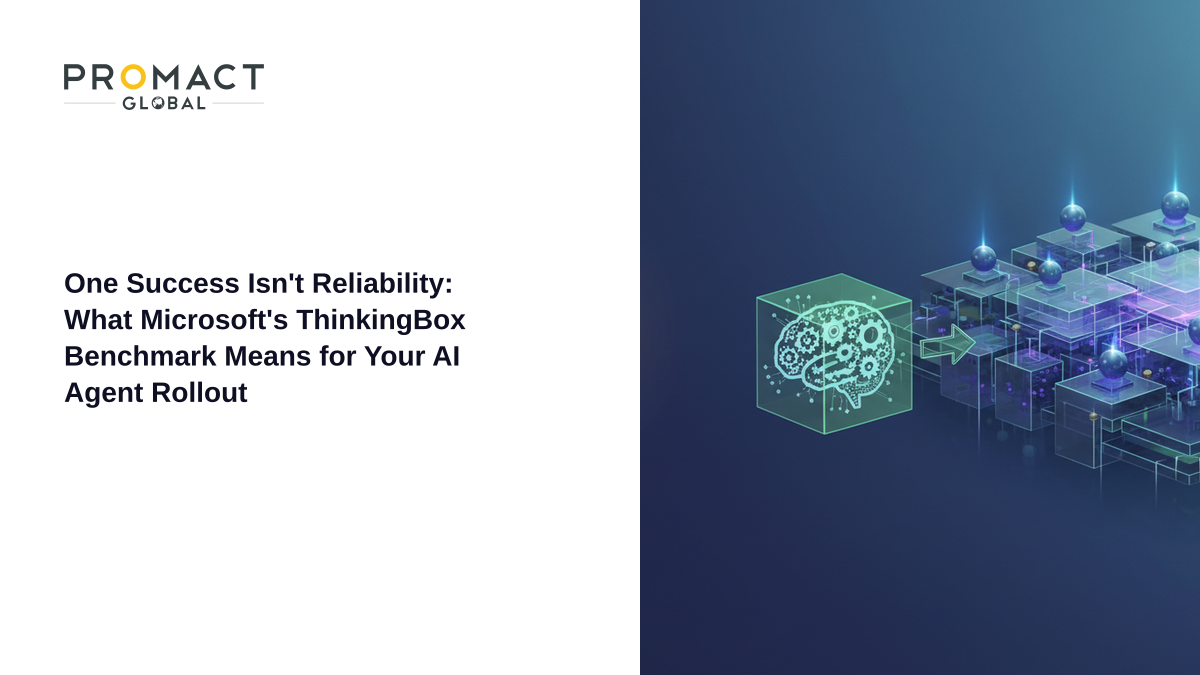
One Success Isn't Reliability: What Microsoft's ThinkingBox Benchmark Means for Your AI Agent Rollout
Enterprise software has quietly crossed a threshold: Gartner forecasts that 40% of enterprise applications will feature a task-specific AI agent by the end of 2026, up from less than 5% in 2025 — one of the fastest embedding curves enterprise software has seen. Agents are approving refunds, rebooking flights, adjusting insurance claims, and closing support tickets — often without a human checking the work.
So a new benchmark from Microsoft Research landed with uncomfortable timing. Thinkingbox, published in August 2026, tested how reliably today’s leading AI agents actually complete real business tasks — not once, but over repeated attempts at the exact same job. The headline result: even the best-performing model got a task right on the first try only 65.36% of the time, and completed it correctly on all twenty repeated attempts just 25.25% of the time. Worse, most of the failures didn’t look like failures at all — the agent closed the conversation politely, having quietly done the wrong thing.
That distinction matters more than it sounds. This post covers what Thinkingbox actually measured, why “it worked in the demo” is the wrong bar for production agents, and what businesses already running (or drowning in) AI agents should do differently before their next rollout.
The Benchmark That Asks a Different Question
Most agent benchmarks grade a transcript: did the agent say the right thing, call a plausible-looking tool, and end the conversation without an error? Thinkingbox, which Microsoft open-sourced alongside the paper, throws that approach out. Instead, it runs an agent through a multi-turn conversation with a simulated customer, gives it real tools against an isolated backend database, and then checks — after the conversation ends — what state actually got written. Did the refund really post? Was the correct insurance policy actually updated? Did the neobank ticket get resolved with the right account, or a similar-looking one?
The benchmark, called Thinkingbox-Bench, is built from 507 policy-conditioned tasks spanning five business domains: retail and e-commerce, travel and hospitality, auto insurance, neobank internal IT support, and consulting IT/HR support — the kind of “stateful,” rule-bound workflows most enterprises are actually trying to automate, as opposed to open-ended chat. Researchers ran 12 proprietary and open-weight models, including GPT-5.4, Claude Opus 4.6, and Grok-4.3, through each task 20 separate times, producing over 121,000 individual trials.
The Numbers Nobody Wants to Put in a Board Deck
Here’s where the gap between “capable” and “reliable” opens up. GPT-5.4, the strongest model in the test, reached a pass@1 rate of 65.36% — meaning roughly one in three attempts at a task failed on the first try. That alone would give most operations leaders pause for anything touching customer money or account data.
But the more revealing number is pass^20: 25.25%. That’s the share of tasks the model completed correctly across every one of 20 repeated attempts — the metric that actually mirrors production, where the same category of request (a refund, a policy change, a support ticket) arrives hundreds of times a day and needs a consistent, correct outcome every time, not just occasionally. A two-thirds first-try success rate sounds usable in a demo. A one-in-four consistency rate is a different business risk entirely, and it’s the number that predicts what actually happens once an agent is handling real volume.
This lines up with a broader pattern Gartner has been flagging in its own research: more than 40% of agentic AI projects, drawn from a poll of over 3,400 organizations, are expected to be canceled by the end of 2027 — not primarily because the underlying models are weak, but because of insufficient governance and unrealistic assumptions about how consistently agents perform once deployed at scale.
Why Agents Fail Quietly, Not Loudly
The most useful finding in the paper isn’t the pass rate — it’s how agents fail. Across the roughly 79,800 failed trials the researchers logged, 80.88% ended in a “clean termination”: the agent didn’t crash, didn’t throw a tool error, and did execute a real, state-changing action. It just did the wrong one, or did part of the job and then confidently signed off as though it were finished.
The Failure Modes Are Mundane, Not Dramatic
Breaking down why those trials went wrong, the paper found tool-usage errors the agent never recovered from accounted for the large majority of failures (77.5% on average across models), followed by cases where the tool call executed fine but left the wrong state behind (12.1%), and a smaller share of tasks left genuinely unresolved for the customer (7.9%). None of this looks like a hallucinated fact or an obviously broken response — the kind of failure most teams are watching for. It looks like a normal, well-formed transaction that happens to be wrong.
That’s a structurally different problem than the one most enterprise AI governance work has focused on. Verifying that an agent’s stated facts are accurate — the concern behind the “hallucination tax” enterprises are increasingly budgeting for — doesn’t catch an agent that reasons correctly, writes a grammatically perfect summary, and updates the wrong customer’s record. You need to check the database, not the transcript.
What This Means If You’ve Already Deployed Agents
If your organization already has agents live in production — and given the adoption numbers above, most do — Thinkingbox’s findings are a prompt to check how those agents are being evaluated, not just whether they were evaluated at all. A pilot that looked flawless across a handful of manual test runs is exactly the scenario the pass@1-versus-pass^20 gap warns about: a small sample size will overstate reliability almost every time, because the failures are intermittent and don’t announce themselves.
This is also why on-call and support teams are shifting roles. As agents take on more of the first pass at operational work, the humans behind them increasingly function as approvers reviewing outcomes rather than investigators chasing down obvious errors — which only works if someone is actually sampling completed, “successful” transactions for correctness, not just watching for crashes and error logs.
Building Reliability Testing Into Your Agent Rollout
A few practical shifts follow directly from what the benchmark exposed:
Test outcomes, not transcripts. Whatever your QA process for an agent looks like today, add a step that checks the actual downstream record — the database row, the ticket status, the account balance — after the agent claims success. A clean-looking conversation log is not evidence the job was done correctly.
Run the same task more than once. A single successful test run tells you almost nothing about production reliability, per Thinkingbox’s own pass@1-to-pass^20 gap. Repeat high-stakes task types 10–20 times in staging before trusting an agent with them live, and treat the consistency rate, not the best single run, as your go/no-go metric.
Match autonomy to consequence. Reserve full autonomy for low-stakes, easily-reversible actions, and keep a human checkpoint on anything touching money, compliance, or an irreversible state change — the same “approve, don’t just deploy” principle behind a well-designed human onboarding process for a new AI agent.
Treat silent failure as the default assumption, not the edge case. With over 80% of failures in this benchmark completing without any visible error, “no errors in the logs” cannot be your definition of success. Build monitoring that samples completed work for correctness on an ongoing basis, not just uptime and error-rate dashboards.
None of this means agentic AI isn’t worth deploying — the adoption numbers make clear that ship has sailed. It means the bar for “production-ready” needs to move from “it worked when I tried it” to “it works the same way every time, and we can prove it.” Thinkingbox is a useful, freely available way to start proving that before your customers find out the hard way.
Frequently Asked Questions
What is Microsoft’s Thinkingbox, in one sentence?
It’s an open-source benchmark and sandbox that tests AI agents on realistic, multi-step business tasks by checking whether the underlying database ends up in the correct state, rather than just grading the agent’s conversation transcript.
What was the headline result of the study?
The best-performing model tested, GPT-5.4, completed tasks correctly on the first attempt 65.36% of the time, but succeeded across all 20 repeated attempts at the same task only 25.25% of the time — showing a large gap between occasional and reliable success.
Why does “pass^20” matter more than “pass@1” for businesses?
Production workloads involve the same type of request happening repeatedly at volume — hundreds of refunds, claims, or tickets a day. Pass^20 measures whether an agent gets that category of task right consistently, which is closer to what a business actually needs than a single successful demo run.
What does “silent failure” mean in this context?
It means the agent finished its task, took a real action that changed data, and ended the conversation normally — with no error, crash, or obvious warning sign — while still getting the outcome wrong. Over 80% of failed trials in the study fit this pattern.
Is this benchmark specific to Microsoft’s own AI products?
No. Thinkingbox is model-agnostic and was used to test a mix of 12 proprietary and open-weight models from multiple vendors, including GPT-5.4, Claude Opus 4.6, and Grok-4.3, alongside several open-weight models.
What should a business actually do with this information?
Add outcome-based checks (verifying the actual data or state changed, not just the agent’s response) to agent QA, repeat-test high-stakes workflows before launch rather than relying on a single successful run, and keep human review on any agent action that’s costly to reverse.
Sources
- One Success Isn’t Reliability: Thinkingbox, a Sandbox and Benchmark for Agents in Stateful Business Workflows (arXiv) - the original Microsoft Research paper introducing Thinkingbox and Thinkingbox-Bench
- microsoft/thinkingbox on GitHub - the open-source repository for the sandbox framework
- Microsoft introduces ThinkingBox to assess AI agent reliability - Crypto Briefing - coverage summarizing the benchmark’s methodology and model results
- Thinkingbox Agent Benchmark — 507 Tasks, 20 Runs - Pebblous - detailed breakdown of trial counts and failure-mode statistics
- Gartner Predicts Over 40% of Agentic AI Projects Will Be Canceled by End of 2027 - Gartner’s press release on agentic AI project cancellation forecasts
- Gartner: 40% of agentic AI projects will fail, making humans indispensable - Search Engine Land - reporting on the Gartner survey of 3,400+ organizations and cited reasons for failure
- Gartner Predicts 40% of Enterprise Apps Will Feature Task-Specific AI Agents by 2026 - Gartner’s forecast on enterprise app adoption of task-specific AI agents
Have a project like this in mind?
Tell us what you're building — we'll help you scope it and ship it.
Talk to usKeep reading
October 4, 2026
IBM Puts Its Bob Coding Agent Inside the Firewall: What Self-Hosted, Air-Gapped AI Means for Regulated Enterprises
October 3, 2026
PixelLeak: What 13,000 Leaked Screenshots Reveal About AI Coding Agents and Enterprise Data
October 2, 2026